

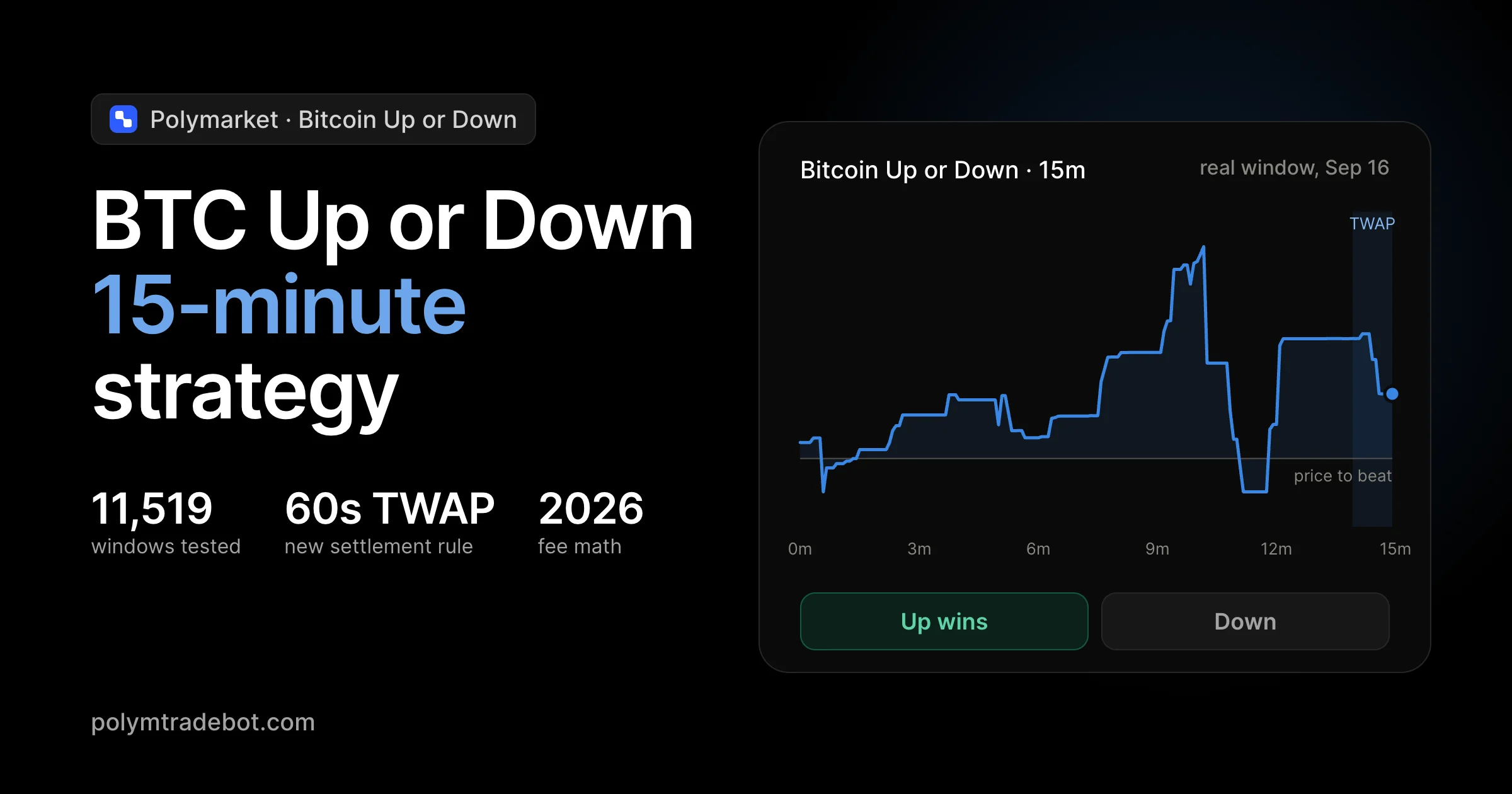
The BTC Up or Down 15 minutes strategy that survives contact with data is to price the lead instead of predicting the candle. Wait until the window has run 8 to 12 minutes, measure how far Bitcoin sits from the price to beat, look up how often a lead of that size has held, and buy only when the share costs less than that probability after the taker fee. Everything else in this guide is a refinement of that one comparison. It is also the thinking behind the Polymarket trading bot we build for these windows, so read it as the reasoning behind the script or as a playbook for trading by hand.
We trade these markets with that bot ourselves, so we wanted numbers rather than folklore. We replayed 11,519 fifteen-minute windows (May 20 to September 16, 2026) at one-second resolution under the settlement rule Polymarket switched to on August 7, 2026, when a 60-second Chainlink TWAP replaced the single closing tick. Below: how often the side in front actually wins, what the 2026 fee formula does to your break-even, five strategies with their real arithmetic, and the Python to check every number yourself. Last updated September 18, 2026.
Key takeaways
- Up won 49.3% of windows. Direction at the open is a coin flip, and a taker who buys a coin flip at 50¢ pays a 1.75¢ fee per share, so the break-even is 51.75%.
- Half of all windows finish within 8.6 basis points (0.086%) of the price to beat, about $65 with Bitcoin at $75,000. One window in three finishes within 5 basis points.
- Time turns small leads into near-certainties. A 5 to 10 basis point lead held 73.6% of the time with 10 minutes left, 86.1% with 5 minutes left and 95.0% with 2 minutes left.
- Volatility moves the answer by about ten points. The same 5 to 10 bp lead with 5 minutes left held 90.6% of the time in calm hours and 80.1% in volatile ones.
- The TWAP close changed the last minute. With 10 seconds to go, the side that spot said was winning still lost 2.5% of windows; the side ahead on the running average lost 0.2%.
- After two same-direction windows the next one reversed 53.1% of the time: real, stable across both halves of the sample, and thin.
Table of contents
- How the BTC Up or Down 15-minute market works in 2026
- What 11,519 windows say about Bitcoin in 15 minutes
- Strategy 1: price the lead, do not predict the candle
- Strategy 2: the late favorite, and the math against it
- Strategy 3: quote instead of crossing the spread
- Strategy 4: own both sides for less than $1
- Strategy 5: fade the streak, carefully
- What does not work
- When to trade: hours and days
- Risk rules for a market that settles 96 times a day
- Automating a BTC Up or Down 15 minutes strategy in Python
- FAQ
- Methodology and sources
How the BTC Up or Down 15-minute market works in 2026
Every 15 minutes, at :00, :15, :30 and :45, Polymarket opens a new Bitcoin Up or Down market, 96 a day. Two shares trade, Up and Down, each priced between 1¢ and 99¢, and the winning side pays $1. If you need the product basics first, start with how the Up or Down markets work on Polymarket; this section covers only what matters for strategy and what changed this year.
| Rule | Value in September 2026 |
|---|---|
| Resolves Up when | the closing TWAP is greater than or equal to the opening TWAP (a tie is Up) |
| Price source | Chainlink BTC/USD 60-second TWAP data stream, not any exchange's spot price |
| Taker fee | shares × 0.07 × price × (1 − price) |
| Maker fee | none, and makers share 20% of taker fees as daily rebates |
| Taker delay | marketable orders wait 50 ms before matching (250 ms until August 17, 2026) |
| Order limits | 1¢ tick, minimum 5 shares |
| Collateral | pUSD, Polymarket's USDC-backed token, since the CLOB v2 upgrade on April 28, 2026 |
The close is a 60-second average now
Until August 7, 2026 these markets compared two single prints, the Chainlink price at the start of the window and at the end. Now both the price to beat and the settlement price are 60-second time-weighted averages computed by Chainlink, per the Polymarket changelog. The market rules are explicit that only the Chainlink BTC/USD TWAP stream counts, not Binance, Coinbase or any other spot venue. The 5-minute market moved to the same 60-second average on August 14, so the differences between the 5-minute and 15-minute markets are now about pace and liquidity, not settlement mechanics.
Two consequences. A one-second wick at :14:59 no longer decides anything, because it is one sixtieth of the closing price. And the result is largely known before the window ends: with ten seconds to go, fifty of the sixty seconds that make up the closing price are already in the books. In our replay the TWAP rule and the old last-tick rule disagreed on the winner in 5.8% of windows, so any backtest or rule of thumb from before August 2026 describes a slightly different game.
The 2026 fee formula and your break-even
Polymarket's fee schedule for crypto markets charges takers shares × 0.07 × p × (1 − p), where p is the share price. Makers pay nothing. The fee peaks at 50¢, where it is 1.75¢ per share, or 3.5% of the money you put in. When fees were first switched on for these markets in January 2026 the peak was 1.56% of the stake, and many strategy guides still quote that number.
| Buy price | Taker fee per 100 shares | Fee as % of stake | Win rate needed to break even |
|---|---|---|---|
| 10¢ | $0.63 | 6.30% | 10.63% |
| 30¢ | $1.47 | 4.90% | 31.47% |
| 50¢ | $1.75 | 3.50% | 51.75% |
| 60¢ | $1.68 | 2.80% | 61.68% |
| 70¢ | $1.47 | 2.10% | 71.47% |
| 80¢ | $1.12 | 1.40% | 81.12% |
| 90¢ | $0.63 | 0.70% | 90.63% |
| 95¢ | $0.33 | 0.35% | 95.33% |
| 98¢ | $0.14 | 0.14% | 98.14% |
CRYPTO_FEE_RATE = 0.07


def taker_fee(price, shares=1, rate=CRYPTO_FEE_RATE):
    """Polymarket taker fee in dollars: shares x rate x p x (1 - p)."""
    return shares * rate * price * (1 - price)


def break_even(price, rate=CRYPTO_FEE_RATE):
    """Win rate a taker needs when buying at `price` and holding to the close."""
    return price + taker_fee(price, rate=rate)


break_even(0.50)   # 0.5175
break_even(0.80)   # 0.8112
A maker filled at the same prices has a break-even equal to the price itself. Keep that in mind; it is Strategy 3. High-volume takers get part of the fee back through the tiered Taker Rebate Program (3% at Bronze, up to 50% at Obsidian), which matters for a bot doing thousands of trades and not for someone risking $20 a window.
What 11,519 windows say about Bitcoin in 15 minutes
Method in one paragraph. We took Binance spot BTCUSDT one-second closes for 120 days, May 20 to September 16, 2026, cut them into the same :00, :15, :30 and :45 windows Polymarket uses, and rebuilt the rule: the price to beat is the average of the 60 seconds before the window opens, the settlement price is the average of its last 60 seconds, and a tie goes to Up. That gives 11,519 windows. Binance is a proxy for the Chainlink stream, not a copy of it; the limits are spelled out under Methodology.
- Up won 49.3% of windows, Down 50.7%.
- The median move from the price to beat was 8.6 basis points. A quarter of windows moved less than 3.7 bp, a quarter more than 17.1 bp, and one in ten more than 30 bp.
- 6.8% of windows were decided by less than one basis point, about $7.50 at $75,000, and 32.7% by less than five.
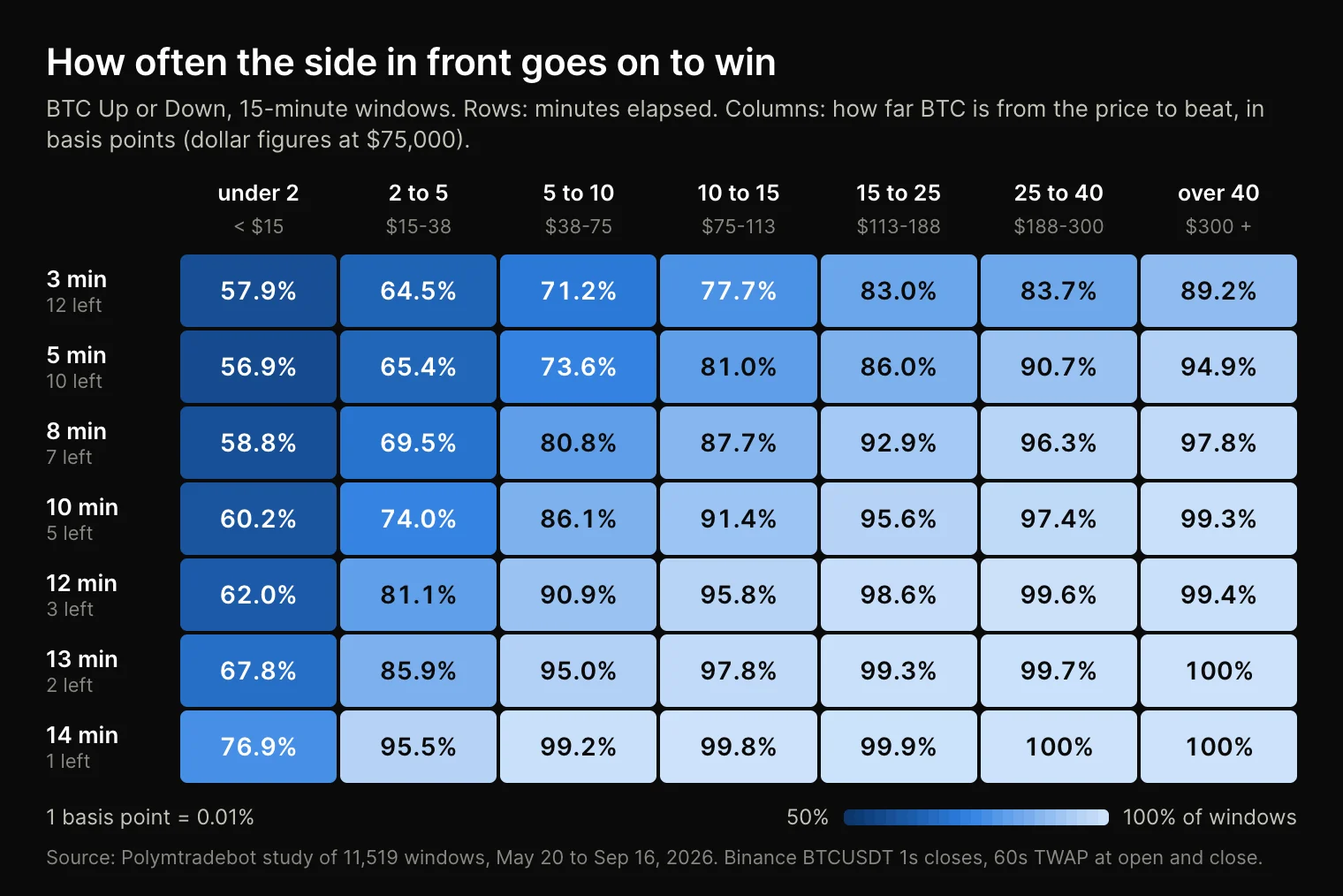
The table that matters is the next one: at a given minute, given how far Bitcoin is from the price to beat, how often did the side in front go on to win? Up and Down leads behaved symmetrically (82.8% versus 82.9% with five minutes left), so they are pooled.
| Minutes elapsed | under 2 bp | 2 to 5 bp | 5 to 10 bp | 10 to 15 bp | 15 to 25 bp | 25 to 40 bp | over 40 bp |
|---|---|---|---|---|---|---|---|
| 3 min | 57.9% | 64.5% | 71.2% | 77.7% | 83.0% | 83.7% | 89.2% |
| 5 min | 56.9% | 65.4% | 73.6% | 81.0% | 86.0% | 90.7% | 94.9% |
| 8 min | 58.8% | 69.5% | 80.8% | 87.7% | 92.9% | 96.3% | 97.8% |
| 10 min | 60.2% | 74.0% | 86.1% | 91.4% | 95.6% | 97.4% | 99.3% |
| 12 min | 62.0% | 81.1% | 90.9% | 95.8% | 98.6% | 99.6% | 99.4% |
| 13 min | 67.8% | 85.9% | 95.0% | 97.8% | 99.3% | 99.7% | 100% |
| 14 min | 76.9% | 95.5% | 99.2% | 99.8% | 99.9% | 100% | 100% |
One basis point is 0.01%, so 10 bp is $75 with Bitcoin at $75,000. Every cell holds at least 102 windows and most hold 1,000 to 2,800. Read it like this: with 10 minutes elapsed (5 left) and Bitcoin 5 to 10 bp above the price to beat, Up won 86.1% of the time. If the market sells Up for 80¢, you are being offered 86¢ of value for 81.1¢ after fees. If it sells for 88¢, you are overpaying.
Strategy 1: price the lead, do not predict the candle
This is the strategy from the first paragraph, made concrete. Your edge per share is the probability from the table minus what a taker pays:
def edge_per_share(p_win, ask, rate=CRYPTO_FEE_RATE):
    """Expected profit per share for a taker who buys at `ask` and holds."""
    return p_win - break_even(ask, rate)


edge_per_share(0.861, 0.80)   # +0.0498  ->  about 5 cents per share
Three rules make it tradeable. Insist on a margin of safety of at least three cents, because the table is an average across regimes and your fills will be worse than the mid. Skip the under-2-bp column entirely: it is a coin flip for most of the window and only a 77% proposition with one minute left, which is not worth 80¢. And split the table by volatility, because that is where the average lies to you.
The same lead is worth ten points less on a volatile day
We tagged every window by the volatility of the previous hour (the standard deviation of one-minute returns, median 3.9 bp) and split at the median. With five minutes left:
| Lead with 5 minutes left | Calm hours | Volatile hours |
|---|---|---|
| under 2 bp | 63.9% | 52.1% |
| 2 to 5 bp | 77.7% | 67.4% |
| 5 to 10 bp | 90.6% | 80.1% |
| 10 to 15 bp | 94.9% | 88.5% |
| 15 to 25 bp | 97.8% | 94.7% |
| 25 to 40 bp | 98.8% | 97.0% |
Worked example. Up is offered at 80¢ with five minutes left and Bitcoin 7 bp above the price to beat. In an average window that is 86.1% against a break-even of 81.12%: +5.0¢ per share. In a calm hour it is 90.6%: +9.5¢. In a volatile hour it is 80.1%: −1.0¢. Same screen, opposite decisions, and the only input that changed is something the order book does not show you.
A formula that adapts to volatility
The table is a lookup; the continuous version is a random-walk model. If Bitcoin's one-minute returns have standard deviation sigma_1m, the probability that the lead survives to the close is a normal tail probability. One detail is specific to this market: because the close is a 60-second average, the final minute contributes only a third of its variance, which is equivalent to shortening the horizon by 40 seconds.
from math import erf, log, sqrt


def fair_up_probability(spot, price_to_beat, sigma_1m, seconds_left):
    """P(Up) if BTC is a driftless random walk until the window closes.

    sigma_1m: standard deviation of recent 1-minute log returns.
    Valid while more than 60 seconds remain; inside the final minute
    track the running average instead (see Strategy 2).
    """
    horizon_min = max(seconds_left - 40, 1) / 60
    z = log(spot / price_to_beat) / (sigma_1m * sqrt(horizon_min))
    return 0.5 * (1 + erf(z / sqrt(2)))


fair_up_probability(76_650, 76_600, 0.00025, 300)   # calm: 0.895
fair_up_probability(76_650, 76_600, 0.00060, 300)   # volatile: 0.699
We scored the formula against every window, feeding it the trailing hour's volatility. With five minutes left:
| Model said the favorite wins | Favorite actually won | Windows |
|---|---|---|
| 55% | 56.5% | 1,698 |
| 65% | 71.6% | 1,638 |
| 75% | 79.3% | 1,895 |
| 85% | 89.5% | 1,939 |
| 93% | 92.8% | 1,325 |
| 97% | 96.6% | 1,432 |
| 99.8% | 98.1% | 1,588 |
Two lessons. In the 60 to 90% zone the favorite won three to six points more often than the formula predicted, so the model is a conservative floor there. Above 97% it is overconfident: Bitcoin has fat tails, and when the model said 99.8% the favorite still lost about one window in fifty. Never pay 99¢ because a bell curve told you to.
Strategy 2: the late favorite, and the math against it
The most popular BTC Up or Down 15 minute strategy on social media is buying the obvious winner at 95 to 99¢ in the last two minutes. The table shows why it feels safe: with two minutes left, a lead of 10 basis points or more held 97.8% to 100% of the time.
The arithmetic is less kind. At 98¢ you risk 98.14¢ (price plus fee) to make 1.86¢, so one loss erases 53 wins. A 10 to 15 bp lead with two minutes left won 97.8% of the time in our sample, below the 98.14% you need: negative expectancy, paid out as a long run of small wins and one bad afternoon. Only leads of 15 bp and more (99.3% and up) cleared the bar, and by then the favorite typically trades at 99¢, where the break-even is 99.07%. Add the model's overconfidence in the tails from the previous section and the late favorite is a strategy that works until it does not.
What the TWAP did to the final minute
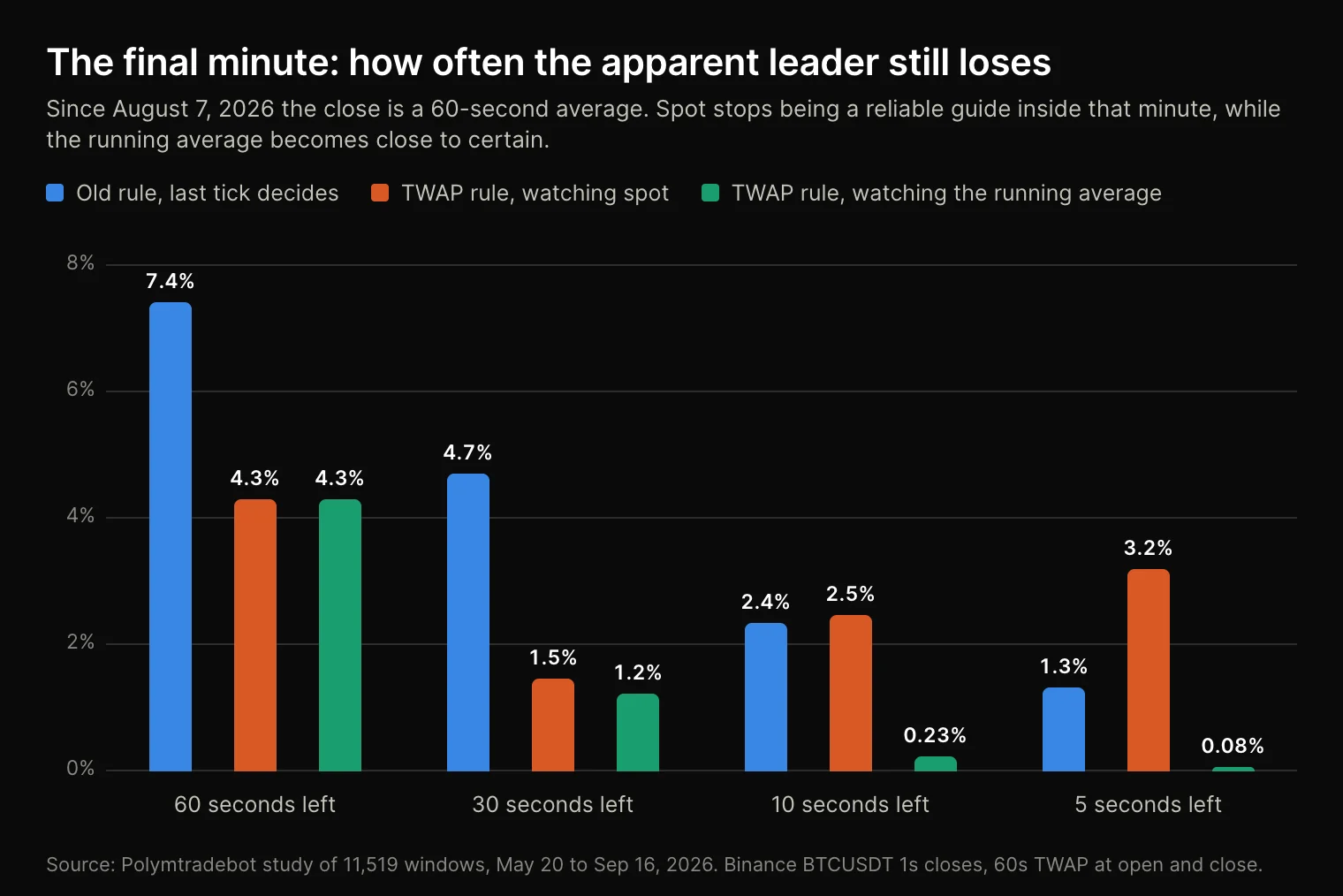
With 60 seconds left the leader lost 4.3% of windows under the TWAP rule versus 7.4% under the old last-tick rule; with 30 seconds left, 1.5% versus 4.7%. The outcome is known earlier, which compresses the window in which a late entry is available at any price.
Inside the final minute, stop looking at spot. Under the old rule the side ahead with five seconds to go lost 1.3% of the time. Under the TWAP rule the side that spot says is ahead loses 3.2% of the time with five seconds left, because spot is only the last sliver of a 60-second average. Track the running average instead, the mean of the seconds already elapsed in the final minute with the remainder filled in at the current price, and the error falls to 0.08%. That is not free money, since by then the book shows 99¢ or nothing at all, but it is a warning for anyone still sniping the last tick with a pre-August playbook.
Strategy 3: quote instead of crossing the spread
Every number above assumes you pay the fee. Makers do not. A resting limit order that gets filled pays no fee and earns a share of the rebate pool, which is 20% of the taker fees collected in that market, paid daily in pUSD (Maker Rebates Program). At 50¢ that moves your break-even from 51.75% to 50.00%, and in a market where the measurable edges are one to five cents, that is the whole edge.
The catch is adverse selection: your bid gets hit precisely when spot moves against it. Polymarket holds marketable orders on crypto markets for 50 ms before they match, down from 250 ms since August 17, 2026. That head start is what lets a maker cancel a stale quote, and at 50 ms only software can use it. Practical rules: quote only at prices your fair value already likes, so a fill is a win even if it came because the price moved; reprice or cancel the moment spot moves, not at the next polling interval; keep clips small, because a 5-share fill teaches you the same lesson as a 500-share fill; and remember that an order that never fills costs nothing, which is more than can be said for a market order.
Strategy 4: own both sides for less than $1
One Up share plus one Down share always pays exactly $1. If you own both for less than $1 in total, fees included, the difference is locked in whatever Bitcoin does. Nobody sells you that pair at once; the two asks add up to a dollar or more. The pair is built in two legs, minutes apart, as the price swings. Say a resting bid on Up fills at 44¢ early in the window, Bitcoin dips, and Down can later be bought for 50¢. The second leg takes liquidity, so it pays 1.75¢: total 95.75¢, locked profit 4.25¢ per pair, no opinion about the close required.
The risk lives between the legs. If the second leg never comes, you are simply holding a directional position you did not choose, at a price you liked for a different reason. Pair-locking is execution-heavy, which is why it is mostly done by software: one process watching both books, sizing the second leg to the unhedged remainder, and refusing to chase when the sum no longer works.
Strategy 5: fade the streak, carefully
Streak betting is the oldest idea in binary markets, so we checked it. After a run of same-direction windows, how often did the next window go the other way?
| After this many same-direction windows | Next window reversed | Windows |
|---|---|---|
| 1 | 51.4% | 11,518 |
| 2 | 53.1% | 5,597 |
| 3 | 52.8% | 2,625 |
| 4 | 54.4% | 1,237 |
The effect showed up in both halves of the sample (53.2% and 53.0% after two), and it grows with the size of the previous move: after a window that moved more than 40 bp, the next one reversed 55.9% of the time. So mean reversion at the 15-minute scale is probably real. It is also small. A taker buying the reversal side at 51¢ needs 52.75% to break even, so after two windows the edge is 0.35¢ per share, which is nothing. As a maker filled at 50¢ it is 3.1¢, which is something, provided the market has not already priced the reversal into the open.
Two warnings. We measured Bitcoin's tendency, not Polymarket's opening quotes, so the market may already lean the same way. And a 53% edge does not survive doubling down: six losses in a row happen about once every 94 sequences at that win rate, and with 96 windows a day you will meet that run within the week. Martingale sizing turns a thin edge into a certain blow-up.
What does not work
- Buying the open as a taker. Direction at :00 is 49.3% Up. At 50¢ you pay 1.75¢ to enter a coin flip: −3.5% of stake per window, before the spread.
- Sniping the last tick. The close is a 60-second average. Spot at :14:59 is one sixtieth of it, and the side spot favors in the final five seconds loses 3.2% of the time.
- Martingale and "recovery" sizing. See above. The 15-minute cadence produces long losing runs on schedule.
- Copying leaderboard wallets by hand. By the time a fill shows up on a profile the price has moved, and the copied trader's edge is often maker rebates and a 50 ms reaction you do not have.
- Reading settlement off an exchange chart. Resolution is the Chainlink BTC/USD TWAP. When 6.8% of windows are decided by less than one basis point, the venue and the averaging matter.
- One rule for every hour. The next section is why.
When to trade: hours and days
Bitcoin's 15-minute range follows the trading day. Median absolute move from the price to beat, by the hour the window opened:
| Session | UTC | New York | Median 15-minute move |
|---|---|---|---|
| US morning | 13:00 to 17:00 | 9 am to 1 pm | 11.1 to 12.6 bp |
| Asia open | 00:00 to 02:00 | 8 pm to 10 pm | 9.8 to 10.3 bp |
| Quiet hours | 04:00, 10:00 to 12:00, 20:00 | 12 am, 6 to 8 am, 4 pm | 6.4 to 6.8 bp |
| Weekdays | all | all | 10.3 bp |
| Weekends | all | all | 5.5 bp |
Bigger moves are not automatically better. Active hours decide more windows early, which is good for Strategy 1, and reprice faster, which punishes slow hands. Quiet hours and weekends produce more windows decided by a few dollars, where the under-2-bp column applies and the honest answer is often no trade. Whatever you run, keep separate statistics per session; a rule that pays in the New York morning may be a coin flip at 4 pm.
Risk rules for a market that settles 96 times a day
The strategies above have edges of a few cents per share. Those survive only inside a risk framework; outside one they are noise with a fee attached. Our rules, in order of importance:
- Risk a fixed fraction per window, 1 to 2% of the bankroll, and never increase it after a loss. Variance in a 96-a-day market arrives fast and looks like a trend.
- Hard daily loss limit that stops the process, not a number on a dashboard. Cancel every open order, stop posting, and require a human to restart.
- Cap total exposure across open windows. The 5-minute and 15-minute markets and the ETH and SOL versions all move with Bitcoin; ten open positions are one bet.
- Require a minimum edge after fees, three cents or more, and skip the under-2-bp column. Most windows do not deserve a trade, and skipping is free.
- Paper trade against the real book first. A paper fill at the mid is fiction. Model the queue, the fee and the cancel latency, then compare the paper win rate per table cell with the table. Our guides on paper trading mode and risk management before going live cover the mechanics.
- Log every decision, including the ones you did not take. If your 80¢ entries are winning 78% instead of 86%, the table is not wrong; your fills are.
Automating a BTC Up or Down 15 minutes strategy in Python
None of this is a manual job 96 times a day. This is the plumbing every bot for this market starts with, using only public endpoints: find the live window, read the order book, and compare the ask with a probability you supply.
import json
import time

import requests

GAMMA = "https://gamma-api.polymarket.com"
CLOB = "https://clob.polymarket.com"


def current_btc_15m_market():
    """The BTC Up or Down market for the 15-minute window open right now."""
    start = int(time.time()) // 900 * 900      # windows open at :00 :15 :30 :45
    slug = f"btc-updown-15m-{start}"
    event = requests.get(f"{GAMMA}/events", params={"slug": slug}, timeout=10).json()[0]
    market = event["markets"][0]
    up_token, down_token = json.loads(market["clobTokenIds"])
    return {
        "slug": slug,
        "seconds_left": start + 900 - time.time(),
        "up_token": up_token,
        "down_token": down_token,
        "fee_rate": market["feeSchedule"]["rate"],   # 0.07 for crypto
    }


def best_ask(token_id):
    """Cheapest offer for one outcome token, from the public order book."""
    book = requests.get(f"{CLOB}/book", params={"token_id": token_id}, timeout=10).json()
    return min((float(level["price"]) for level in book["asks"]), default=None)


market = current_btc_15m_market()
ask = best_ask(market["up_token"])
p_up = fair_up_probability(spot, price_to_beat, sigma_1m, market["seconds_left"])
print(market["slug"], "Up ask", ask, "edge", round(edge_per_share(p_up, ask), 4))
The three inputs the snippet does not fetch, spot, the price to beat and volatility, come from a price feed. Polymarket's own live-data socket relays both the Chainlink spot price and the Chainlink 60-second TWAP for btc/usd without credentials (Chainlink TWAP prices). The TWAP value on a window boundary is the price to beat, and the spot stream is what the lead is measured against:
import asyncio
import json

import websockets

RTDS = "wss://ws-live-data.polymarket.com"
TOPICS = ("crypto_prices_twap_sixty", "crypto_prices_chainlink")


async def heartbeat(ws):
    while True:                      # the socket expects a text PING every 5 s
        await asyncio.sleep(5)
        await ws.send("PING")


async def watch_lead():
    """Print how far Chainlink spot is from the price to beat, once a second."""
    subscribe = {"action": "subscribe", "subscriptions": [
        {"topic": t, "type": "update", "filters": '{"symbol":"btc/usd"}'} for t in TOPICS
    ]}
    price_to_beat = None
    async with websockets.connect(RTDS) as ws:
        await ws.send(json.dumps(subscribe))
        asyncio.create_task(heartbeat(ws))
        async for raw in ws:
            if not raw.startswith("{"):
                continue
            msg = json.loads(raw)
            tick = msg.get("payload", {})
            if "value" not in tick:
                continue             # the first message per topic is a history snapshot
            seconds = tick["timestamp"] // 1000
            if msg["topic"] == "crypto_prices_twap_sixty":
                if seconds % 900 == 0:
                    price_to_beat = tick["value"]    # the TWAP on the boundary
            elif price_to_beat:
                lead_bp = (tick["value"] / price_to_beat - 1) * 10_000
                print(f"{900 - seconds % 900:>3}s left  lead {lead_bp:+.1f} bp")


asyncio.run(watch_lead())
Start it before a window opens and it prints the lead in basis points every second; add the trailing volatility and the table above, and you have Strategy 1 as a signal. From there to a bot is the unglamorous ninety percent: signing CLOB v2 orders, keeping a socket alive for days, canceling stale quotes inside the 50 ms window, modeling the fill queue so paper results mean something, settling and logging every window, and refusing to trade when a feed goes quiet. Our earlier write-up on building a Python Polymarket bot for the Bitcoin Up or Down markets walks through that architecture.
That part is what we sell. The Polymarket trading bot is a Python script you run on your own machine or VPS, built for the 5-minute and 15-minute Bitcoin Up or Down markets: several built-in strategy modes (directional, maker and two-sided) with every threshold in a config file, a paper trading mode that fills against the real order book, a WebSocket engine that re-quotes on every book update, a daily-loss kill switch and exposure cap, hourly Telegram reports and CSV exports. Your private key stays in a local .env file; we never see it. The changelog lists what shipped in each release. One payment, no subscription, full source code.
FAQ
What is the best strategy for BTC Up or Down 15 minutes?
Price the lead rather than predict direction. Wait until 8 to 12 minutes of the window have passed, compare Bitcoin's distance from the price to beat with how often that lead has held historically (86% for a 5 to 10 basis point lead with 5 minutes left in our sample), and buy only when the share price plus the taker fee is below that probability. Enter with limit orders where you can, because makers pay no fee.
How does the Bitcoin Up or Down 15-minute market resolve?
It resolves Up if the closing price is greater than or equal to the opening price, otherwise Down. Since August 7, 2026 both prices are 60-second time-weighted averages from Chainlink's BTC/USD data stream rather than single ticks, and an exact tie counts as Up. The market is settled on that stream only, not on any exchange's spot price.
What fees does Polymarket charge on 15-minute crypto markets?
Takers pay shares × 0.07 × price × (1 − price): 1.75¢ per share at 50¢, 1.12¢ at 80¢ and 0.14¢ at 98¢. Makers pay nothing and share 20% of collected taker fees as daily rebates. Polymarket charges nothing to deposit or withdraw, although a payment provider or bridge may.
Can you make money trading Bitcoin Up or Down on Polymarket?
Some accounts do, mostly automated market makers and fast directional bots; many more lose to fees. A taker guessing direction at the open is flipping a coin against a 51.75% break-even. The measurable edges we found are a few cents per share and depend on the volatility regime, the entry price and execution quality, so treat any result as unproven until it holds in paper trading with realistic fills.
Do I need a bot for the 15-minute market?
Not to place a trade, but realistically yes to run a strategy. There are 96 windows a day, good prices last seconds, and since August 17, 2026 taker orders are delayed only 50 milliseconds, which leaves no time for a human market maker to pull a stale quote. A bot also enforces the boring parts: position limits, a daily stop and a log of every decision.
What happens if Bitcoin finishes exactly at the price to beat?
The market resolves Up, because the rule is greater than or equal to. With TWAP prices carried to many decimal places an exact tie is rare, but near-ties are not: 6.8% of the windows in our sample were decided by less than one basis point, about $7.50 with Bitcoin at $75,000.
What time of day is best for trading BTC Up or Down?
Bitcoin moves most between 13:00 and 17:00 UTC (9 am to 1 pm in New York), when the median 15-minute move was 11 to 13 basis points, and least around 04:00, 10:00 to 12:00 and 20:00 UTC and on weekends, when the median was 5.5 basis points. Active hours decide more windows early; quiet hours produce more coin-flip finishes.
Methodology and sources
Data. Binance spot BTCUSDT one-second klines from the public Binance data archive, May 20 to September 16, 2026 UTC: 10,368,000 seconds with no gaps, 11,519 complete windows (the first needs a prior minute for its opening average). Bitcoin traded between $57,800 and $82,300 in the period.
Rule replica. Price to beat: mean of the 60 one-second closes ending when the window opens. Settlement: mean of the 60 closes ending when it closes. Tie resolves Up, as in the market rules. Leads are measured as spot at the checkpoint divided by the price to beat, in basis points.
Limits. (1) Binance BTCUSDT is not the Chainlink BTC/USD aggregate: the venue mix and the USDT quote differ, and Chainlink does not publish its sampling or weighting, so near-ties can resolve differently. (2) These are Bitcoin's probabilities, not Polymarket's fills. We have no historical order books, so nothing here says what price was available at the time. (3) One 120-day sample; regimes change. (4) "Calm" and "volatile" split at the sample median of trailing one-hour volatility, 3.9 bp per minute.
Sources. Polymarket predictions changelog (TWAP resolution, taker delay, fee history, CLOB v2); Polymarket trading fees; Maker Rebates Program; Chainlink TWAP prices on Polymarket; the BTC/USD 60-second TWAP stream named in the market rules.
This article is educational and is not financial advice. Prediction markets are risky and most short-term traders lose money. Polymarket is not available in every jurisdiction; check the rules where you live before trading.