

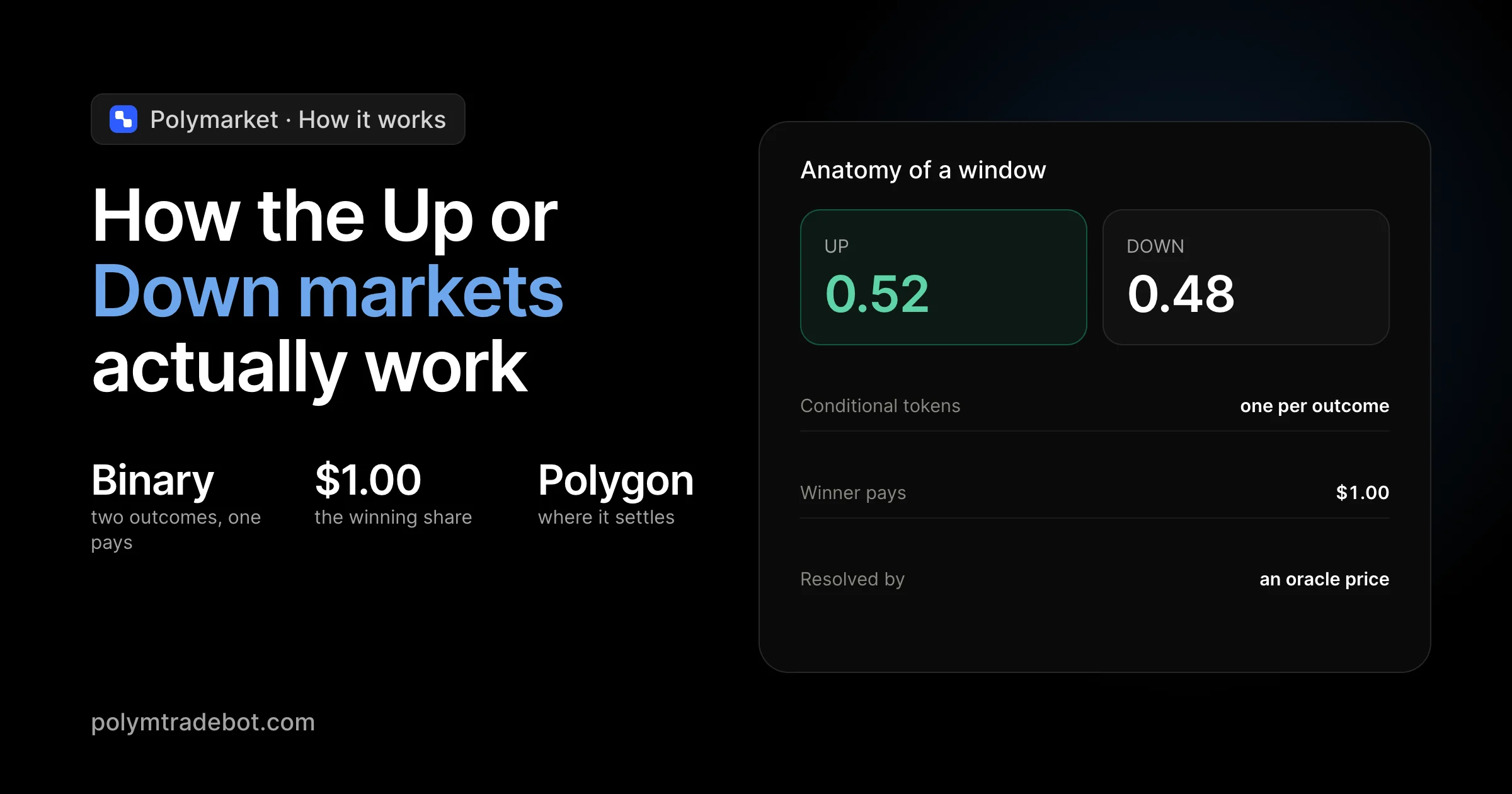
In June 2026, Polymarket reached a milestone of $1 billion in annualized revenue, just six weeks after its U.S. exchange launch, according to CNBC. This massive surge in volume highlights a shift in how traders approach price action for assets like Bitcoin and Ethereum. If you are used to traditional derivatives, you might wonder how the up or down markets work on polymarket compared to a standard exchange order book. These markets do not rely on a centralized house to set odds; instead, they function as decentralized binary options where the price of a "Yes" or "No" share reflects the collective probability of a specific price move within a 5-minute or 15-minute window.
Understanding the underlying architecture is essential if you plan to move beyond manual betting and into systematic execution. You will learn how peer-to-peer liquidity drives price discovery and how oracle resolution ensures settlement is tamper-proof. We focus on the mechanics of the order book and why the 0-to-100 pricing model creates unique opportunities for arbitrage and risk management. For those of us building automated systems at Polymtradebot, mastering these nuances is the difference between guessing on momentum and executing a math-based strategy that capitalizes on market inefficiencies.
Key Takeaways
- Polymarket reached $1 billion in annualized revenue in 2026 following its U.S. expansion.
- Up or Down markets function as peer-to-peer binary options with outcomes between $0 and $1.
- Price discovery is driven by decentralized liquidity rather than a centralized bookmaker.
- Automated execution is necessary to capture spreads in high-frequency 5-minute crypto markets.
Table of contents
- What Polymarket Up or Down markets are and how they function
- The architecture of decentralized price prediction
- How price discovery works in peer-to-peer markets
- The mechanics of settlement and oracle resolution
- Why automated execution matters for short-term markets
- Arbitrage and risk management strategies
- Common misconceptions about prediction market pricing
- Checklist: Verifying market conditions before entry
- Conclusion
- FAQ
- Sources
What Polymarket Up or Down markets are and how they function
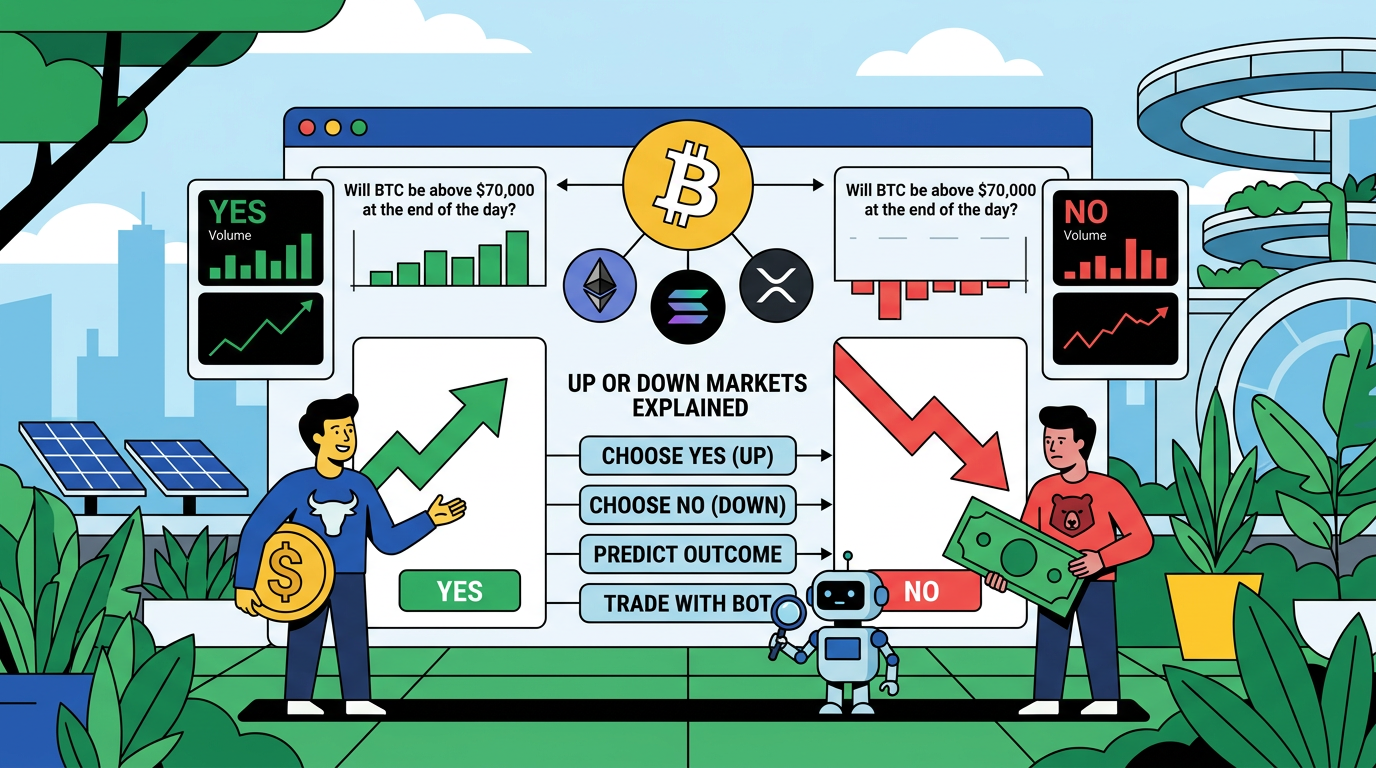 Traders predict whether an asset price will settle above or below a specific strike price
Polymarket Up or Down markets are binary prediction contracts where you bet on whether the price of a specific cryptocurrency will be above or below a "strike price" at a precise expiration time. Unlike traditional spot trading where you profit from the magnitude of a price move, these markets pay out based on a simple yes/no outcome. In 2026, this model has solidified the platform's dominance; according to KuCoin, Polymarket and Kalshi held a combined 97.5 percent market share of the prediction market space.
The binary outcome structure
Every trade on an Up or Down market involves buying shares in either a "Yes" (Up) or "No" (Down) outcome. These shares always trade between $0.00 and $1.00. The current price of a share represents the market’s collective probability of that event occurring. For example, if "Bitcoin Above $70,000" is trading at $0.65, the market assigns a 65% chance to that outcome.
At the moment of expiration, the contract settles:
- If your prediction is correct, your shares settle at $1.00.
- If your prediction is incorrect, your shares settle at $0.00.
This setup removes the need for complex exit strategies based on price targets. Your only concern is the asset's position relative to the strike price at the final second.
Timeframes and asset coverage
Polymarket focuses on high-liquidity assets, specifically Bitcoin (BTC), Ethereum (ETH), Solana (SOL), and Ripple (XRP). To maintain high velocity, the platform standardizes these into short-duration windows:
- 5-minute intervals: Designed for high-frequency scalping where traders react to immediate order flow or momentum shifts.
- 15-minute intervals: Better suited for capturing intraday trends or reacting to minor technical breakouts.
Our case. We noticed that during periods of high volatility, the 5-minute Bitcoin markets often exhibit price lag between the underlying spot price and the Polymarket share price, creating a 2-3 second window for automated execution to capture mispriced shares.
Because these markets are peer-to-peer, you aren't betting against a "house" or a central broker. You are trading against other participants. This decentralization ensures that the odds are determined by actual capital flow rather than a proprietary algorithm designed to favor a bookmaker. For traders using Polymtradebot, this environment is ideal for deploying Python scripts that can calculate these probabilities faster than a human clicking a mouse.
The architecture of decentralized price prediction
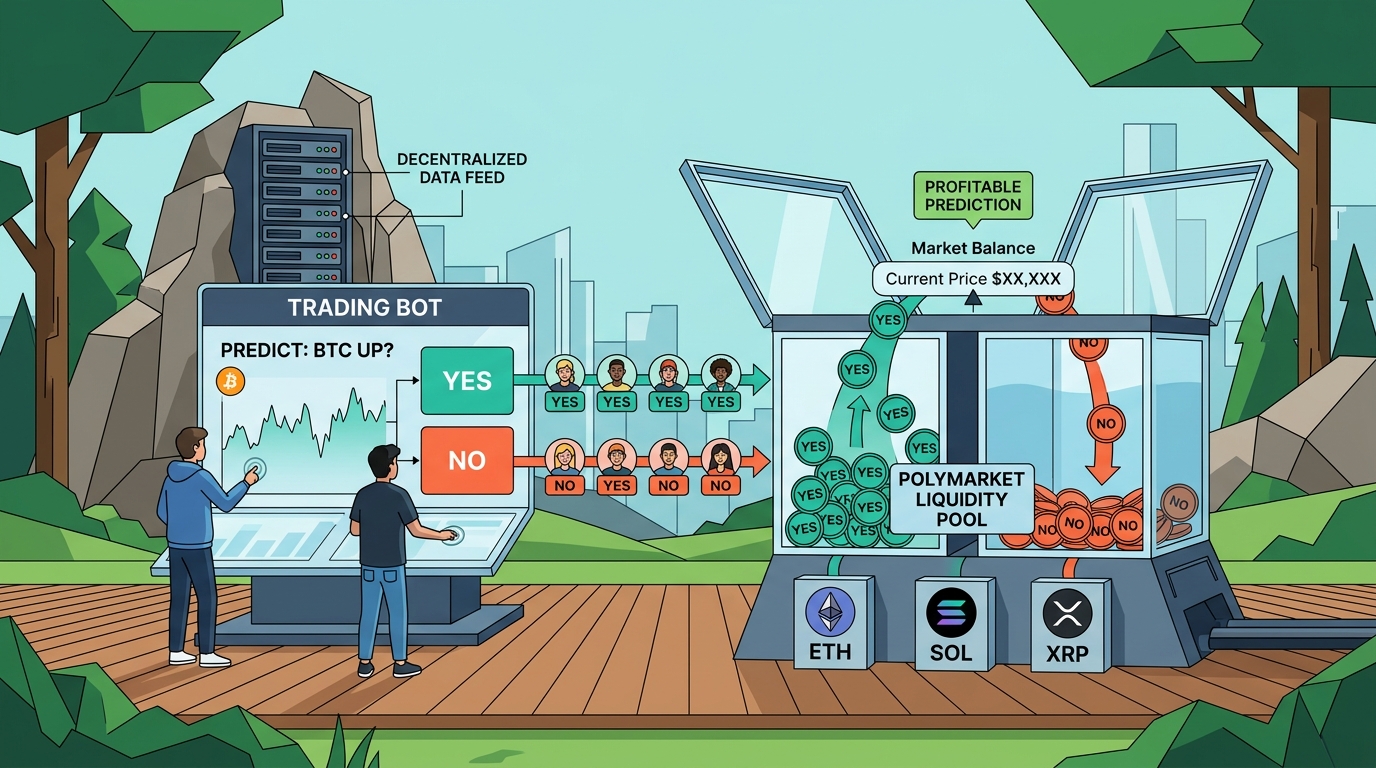 Smart contracts automate the execution of payouts based on real-time binary outcome data
Polymarket functions through a framework of conditional tokens that digitize your stake in a specific price outcome. When you enter a Bitcoin Up or Down market, you aren't trading the coin itself; you are interacting with a smart contract that mints "Outcome Tokens." These tokens represent a binary claim on a future reality—either the price is above the strike, or it isn't.
Conditional tokens and smart contracts
The system utilizes the Conditional Token Framework, originally developed by Gnosis. When you provide liquidity to a 5-minute Bitcoin market, the contract holds your collateral (typically USDC) and mints two sets of shares: "Long" and "Short." These shares are mathematically tied: the price of a Long share plus a Short share always equals $1.00.
If you believe Bitcoin will stay above $65,000 in the next five minutes, you buy the "Up" tokens. If the market resolves in your favor, each share becomes worth $1.00. If not, the value drops to $0.00. This "minting and burning" mechanism ensures the market is always fully collateralized; the contract never owes more than it holds.
The role of the Polygon network
Speed is the defining constraint for high-frequency prediction. Because Polymarket settles on the Polygon network, it achieves the low latency required for 5-minute and 15-minute intervals. On-chain execution happens in seconds with negligible gas fees, which is vital when you are managing a high volume of small-margin trades.
What we noticed. In our development of the Polymtradebot Python script, we found that even a 3-second delay in transaction broadcasting can result in missing the optimal entry price on 5-minute ETH or SOL markets, making direct RPC node access a necessity for automated strategies.
Oracle resolution and settlement
To prevent manipulation, the final settlement price isn't determined by Polymarket’s internal order book. Instead, the market integrates an optimistic oracle, such as UMA, or a direct price feed to verify the asset's value at the exact millisecond of expiry.
- Snapshot. At the 5-minute mark, the oracle records the price from a whitelist of exchanges (like Binance or Coinbase).
- Challenge Period. There is a brief window where participants can dispute the reported price if it deviates from reality.
- Settlement. Once the price is verified, the smart contract "burns" the losing shares and allows holders of the winning shares to claim the $1.00 payout per token.
This decentralized architecture removes the "house" from the equation. You are trading against other participants' perceptions of volatility, with a transparent smart contract acting as the impartial escrow.
How price discovery works in peer-to-peer markets
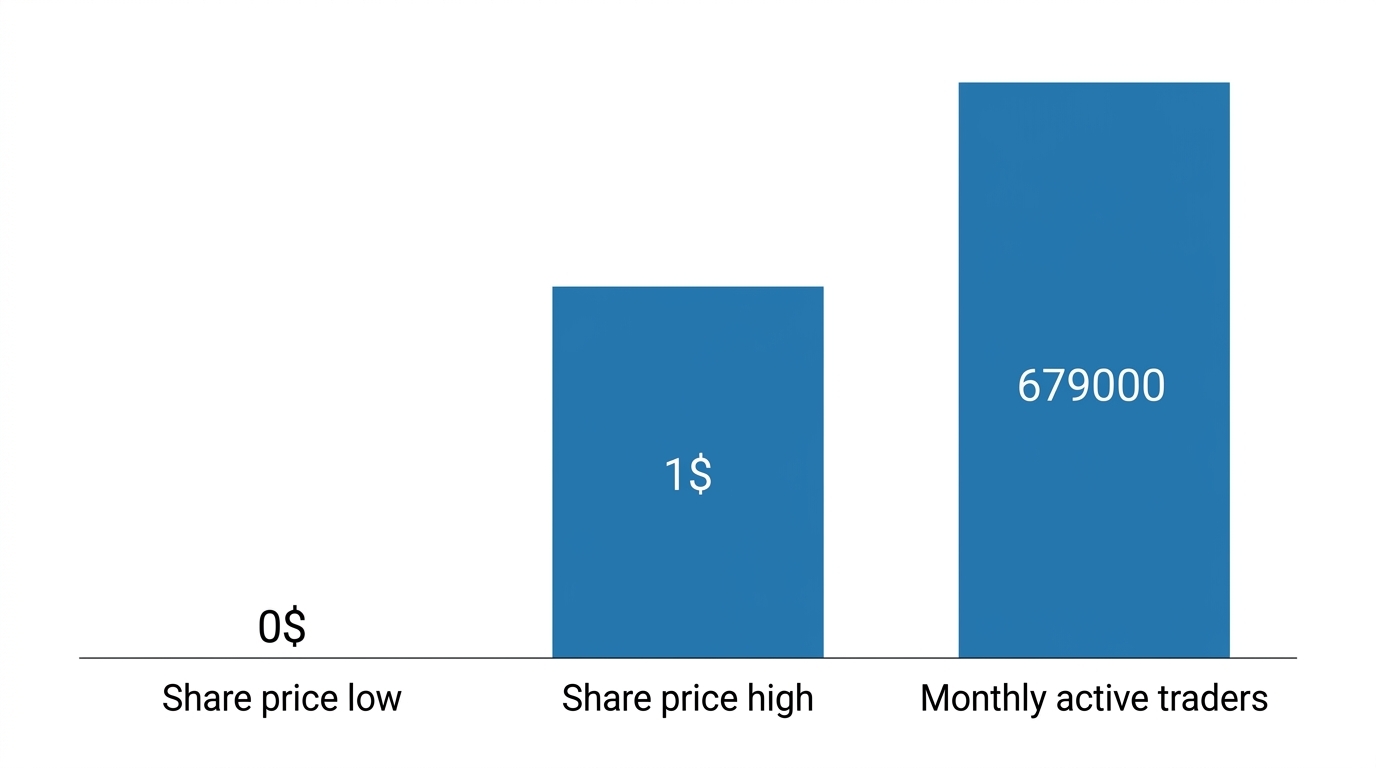 Traders reach a consensus price by balancing supply and demand in real time
Price discovery on Polymarket is a function of supply and demand for binary shares. When you trade the Bitcoin Up or Down markets, you aren't fighting a "house" or a centralized bookmaker; you are trading against other participants. The share price, which fluctuates between $0.00 and $1.00, represents the market's real-time assessment of the probability of an outcome. If "Bitcoin Up" is trading at $0.65, the collective market believes there is a 65% chance the price will settle above the strike.
Implied probability and share pricing
This pricing model creates a direct feedback loop. As new data hits the wire—such as a sudden spike in BTC spot price on Binance—traders rush to buy "Up" shares. This buying pressure pushes the share price toward $1.00. We see this play out in the 5-minute and 15-minute windows where every cent of movement in the share price reflects a 1% shift in implied probability. For high-frequency traders, these micro-fluctuations are the primary source of profit.
The depth of this market is significant. According to data from Token Terminal, Polymarket reached a record high of 679,000 monthly active traders in February 2026. This surge in participation ensures that the "wisdom of the crowd" is backed by actual capital, making the share price a highly sensitive indicator of short-term volatility.
Liquidity, slippage, and market makers
In a peer-to-peer order book, liquidity determines how close you get to the mid-market price. For a 15-minute Bitcoin market, liquidity must be deep enough to absorb large orders without massive slippage. On Polymarket, professional market makers provide this depth by constantly placing limit orders on both sides of the "Up" and "Down" outcomes.
Observation. In our practice developing the Polymtradebot Python script, we’ve noticed that slippage often spikes in the final 120 seconds of a 5-minute market. Executing trades via automated scripts during the first three minutes allows for better entry prices before the order book thins out or becomes too volatile for manual entry.
If you attempt to buy $10,000 worth of "Up" shares in a thin market, you might push the price from $0.50 to $0.55 yourself, instantly losing 5% of your potential upside to slippage. This is why the presence of high-volume liquidity providers is vital for the 5-minute and 15-minute crypto markets; they tighten the spread, allowing for the precise entries required in high-frequency trading. Unlike an Automated Market Maker (AMM) that relies on a constant product formula, Polymarket’s CLOB (Centralized Limit Order Book) model rewards those who can react fastest to the shifting order book depth.
The mechanics of settlement and oracle resolution
Settlement on Polymarket isn't determined by a single exchange price; it relies on a decentralized verification process to ensure the outcome is immune to local price spikes or exchange-specific glitches. For the 5-minute and 15-minute Bitcoin and Ethereum markets, the platform uses a specific price benchmark—often the spot price at the exact expiration second or a Time-Weighted Average Price (TWAP) over the final minute of the candle. This prevents "flash crashes" on a single platform from unfairly triggering a loss for traders.
The final price verification process
Once a market hits its expiration timestamp, the resolution doesn't happen instantly. Polymarket utilizes the UMA Optimistic Oracle to validate the data. Unlike a standard API call that might return a single, potentially flawed value, an optimistic oracle assumes a proposed answer is correct unless it is challenged.
- Data Proposal: A proposer submits the price from a trusted source (like a consolidated feed of Binance, Coinbase, and Kraken).
- Dispute Period: There is a short window where other participants can challenge the data if they believe it’s inaccurate.
- Finality: If no challenge occurs, the price is locked, and the smart contract executes the payout.
This process introduces a slight delay—usually a few minutes—between the market closing and your capital being distributed back to your wallet. While the outcome is locked the moment the clock hits zero, the funds remain in the contract until the oracle confirms the result.
Handling 'push' scenarios and tie-breaking
In high-frequency crypto trading, the price occasionally lands exactly on the strike price. In these "push" scenarios, Polymarket rules typically dictate how the how the up or down markets work on polymarket in a neutral state. If the market specifies "Above [Price]," and the asset lands exactly on that number, the "No" (Down) side wins because the condition "Above" was not met. Always check the specific "Market Rules" sidebar; some contracts are binary (Yes/No), while others might result in a 50/50 split or a refund if the price is a perfect tie.
Observation. In our practice developing the Polymtradebot Python scripts, we’ve found that the 2–5 minute delay in UMA resolution is the primary hurdle for high-frequency compounding. If you are running 5-minute cycles, your bot must account for the fact that capital from "Trade A" won't be liquid and available for "Trade B" the millisecond the price candle closes.
Oracle feeds and data integrity
While UMA is the primary arbiter for settlement, the real-time price you see in the Polymarket interface often pulls from Chainlink or dedicated exchange APIs to provide low-latency feedback. This creates a two-tier system: fast data for the UI and "slow," high-integrity data for the final payout. This dual-layer architecture is why Polymarket has maintained its 2026 dominance; it balances the speed users want with the security required to prevent market manipulation.
Why automated execution matters for short-term markets
Manual trading is a structural disadvantage in 5-minute Bitcoin and SOL markets. When a market expires every 300 seconds, the window for price discovery is so narrow that a three-second delay in clicking "Buy" can shift your entry price by several cents. In the binary world of Polymarket, where shares move between $0.00 and $1.00, a $0.05 slippage isn't just a minor fee—it is a 5% hit to your total ROI before the trade even settles.
Latency advantages in 5-minute windows
In high-frequency intervals, the "correct" price of an Up or Down share often lags behind the underlying spot price of Bitcoin or Solana by a few hundred milliseconds. We designed the Polymtradebot Python script to bridge this gap by polling price feeds and executing via API faster than a human can refresh a browser tab.
Automation allows you to capture these discrepancies. If BTC jumps $40 on Binance, the Polymarket "Up" shares for the current 5-minute window might take a moment to reflect that move. A bot detects the move and hits the order book while the shares are still undervalued. By the time a manual trader sees the price change, the liquidity at the favorable price is gone.
Observation. In our testing of 5-minute XRP and ETH markets, we found that execution delays of more than 1.5 seconds resulted in a 12% decrease in successful arbitrage captures compared to sub-500ms API execution.
Scaling for a billion-dollar market
Polymarket’s growth—reaching a projected $1 billion in annualized revenue in 2026—means liquidity is deeper, but competition is fiercer. Handling the massive volume generated by over 600,000 monthly active users requires a system that doesn't fatigue. A script can monitor BTC, ETH, SOL, and XRP markets simultaneously, 24/7, applying consistent risk parameters without the emotional bias that leads humans to "revenge trade" after a loss.
Risk mitigation through paper trading
Before deploying capital into live 15-minute markets, you need to verify your logic. We include a paper trading mode in the Polymtradebot script to simulate execution against real-time order book data. This allows you to:
- Test how your strategy handles "push" scenarios where the price hits the strike exactly.
- Calculate the impact of trading fees on high-frequency 5-minute cycles.
- Refine your exit triggers without risking a single USDC.
This simulation phase is vital because short-term markets are noise-heavy. Without a backtested, automated approach, traders often find themselves chasing momentum that has already exhausted itself. Automation turns the volatility of prediction markets into a measurable data set rather than a series of guesses.
Arbitrage and risk management strategies
Arbitrage in prediction markets exploits the price gap between the probability-based pricing on Polymarket and the real-time mark price on centralized exchanges (CEX). Because Polymarket share prices represent a binary outcome ($0 or $1), they often lag behind the rapid fluctuations of perpetual futures on Binance or Bybit. If Bitcoin drops sharply on a CEX but the "Down" shares on Polymarket still trade at $0.45, an automated script can buy those shares before the prediction market reflects the new reality.
Cross-platform price discrepancies
Capturing these inefficiencies requires sub-second execution. When the spot price of ETH moves 1% in a minute, the corresponding 5-minute market on Polymarket may take several seconds to adjust its order book depth.
We look for "delta-neutral" opportunities where you can hedge your prediction. For example, if you buy "Up" shares for Bitcoin, you might simultaneously open a short position on a CEX perpetual contract. This setup allows you to profit from the prediction market's higher payout ratio while the short position offsets losses if the underlying spot price moves against your prediction.
Managing exposure and risk parameters
Trading high-frequency markets for volatile assets like XRP and SOL simultaneously creates significant "drawdown" risk if not managed by a bot. Manual trading often fails here because humans cannot track four separate order books and expiration timers at once.
Effective risk management within a bot environment involves three specific layers:
- Fixed-percentage bankroll allocation. Never commit more than 1–2% of your total liquidity to a single 5-minute window.
- Dynamic stop-losses. If a share price drops 20% below your entry due to a sudden trend reversal, the bot should exit the position to preserve capital for the next cycle.
- Correlation filters. If you are trading both ETH and SOL "Up" markets, recognize they usually move in tandem; a bot can limit total exposure to highly correlated assets to prevent a single market event from wiping out your balance.
Observation. In our practice, we’ve seen that 15-minute markets offer more stable arbitrage windows than 5-minute ones because the latter often suffer from wider bid-ask spreads that eat into the 2–3% price discrepancies we target.
Automated execution with Polymtradebot
Using a Python-based tool like Polymtradebot allows you to run these strategies 24/7 without emotional interference. The script handles the heavy lifting: monitoring CEX price feeds, calculating the implied probability on Polymarket, and executing trades when the spread exceeds your defined threshold. Before going live, you can use the paper trading mode to simulate how your arbitrage logic performs against historical 5-minute volatility without risking actual USDC.
Common misconceptions about prediction market pricing
Polymarket is often confused with a traditional sportsbook, but the mechanics of how the up or down markets work on polymarket rely on a peer-to-peer exchange model rather than a "house" setting odds. In a decentralized prediction market, you aren't betting against the platform; you are trading shares with other participants who hold the opposite view. This distinction is critical because it eliminates the house edge typically found in gambling, replacing it with a transparent order book where the spread is dictated by liquidity providers.
The 'House' myth in decentralized protocols
The platform cannot "win" your money. Polymarket functions as a facilitator, using smart contracts to escrow funds and the UMA Optimistic Oracle to verify outcomes. Because settlement is code-based, the platform has no incentive—or technical ability—to manipulate price feeds to trigger liquidations. When a 15-minute Bitcoin market expires, the contract executes based on the oracle's data, distributing the $1.00 payout to winning share holders automatically.
Volume vs. Accuracy
A common trap is assuming that a market with millions in volume is inherently more "correct" about a price move than a lower-volume one. High volume indicates liquidity, not necessarily a higher probability of a specific outcome. In short-term 5-minute windows, volume can be driven by a few large whales or automated bots hedging positions elsewhere.
What matters is the price discovery process:
- Market Sentiment: The share price (e.g., $0.55) reflects the collective belief in an outcome, but it can be skewed by emotional "panic" trades during high volatility.
- Technical Reality: The underlying asset price on Binance or Coinbase often diverges from the Polymarket "implied" price, creating arbitrage opportunities for those using automated execution.
Probability modeling vs. Gambling
Treating a 15-minute ETH or SOL window as a coin toss is a recipe for rapid drawdown. While gambling relies on luck, successful trading in these markets relies on statistical probability. Professional traders look for "mispriced" shares where the cost of an 'Up' share is lower than the statistical likelihood of the move based on current momentum and order flow.
What we noticed. In our development of the Polymtradebot script, we found that the most profitable windows aren't found by "guessing" the trend, but by identifying 1-2% discrepancies between the Polymarket share price and the real-time perpetual futures funding rates on centralized exchanges.
By using a Python trading bot script, you shift from reactive gambling to systematic execution. This allows you to exploit the 200-500ms window where the prediction market has not yet "caught up" to a sudden move in the underlying spot price, turning a perceived gamble into a high-probability trade.
Checklist: Verifying market conditions before entry
Successful execution in the 5-minute and 15-minute Bitcoin markets requires more than just a directional bias; you must validate the mechanical environment of the trade before committing capital. If the underlying liquidity or the price feed connection is compromised, even a correct prediction on Bitcoin's movement can result in a net loss due to slippage or execution lag.
Liquidity and spread analysis
Before the bot fires an order, it must assess the order book depth for both 'Up' and 'Down' shares. In peer-to-peer markets, thin liquidity means your entry price might deviate significantly from the displayed mid-price. We look for a tight spread—ideally less than $0.02—to ensure the cost of entering and exiting the position doesn't eat the profit margin.
- Slippage ceilings. Set your Python script to abort trades if the projected slippage exceeds 1% of the position size.
- Volume-to-Liquidity ratio. High 24-hour volume is a vanity metric if the current order book depth cannot absorb a $500 trade without moving the price.
- Spread stability. Rapidly widening spreads often precede high-volatility events where market makers pull back; this is usually a signal to stay flat.
Data integrity and system health
The 5-minute close is unforgiving. You must verify that your trading bot API connection is stable and that the latency is low enough to submit orders within the final 30 seconds of a window if your strategy requires it. Simultaneously, cross-reference the market’s specific price feed source—whether it’s the Binance spot price or a specific Chainlink oracle—to ensure your local data matches the settlement source.
Observation. In our practice, we’ve seen localized API timeouts during the final 10 seconds of high-volume Bitcoin 15-minute markets, making pre-calculated "buffer" entries at the 12-minute mark safer than waiting for the absolute close.
Historical settlement patterns
Reviewing historical data on polymtradebot.com allows you to identify how the market typically behaves at expiration. Some markets consistently settle with a slight lag, while others track the spot price with millisecond precision.
- Check the "Push" frequency. Review how often the asset hits the strike price exactly, resulting in a return of capital rather than a win/loss.
- Oracle latency. Compare the "official" expiration time to the actual timestamp of the oracle resolution to calculate the capital lock-up duration.
- Bot performance logs. Use the paper trading mode to compare your simulated entries against real-world settlement prices to identify "ghost" profits that wouldn't exist in live markets.
Conclusion
Success in Polymarket’s Up or Down markets depends on mastering the gap between the order book price and the actual probability of a price move. While the interface looks like a simple binary choice, the underlying mechanics involve a constant struggle between liquidity providers and directional traders. Small inefficiencies in the 5-minute and 15-minute windows create windows where the market price lags behind the real-time spot price of Bitcoin or Ethereum.
We built Polymtradebot to capture these specific micro-inefficiencies that manual traders simply cannot see or act on fast enough. By using automated Python scripts for execution, you remove the emotional hesitation that often leads to entering a trade at a sub-optimal price. Automated risk management ensures that one volatile spike doesn't wipe out a day's worth of consistent gains.
Observation. In our practice, we found that 15-minute markets often exhibit a "mean reversion" pattern in the final 180 seconds, where the price of 'Yes' or 'No' shares overcorrects based on minor spot price fluctuations.
Review the market conditions checklist above and run your first simulations in paper trading mode to see how these price discovery mechanics behave in real-time.
FAQ
What happens to my trade if the Bitcoin price stays exactly at the strike price?
The market resolves to 'No' if the settlement price is exactly equal to the strike price. Polymarket uses a "greater than" logic for 'Up' markets, meaning the price must exceed the target by at least one cent or the smallest measurable unit. In this rare tie scenario, 'Down' holders win and 'Up' holders lose their collateral.
How does Polymarket calculate the final settlement price for 5-minute crypto markets?
Polymarket uses the Pyth Network or UMA optimistic oracles to pull a volume-weighted average price (VWAP) from multiple high-liquidity exchanges. The settlement price is recorded at the exact second the market clock hits zero, not when the UI refreshes. This decentralized data feed prevents any single exchange's price glitch from unfairly triggering a market resolution.
Can I exit an 'Up' or 'Down' position before the 15-minute timer expires?
Yes, you can sell your shares back to the Limit Order Book (CLOB) at any time before the market closes. If the Bitcoin price moves in your favor early, the market price of your 'Yes' shares will rise, allowing you to lock in profit without waiting for settlement. This liquidity allows for scalp trading within the 15-minute window.
Are there fees associated with trading price predictions on the Polygon network?
You pay a small transaction fee in POL (formerly MATIC) to the Polygon network for every order placement or cancellation. While Polymarket itself does not charge a traditional "trading fee" per swap, the bid-ask spread acts as an implicit cost. Because Polygon is a Layer-2, these gas fees typically remain under $0.01 per execution.
How do automated bots interact with the Polymarket CLOB for high-frequency trades?
Bots connect via the Polymarket API to place limit orders or hit existing bids in the central limit order book. By monitoring the spread between the spot price and the share price, a bot can execute a trade in under 200 milliseconds. This speed is vital for arbitrage strategies where the prediction market hasn't yet adjusted to a sudden Bitcoin price move.
Sources
- CNBC (2026) — Polymarket reached a milestone of $1 billion in annualized revenue in June 2026, just six weeks after its U.S. exchange launch.
- Token Terminal (2026) — The platform's monthly active user base reached a record high of 679,000 traders in February 2026, reflecting increased engagement in decentralized networks.
- KuCoin (2026) — Polymarket and Kalshi dominated the prediction market sector in 2025, collectively accounting for approximately 97.5% of total global trading volume.