

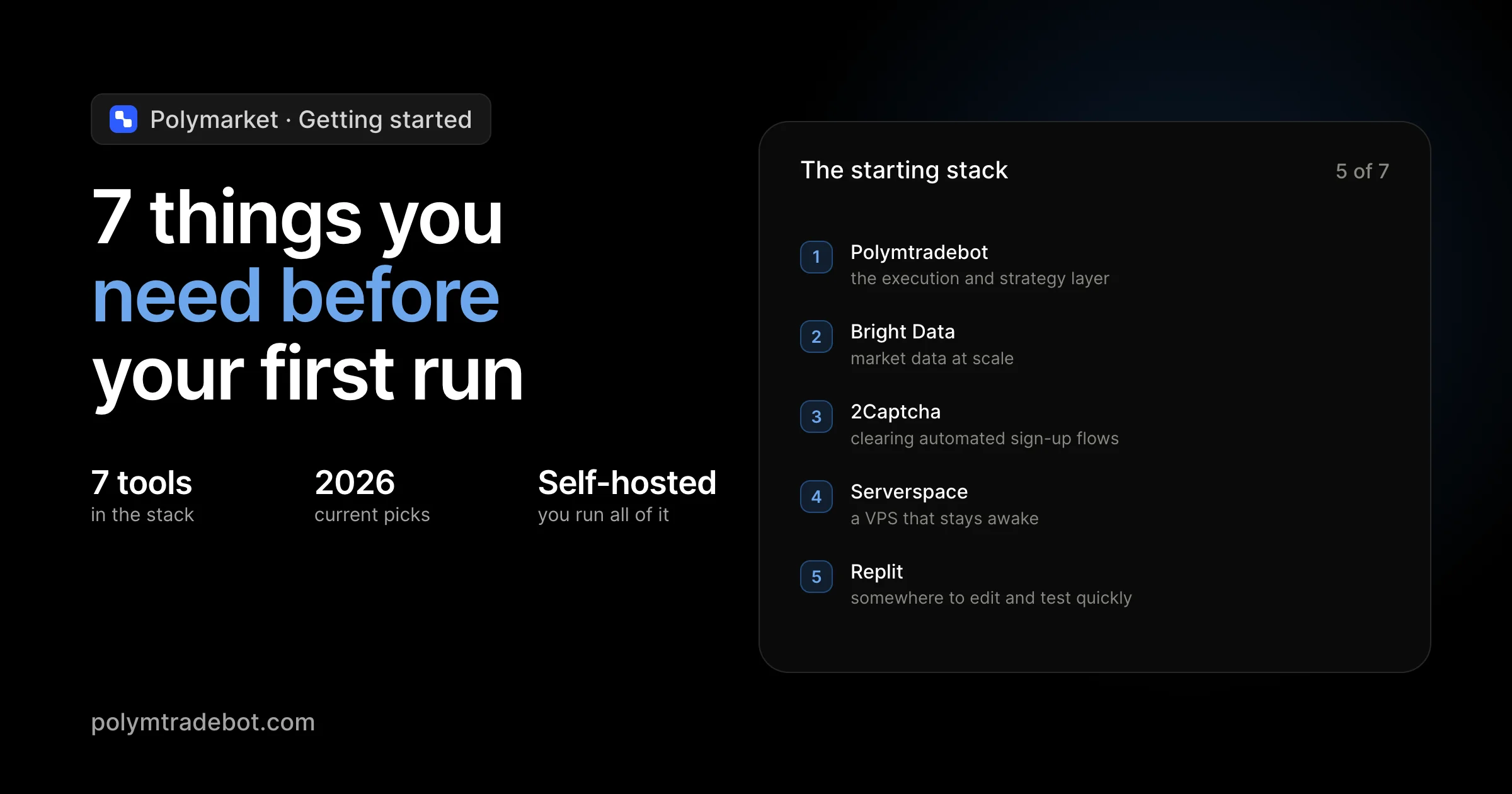
Manual execution on Polymarket's 5-minute Bitcoin markets often leaves you fighting a losing battle against execution lag and emotional bias. To transition from manual betting to profitable automated execution, you must bridge the gap between a raw Python script and a production-ready infrastructure that handles latency, captchas, and risk management. Without a dedicated stack, your bot will likely fail due to rate limits or API timeouts during high-volatility events where every millisecond counts toward your ROI.
Success in algorithmic prediction markets requires more than just a strategy; it requires a robust environment that maintains uptime and bypasses anti-bot hurdles. You need to secure 7 things you need before running your first bot to ensure your capital isn't wiped out by a simple server migration or a stale price feed. These essential components provide the stability needed to run complex arbitrage and trend-following scripts around the clock.
Check out these essential tools for your trading stack.
A quick look at each pick:
- Polymtradebot: Ready-to-use Python trading bot script for Polymarket's 5-minute and 15-minute Bitcoin Up or Down markets crypto Bitcoin, ETH, SOL, XRP. It features automated execution
- Bright Data: A premium residential proxy network for bots that need to bypass geo-blocks and avoid IP bans.
- 2Captcha: A reliable human-powered and AI-driven service to solve CAPTCHAs that block your automated bot workflows.
- Serverspace: A flexible cloud VPS provider optimized for hosting trading bots and automated infrastructure with low latency.
- Replit: A browser-based IDE and cloud platform for building, testing, and instantly deploying bot code.
- Netdata: A real-time monitoring tool that tracks your bot's server health and resource usage with zero-latency dashboards.
- Wispbyte: A specialized hosting provider designed specifically for persistent Discord and Telegram gateway bots.
Quick comparison:
| Tool | Key features | Pricing | Best for |
|---|---|---|---|
| Polymtradebot | pricing, blog, https://polymtradebot.com | — | Polymarket trading bot for Bitcoin, ETH, SOL, XRP |
| Bright Data | 400M+ ethically sourced IPs, Precise city and carrier targeting, 99.9% success rate | from $4/GB (Pay-as-you-go) | Enterprise-scale web scraping |
| 2Captcha | Supports reCAPTCHA, hCaptcha, and Turnstile, Average solve time under 15 seconds, API libraries for Python and Node.js | from $0.50 per 1,000 solves | Bypassing mandatory security challenges |
| Serverspace | Deploy servers in under 60 seconds, High-performance NVMe SSD storage, Hourly billing for cost efficiency | from $4.99/mo | Algorithmic trading bot hosting |
| Replit | Integrated AI coding assistant, Zero-config deployment environment, Collaborative real-time code editing | Free–$20/mo | Rapid prototyping and bot development |
| Netdata | Per-second metric collection, Automated anomaly detection, Lightweight agent with minimal overhead | Free–$3/node/mo | Monitoring bot performance and uptime |
| Wispbyte | 24/7 uptime for gateway connections, DDoS protection up to 17 Tbit/s, One-click deployment for Node.js/Python | Free–$5/mo | Discord and community management bots |
- 1. Polymtradebot
- 2. Bright Data
- 3. 2Captcha
- 4. Serverspace
- 5. Replit
- 6. Netdata
- 7. Wispbyte
- Conclusion
- FAQ
1. Polymtradebot
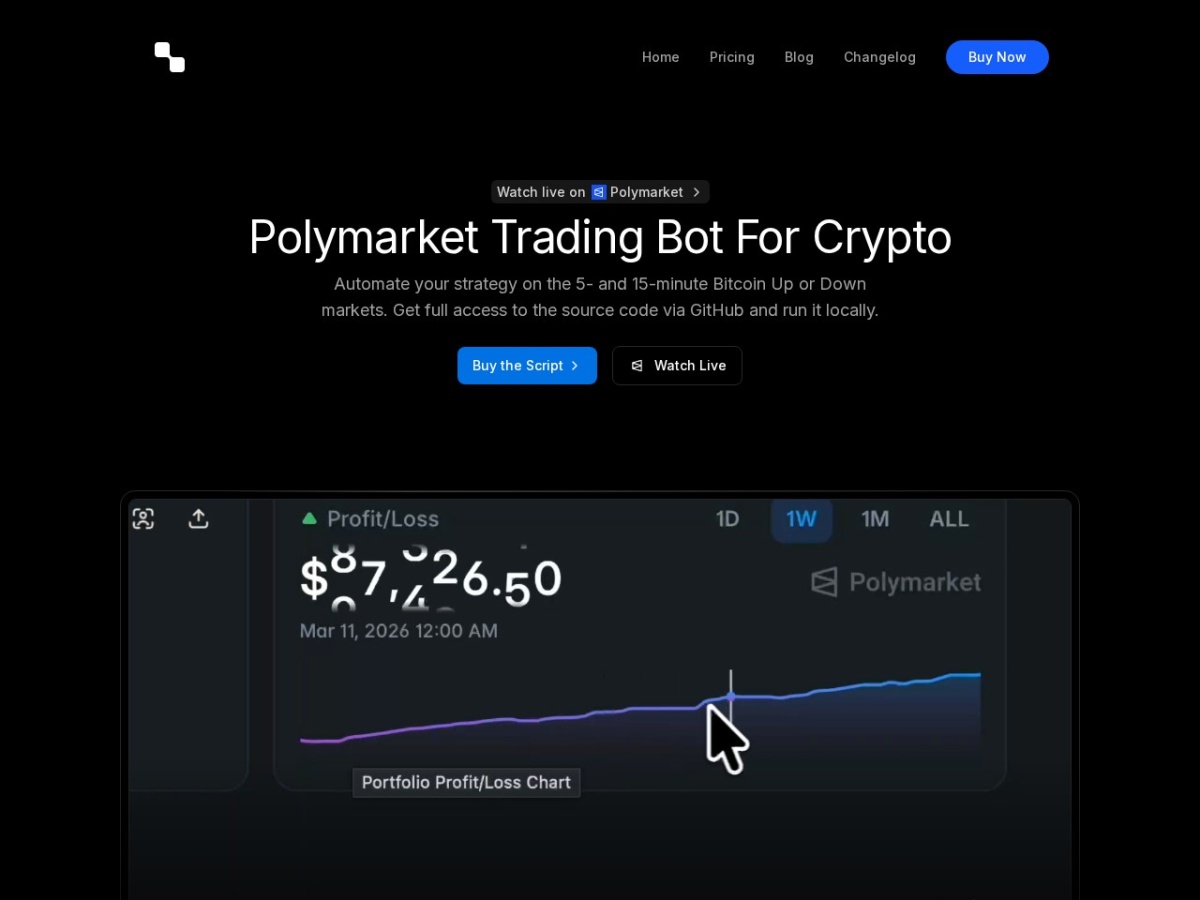
Polymtradebot provides a ready-to-use Python trading bot script specifically designed for Polymarket’s high-frequency prediction markets. If you are targeting the 5-minute and 15-minute intervals for Bitcoin, ETH, SOL, or XRP, this tool automates the execution that is nearly impossible to maintain manually over long sessions.
Automation and execution
The core of the script focuses on the "Up or Down" binary outcomes prevalent on Polymarket. By using Python, the bot interacts directly with market contracts to place trades based on preset logic. It handles the heavy lifting of monitoring price movements across Bitcoin and major altcoins, executing orders the moment your criteria are met. This removes the latency of human decision-making, which is often the difference between profit and a missed window in a 5-minute market.
Risk management and simulation
Trading on prediction markets involves high volatility, so the script includes built-in risk management parameters to protect your capital. Before deploying real funds, you can use the paper trading mode. This simulation environment allows you to test how your strategies perform against live market data without financial exposure. It is a necessary step for refining your entry and exit points in the volatile crypto prediction space.
Strategy and coverage
While many traders focus solely on price direction, the bot allows for more sophisticated approaches like arbitrage. It scans the spreads between Polymarket’s prediction prices and the actual spot prices of assets like ETH or SOL. Because the bot is localized to your machine as a script, you retain full control over the logic and API keys, ensuring your trading data isn't sitting on a third-party cloud server.
Observation. In our practice, we’ve seen that 5-minute markets are highly sensitive to exchange API lag; running a local Python script directly against the contract often provides the execution speed necessary to capture fast-moving spreads.
Who it is for
This tool is built for traders who understand the basics of the Python programming language and want to move beyond the manual web interface. It suits those looking to scale their volume on Bitcoin and altcoin markets by running automated cycles 24/7. You don't need to build a bot from scratch; you just need to configure the existing script to match your risk appetite.
2. Bright Data
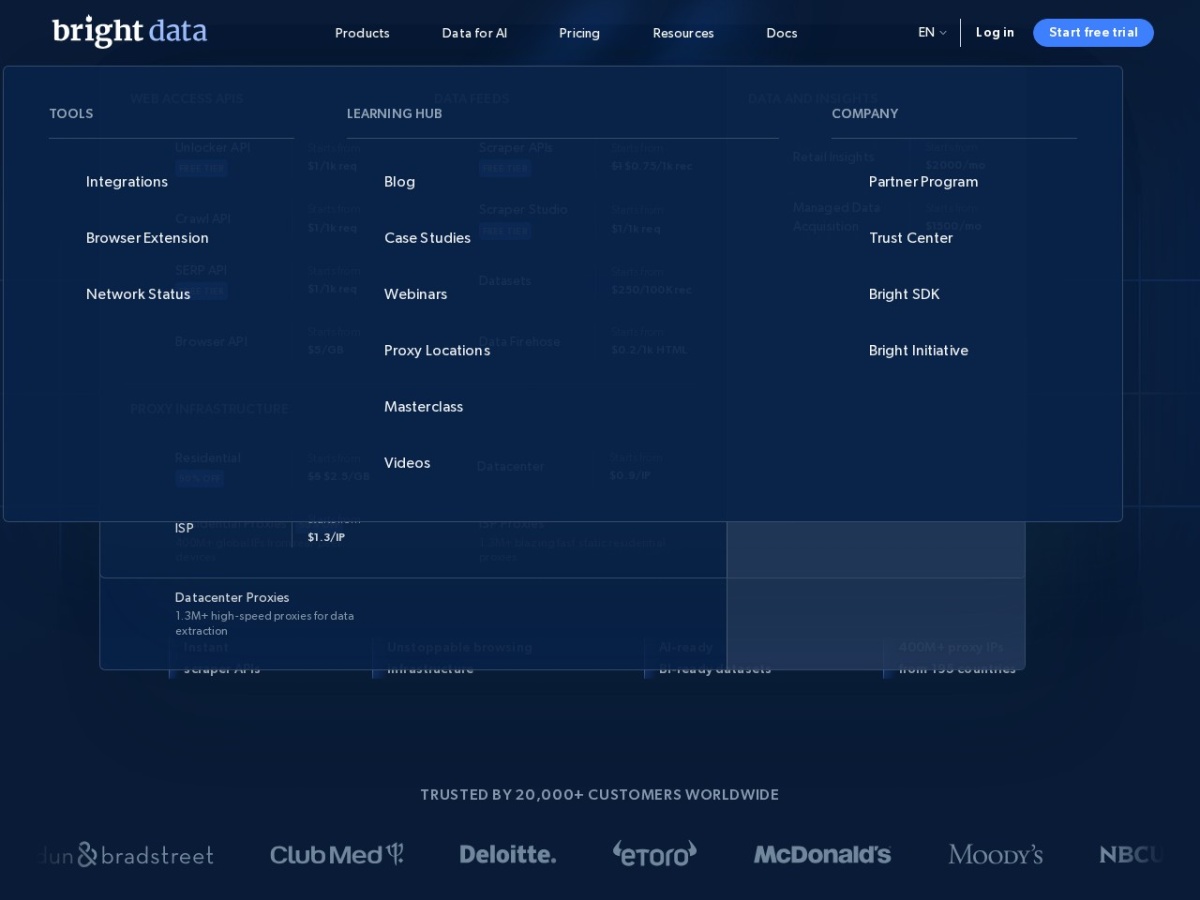
Bright Data is a premium residential proxy network designed for developers whose bots require high anonymity and the ability to bypass geographic restrictions. If you are running automated scripts that need to appear as genuine domestic users rather than data center servers, this infrastructure provides the necessary IP diversity to avoid detection.
Features and coverage
The network consists of over 400 million ethically sourced IPs, which is one of the largest pools available in 2026. This scale allows for precise targeting down to the level of specific cities or mobile carriers. For a trading bot, this means you can route traffic through specific regions to reduce latency or satisfy the geographic requirements of a platform. The system maintains a 99.9% success rate by automatically rotating IPs if a connection fails or a target site issues a challenge.
Who it is for
This tool is built for enterprise-scale web scraping and high-frequency automation where IP bans are a primary risk. While data center proxies are cheaper, they are easily identified by sophisticated firewalls. Bright Data’s residential IPs are assigned by Internet Service Providers (ISPs) to real homes, making them nearly indistinguishable from organic traffic. This is critical for users who need to maintain consistent uptime across hundreds of concurrent sessions without triggering security protocols.
Observation. In our practice developing the Polymtradebot, we found that using standard data center IPs often leads to immediate rate-limiting on high-traffic exchange interfaces. Switching to a residential rotation ensures the bot's execution remains stable during peak volatility when exchange servers are most sensitive to automated patterns.
Pricing and plans
Access to the network operates on a usage-based model starting from $4/GB for the pay-as-you-go tier. This structure is useful for testing scripts before committing to a monthly subscription. As your data throughput increases, the cost per gigabyte typically scales down. Because residential bandwidth is significantly more expensive than static IP hosting, it is best used for the specific parts of your bot's workflow that interact with protected web interfaces, rather than for simple internal data processing.
3. 2Captcha
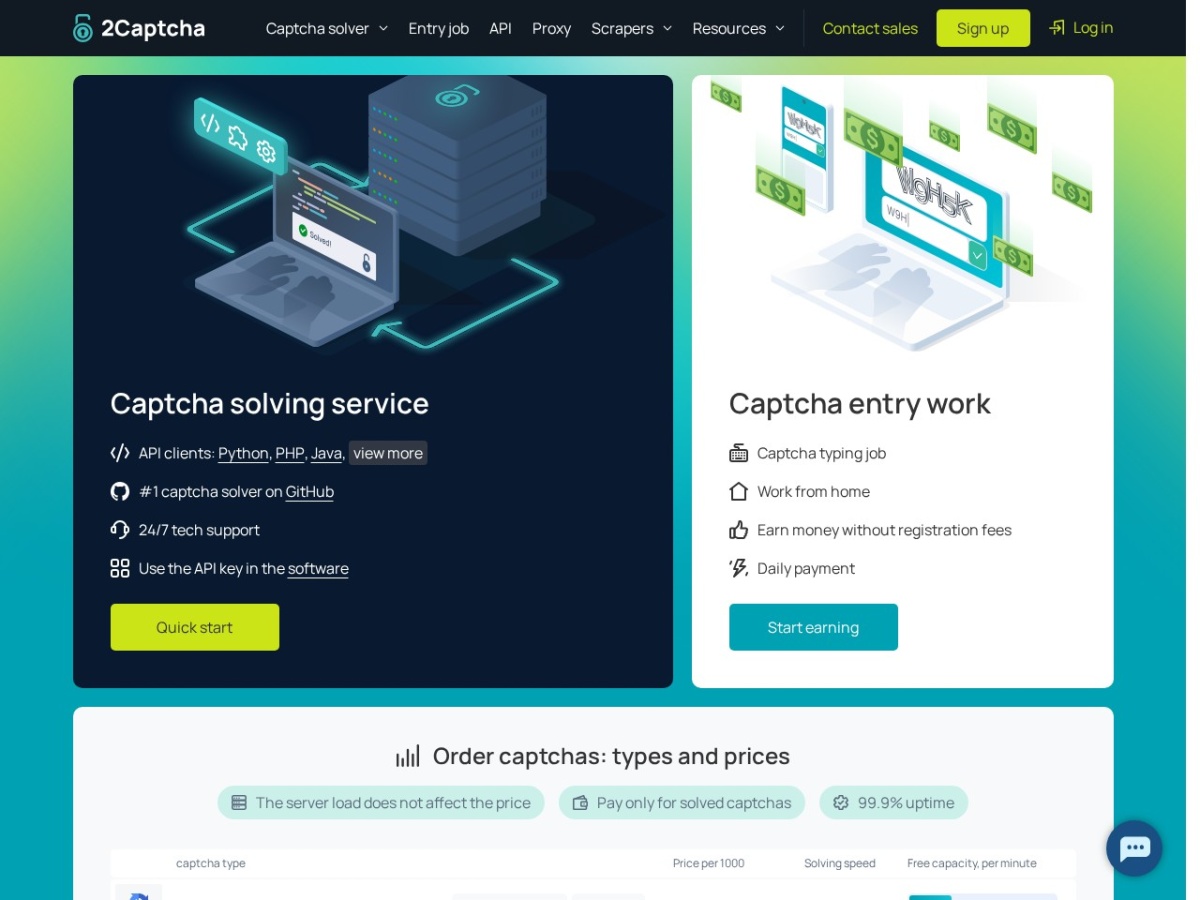
Automated trading on platforms like Polymarket often hits a wall when sites trigger security challenges to verify human intent. To keep your bot running without manual intervention, you need a service like 2Captcha to handle these interruptions. It functions as a middleware that receives CAPTCHA images or tokens from your script and returns the solution, allowing the workflow to continue.
Automation and solve times
The service combines AI-driven solvers with a human-in-the-loop backup system to maintain high success rates. While simple image puzzles are solved almost instantly, complex challenges like reCAPTCHA or hCaptcha typically see an average solve time under 15 seconds. This speed is critical when running our Polymtradebot scripts on 5-minute or 15-minute Bitcoin markets, where a delay in execution can result in missing a specific price entry.
Integrations and coverage
You can integrate the service into your Python or Node.js environment using its official API libraries. It covers the most common blockers found on modern web applications, including Google’s reCAPTCHA (v2 and v3), hCaptcha, and Cloudflare’s Turnstile. Because it uses a standardized API, you can swap it into existing Selenium, Playwright, or custom HTTP request-based bots with minimal code changes.
Observation. In our practice, we’ve found that even "invisible" CAPTCHAs can occasionally flag automated sessions if the bot’s request patterns appear too mechanical; having a solver integrated prevents the entire execution thread from crashing during a live trade.
Pricing and plans
The cost structure is based on a pay-as-you-go model rather than a monthly subscription, which suits traders who only run bots during specific market conditions. Prices start from $0.50 per 1,000 solves. This low overhead makes it feasible to run high-frequency simulations in paper trading mode without inflating your operational costs. Since you only pay for successful solves, your budget scales directly with your bot's activity levels.
4. Serverspace
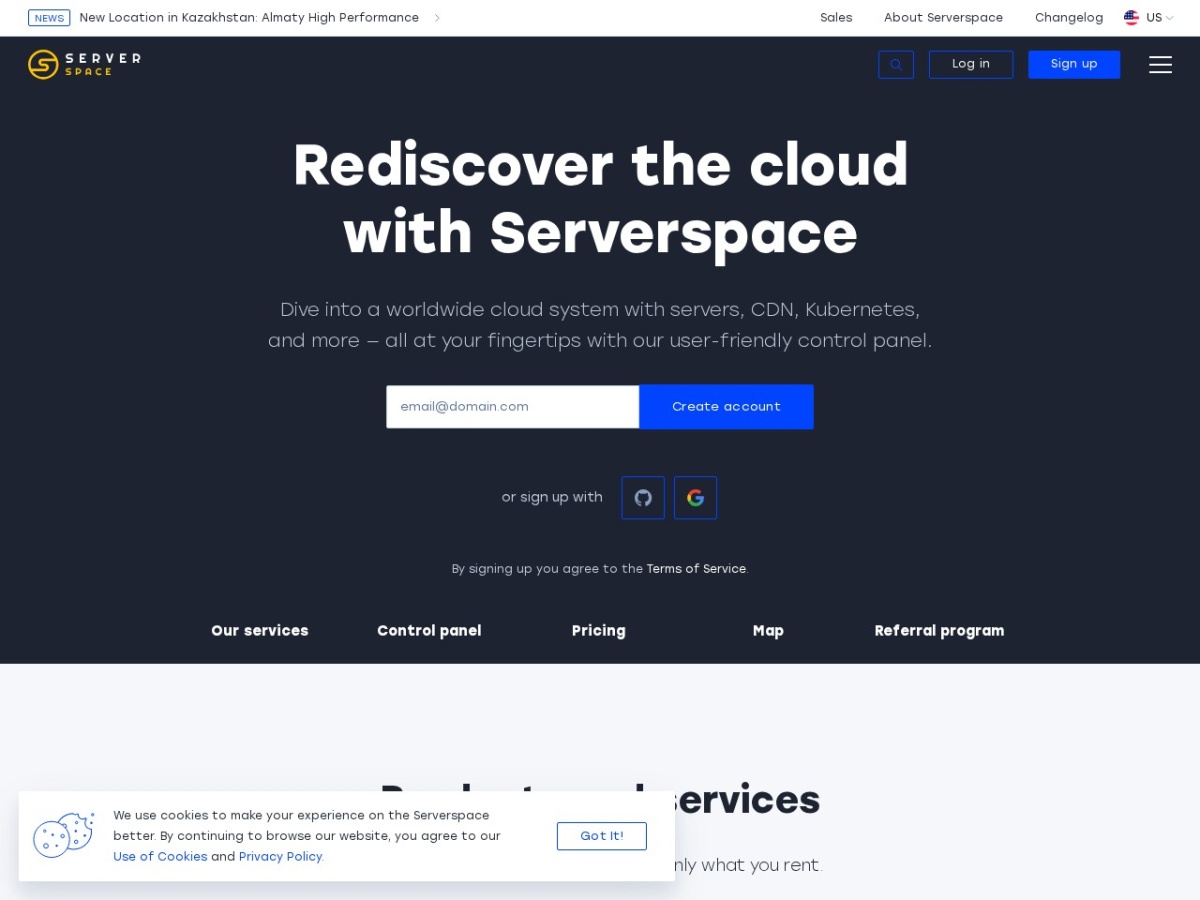
Serverspace is a cloud VPS provider built for developers who need to deploy automated infrastructure with minimal friction. It serves as a reliable hosting environment for algorithmic trading bots that require consistent uptime and low-latency connections to exchange APIs.
Performance and deployment
You can spin up a new server instance in under 60 seconds, which is critical when you need to iterate on a new strategy or scale your compute resources quickly. The infrastructure utilizes high-performance NVMe SSD storage to ensure that data read/write operations don't become a bottleneck during periods of high market volatility. By hosting your bot on a VPS rather than a local machine, you eliminate risks associated with home internet outages or hardware failures.
Cost efficiency and scaling
The provider uses an hourly billing model, allowing you to pay only for the resources your bot consumes. If you are testing a new Python script for 15-minute Bitcoin markets, you can run the server for a few hours and shut it down without committing to a full monthly fee. Plans start from $4.99/mo, making it an accessible entry point for traders who are moving away from local execution to cloud-based automation.
Who it is for
This service is designed for users who prioritize deployment speed and hardware performance over managed software suites. It is particularly effective for hosting lightweight Python environments, such as those used for Polymarket trading bots. If your strategy relies on rapid execution in 5-minute or 15-minute windows, the combination of NVMe storage and a global data center footprint helps maintain the necessary connection speeds.
Observation. In our practice, we noticed that hosting automated scripts on NVMe-backed instances significantly reduces the execution lag often seen on standard HDD cloud tiers, which is vital for capturing arbitrage opportunities before they vanish.
Infrastructure reliability
Maintaining a persistent connection to the REST API of an exchange is the baseline for any successful bot. Serverspace provides the underlying stability needed to run risk management modules and paper trading simulations 24/7. This ensures that your automated execution remains active even when your personal computer is turned off, preventing missed trades in round-the-clock crypto markets.
5. Replit

Replit is a browser-based IDE and cloud platform designed for developers who want to build, test, and deploy bot code without managing local hardware. It functions as a complete development environment that lives in your tab, making it a standard choice for traders who need to move from a script idea to a live execution environment in minutes.
Features and automation
Replit removes the friction of environment configuration by providing a zero-config deployment setup. When you write a Python script for a trading bot, you don't need to install libraries or manage virtual environments on your machine; the platform handles the backend infrastructure automatically. It includes an integrated AI coding assistant that helps debug logic errors or suggest boilerplate code for API connections. For those working in teams, the real-time collaborative editor allows multiple users to work on the same script simultaneously, similar to a Google Doc for code.
Pricing and plans
The platform operates on a tiered model ranging from a free tier to approximately $20 per month for professional features. The free version is suitable for exploration and basic testing, but serious bot hosting typically requires a paid plan to ensure the script remains active 24/7 and has access to more compute resources. Because it is a third-party cloud provider, you should check their site for the most current pricing updates and resource limits.
Who it’s for
This tool is best for rapid prototyping and developers who prioritize mobility. If you are building a script like the one we use at Polymtradebot, Replit allows you to verify your logic in a sandbox before moving to a dedicated server. It bridges the gap between writing code on a laptop and deploying it to a permanent cloud home.
Observation. We noticed that many first-time traders struggle with "it works on my machine" bugs when moving scripts to production; using a cloud IDE like Replit early in the process eliminates these environment-specific errors by forcing the code to run in a standardized container from day one.
Integrations and coverage
Since it is a generalized development platform, Replit supports a wide range of languages including Python, which is the backbone of most Polymarket trading integrations. It provides a persistent uptime environment, meaning your bot can stay connected to market data feeds and execute trades even when your personal computer is shut down. This is a fundamental requirement for strategies targeting 5-minute or 15-minute market windows where missing a single signal impacts the week's total return.
6. Netdata
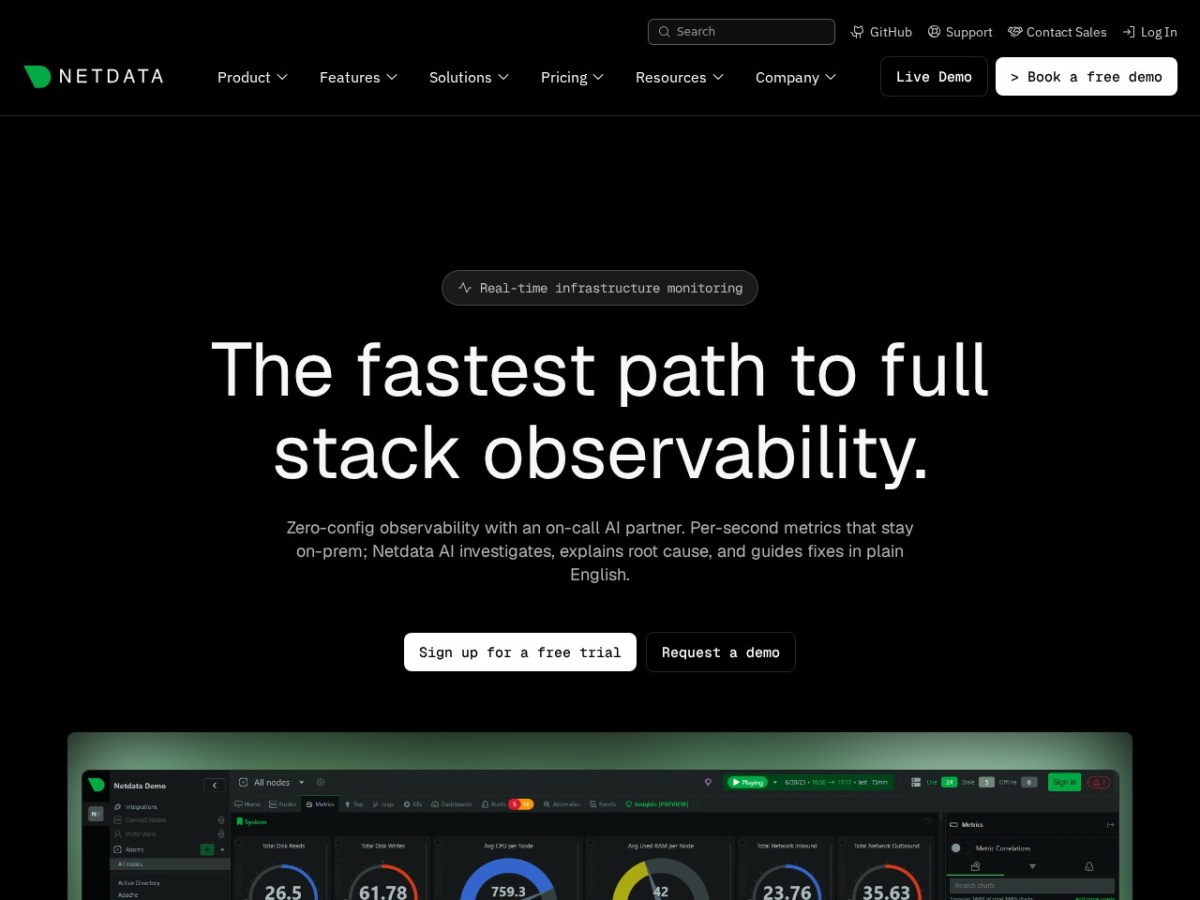
Netdata is a real-time monitoring tool designed to track your server’s health and resource usage through zero-latency dashboards. When you deploy a bot to trade Bitcoin or ETH on Polymarket, you need to know exactly how much CPU and RAM your Python scripts consume to prevent crashes during high-volatility events.
Features and automation
Netdata uses a lightweight agent that collects metrics every second, providing a granular view of your environment that standard cloud provider dashboards often miss. It features automated anomaly detection to identify unusual spikes in resource consumption before they kill your bot's process. Because the agent has minimal overhead, it monitors your system without stealing the compute power your bot needs for trade execution. This allows you to visualize system performance, disk I/O, and network traffic in real-time.
Who it is for
This tool is for traders who run their bots on private servers or VPS instances and require constant uptime. If your strategy relies on 5-minute or 15-minute market cycles, a server hang-up of even sixty seconds can result in missed entries or failed risk management. Netdata helps you verify that your server environment remains stable enough to handle the rapid API calls required for automated execution. It is particularly useful for those moving from local testing to live production environments where hardware constraints become a factor.
Observation. In our practice, we’ve seen bots fail not because of the strategy logic, but because the underlying server ran out of memory during a sudden influx of market data. Monitoring per-second metrics helps you right-size your VPS so you aren't paying for a 16GB RAM instance when a 4GB one handles the load safely.
Pricing and plans
Netdata offers a range of tiers starting with a Free plan for individual users and scaling to a paid subscription at $3 per node per month. The free version provides the core real-time monitoring and visualization features needed for a single trading setup. For traders managing a fleet of bots across multiple servers, the paid tier offers more advanced alert configurations and longer data retention. You can check their site for the latest pricing updates and specific plan limits.
7. Wispbyte
Wispbyte is a specialized hosting provider built for developers who need to maintain persistent gateway connections for Discord and Telegram bots. While general-purpose cloud servers often struggle with the specific handshake requirements of chat APIs, this platform focuses on keeping those socket connections alive 24/7.
Features and automation
Reliability for a bot depends on its ability to handle high-traffic spikes and network interference. This provider includes DDoS protection capable of mitigating up to 17 Tbit/s, which prevents external attacks from knocking your bot offline during volatile market events. For deployment, you can use one-click setups for Node.js or Python environments. This removes the need to manually configure Linux dependencies or environment variables, allowing you to move from local code to a live production server in a few minutes.
Who it is for
If you are running community management tools or alert systems that notify users about price movements, uptime is your primary metric. Standard web hosting often hibernates scripts after a period of inactivity, but Wispbyte is designed for the persistent nature of gateway bots. It ensures that your Discord or Telegram integration remains responsive to commands without the lag associated with "cold starts."
Observation. In our practice developing trading scripts for Polymarket, we’ve seen that the most common failure point isn't the strategy itself, but the middleware. If your notification bot drops its socket connection, you miss the 5-minute window to hedge a position.
Pricing and plans
The service follows a low-barrier entry model, ranging from a free tier to approximately $5 per month. This makes it an accessible choice for testing new bot ideas or running lightweight community tools without committing to a heavy monthly infrastructure bill. Because the platform specializes in chat bot hosting rather than heavy computational lifting, the resource allocation is optimized for the low-latency communication required by the WebSocket protocol. Check the official site for the most current plan details and resource limits.
Conclusion
Running a trading bot on Polymarket requires more than just a functional script; it demands a resilient infrastructure that can handle 300-millisecond API calls and constant proxy rotation. We see many traders fail because they treat their bot like a browser tab rather than a high-frequency execution tool. By offloading captcha solving to 2Captcha and hosting on a dedicated VPS like Serverspace, you minimize the latency that causes missed entries in 5-minute markets.
Our team at Polymtradebot developed our Python scripts specifically to handle these infrastructure demands for Bitcoin and ETH markets. You get the benefit of built-in risk management and arbitrage strategies without having to build the backend from scratch. Review the technical requirements on polymtradebot.com to ensure your environment is ready for automated execution.
FAQ
What is the minimum technical stack required to run a Polymarket trading bot without downtime?
You need a Python environment hosted on a Linux VPS with at least 2GB RAM, a dedicated proxy provider like Bright Data, and an automated captcha-solving API. This setup ensures your bot remains active during high-traffic events. Using a process manager like PM2 or Systemd will automatically restart the script if it crashes.
How much should I budget for third-party API services like proxy rotation and captcha solving per month?
Budget approximately $30 to $60 per month for essential third-party services. Residential proxies typically cost $10–$15 per GB, while captcha solving services like 2Captcha charge about $2.99 per 1,000 solved challenges. These costs are necessary to bypass rate limits and anti-bot measures implemented by the Wikipedia article on Cloudflare and similar protection layers.
Is it better to host a trading script on a local machine or a dedicated cloud server for 5-minute market execution?
A dedicated cloud server is superior because it provides 99.9% uptime and lower latency to Polymarket’s API endpoints. Local machines are prone to ISP throttling, power outages, and hardware sleep cycles that can disrupt 5-minute trade signals. For markets moving this fast, a VPS located in a major data hub ensures your orders execute within milliseconds of the signal.