

Building a profitable crypto prediction bot in 2026 requires balancing low-latency execution with robust backtesting frameworks to navigate the volatility of 5-minute and 15-minute price action. As prediction markets like Polymarket grow in liquidity, the challenge for developers is no longer just generating a signal, but managing the technical overhead of API rate limits and slippage across decentralized and centralized exchanges. The right stack must handle high-frequency data streams while providing a sandbox for paper trading before you risk real capital on Bitcoin or Solana movements.
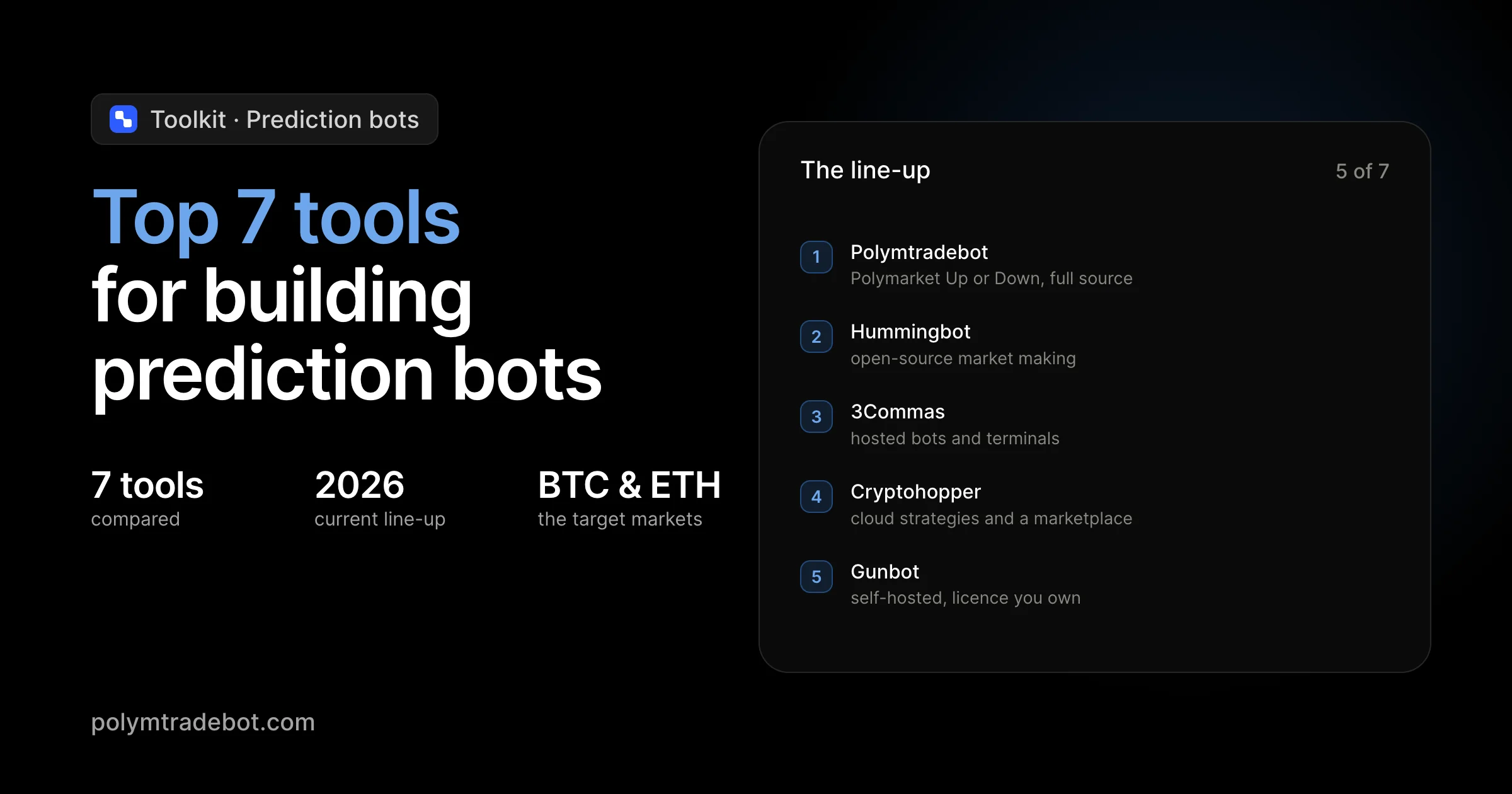
This guide evaluates the top 7 tools for building crypto prediction bots based on their ability to integrate automated execution with sophisticated risk management modules. Whether you are looking for a ready-to-use Python script for arbitrage or a visual strategy builder, these platforms solve the core problem of translating market sentiment into executable orders. The following selection focuses on tools that prioritize data accuracy and execution speed for modern traders.
A quick look at each pick:
- Polymtradebot: Ready-to-use Python trading bot script for Polymarket's 5-minute and 15-minute Bitcoin Up or Down markets crypto Bitcoin, ETH, SOL, XRP. It features automated execution
- Hummingbot: An open-source Python framework for building high-frequency market making and arbitrage bots across 140+ venues.
- 3Commas: A comprehensive automation platform for traders to build, backtest, and deploy DCA and Grid bots.
- Cryptohopper: A cloud-based bot builder featuring an AI strategy designer and a vast marketplace for templates.
- Gunbot: A privacy-focused, self-hosted trading bot allowing for fully custom JavaScript strategy development.
- Kryll.io: A visual drag-and-drop builder for creating complex crypto trading strategies without writing code.
- Pionex: A crypto exchange with 16+ built-in automated bots for grid trading and arbitrage.
Quick comparison:
| Tool | Key features | Pricing | Best for |
|---|---|---|---|
| Polymtradebot | pricing, blog, https://polymtradebot.com | — | Polymarket trading bot for Bitcoin, ETH, SOL, XRP |
| Hummingbot | Modular strategy engine for custom Python scripts, Standardized connectors for CEX and DEX APIs, Liquidity mining integration for earning rewards | Free (Open-source) | Developers and quant traders |
| 3Commas | Advanced DCA and Grid bot configuration, TradingView webhook integration for custom signals, Robust backtesting engine using historical data | Free–$160/mo | Intermediate traders and signal users |
| Cryptohopper | AI Strategy Designer for automated pattern recognition, Developer API for custom app and bot extensions, Marketplace for buying/selling trading signals | Free–$108/mo | Traders seeking AI-assisted strategy design |
| Gunbot | Custom JavaScript strategy engine for developers, Self-hosted architecture for maximum data privacy, Support for 100+ exchanges including DEXs | $199–$499 (One-time lifetime license) | Privacy-conscious developers |
| Kryll.io | Visual strategy editor with logical blocks, Cloud-based execution with no local setup, Marketplace for community-generated strategies | Free (Pay-per-use via KRL tokens) | Non-coders building complex logic |
| Pionex | Built-in exchange bots (no API keys required), AI-guided setup based on 30-day backtests, Low 0.05% trading fees for high-frequency bots | Free (0.05% trading fee) | Beginners and cost-conscious traders |
- 1. Polymtradebot
- 2. Hummingbot
- 3. 3Commas
- 4. Cryptohopper
- 5. Gunbot
- 6. Kryll.io
- 7. Pionex
- Conclusion
- FAQ
1. Polymtradebot
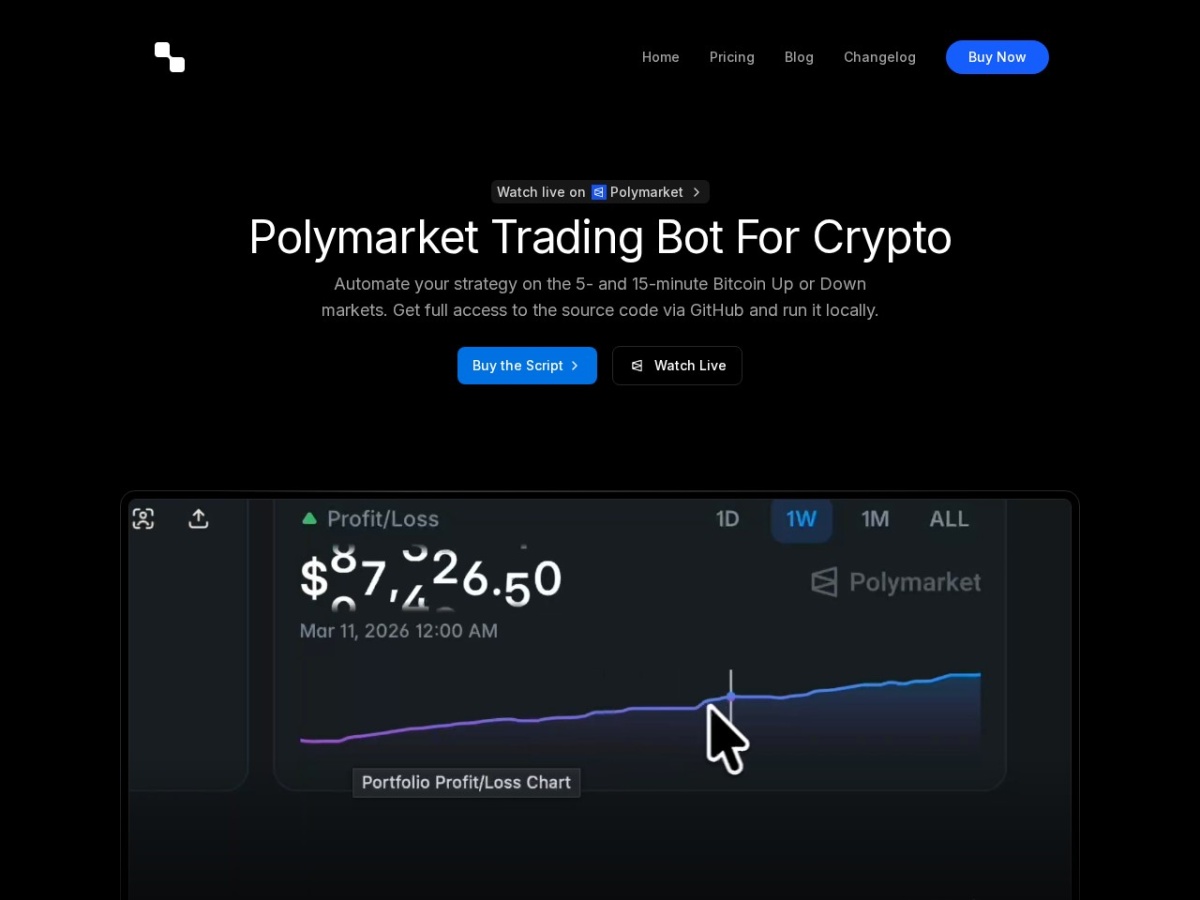
Polymtradebot provides a ready-to-use Python script specifically engineered for Polymarket’s binary prediction markets. If you are targeting the "Bitcoin Up or Down" contracts, this tool automates the manual overhead of monitoring price fluctuations and executing trades across 5-minute and 15-minute intervals.
Features and automation
The bot functions as a specialized execution layer for Python users who need to act on rapid market shifts. It handles automated execution for Bitcoin, ETH, SOL, and XRP markets, removing the latency inherent in manual web-interface trading. Beyond simple execution, the script includes built-in arbitrage strategies and risk management protocols to protect your capital during high-volatility events. We found that having a paper trading mode is essential for this niche; it allows you to simulate your logic against live Polymarket data without committing real USDC until your hit rate stabilizes.
Observation. In the 5-minute prediction markets, execution speed is the primary differentiator because the window to capitalize on price-action lag is extremely narrow.
Integrations and coverage
The tool focuses on the core assets driving volume on prediction platforms: Bitcoin, Ethereum, Solana, and XRP. Because it is a script-based solution rather than a restrictive SaaS platform, you can modify the underlying logic to fit specific technical indicators or external data feeds. It connects directly to Polymarket’s infrastructure, ensuring that your buy and sell orders for "Yes" or "No" shares are processed the moment your price targets are hit. This level of direct integration is necessary for managing the 15-minute cycles where sentiment can flip based on a single candle.
Getting started
The developers maintain a dedicated blog and technical documentation at polymtradebot.com to assist with the initial setup. You don't need to build a custom API wrapper from scratch; the bot comes as a prepared package that handles the authentication and order-routing logic out of the box. For traders who already use Python for data analysis, this bridges the gap between identifying an price trend and actually capturing the profit on a decentralized prediction exchange.
2. Hummingbot
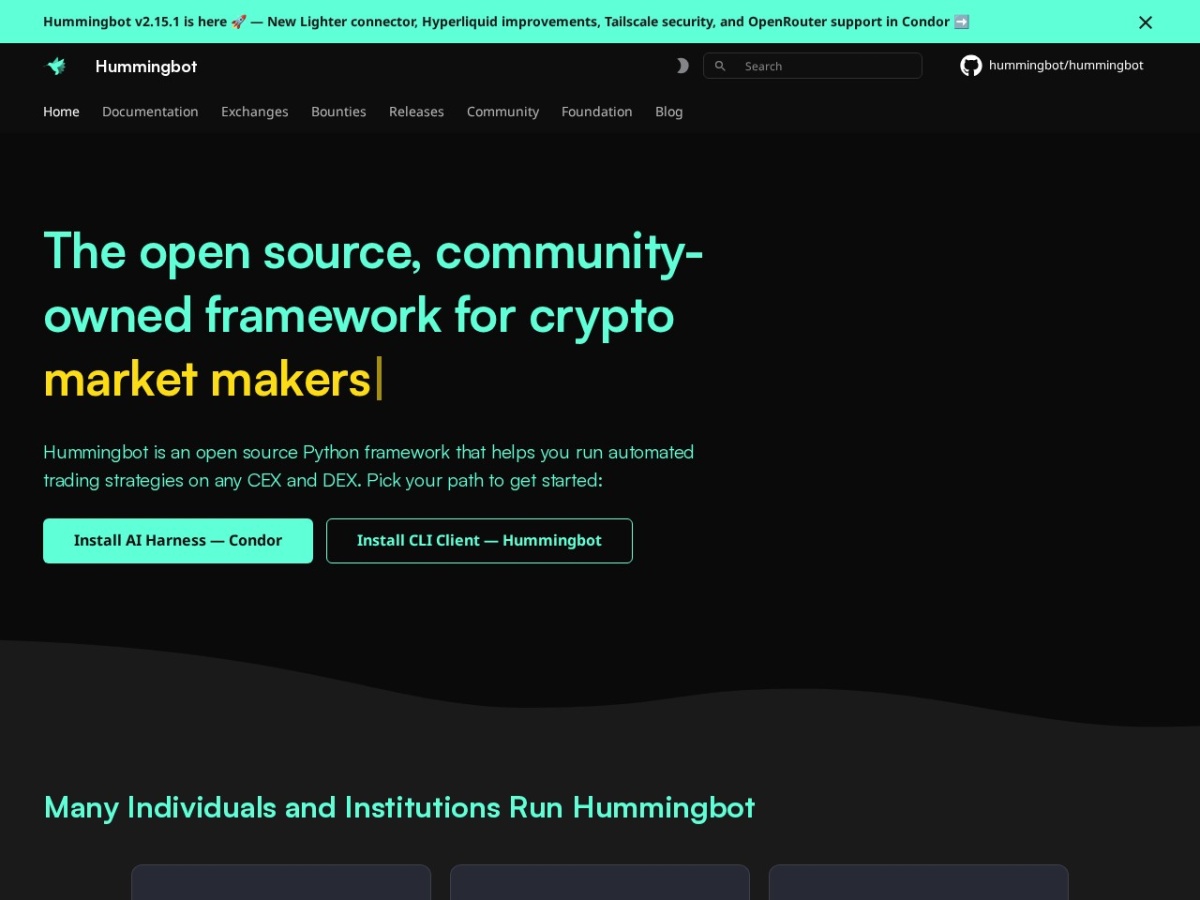
Hummingbot is an open-source Python framework designed for developers and quant traders who need to build high-frequency market making and arbitrage bots. While many tools focus on simple directional bets, this software provides a modular engine for executing complex strategies across more than 140 different centralized and decentralized exchanges.
Features and automation
The core of the platform is a modular strategy engine that allows you to write custom Python scripts for automated execution. Instead of building a bot from scratch, you use standardized connectors to interact with various exchange APIs. This setup is particularly useful for liquidity mining, where you can earn rewards by providing buy and sell orders to specific markets. The framework handles the low-level connectivity, so you focus on the logic of your prediction or market-making algorithm.
Integrations and coverage
Coverage is the framework's strongest suit, connecting to a vast array of CEX and DEX venues. This broad integration makes it a primary choice for cross-exchange arbitrage—buying an asset on one platform and selling it on another to capture price discrepancies. Because it is built on Python, you can integrate external libraries for data analysis or machine learning to refine how your bot predicts price movements before executing trades.
Observation. In our practice building the Polymtradebot for prediction markets, we found that while high-frequency frameworks like Hummingbot excel at liquidity provision on standard exchanges, specialized markets like Polymarket often require scripts tailored for binary outcomes and specific timeframes like 5-minute or 15-minute intervals.
Pricing and plans
The software is free and open-source under the Apache 2.0 license. This means you can inspect the code, modify it for your specific needs, and run it on your own local machine or a private cloud server without paying subscription fees. There are no limits on the number of bots or trading volume, though you are responsible for managing your own infrastructure and API security. For developers who want total control over their execution environment, this open-source model eliminates the "black box" risks associated with proprietary trading software.
3. 3Commas
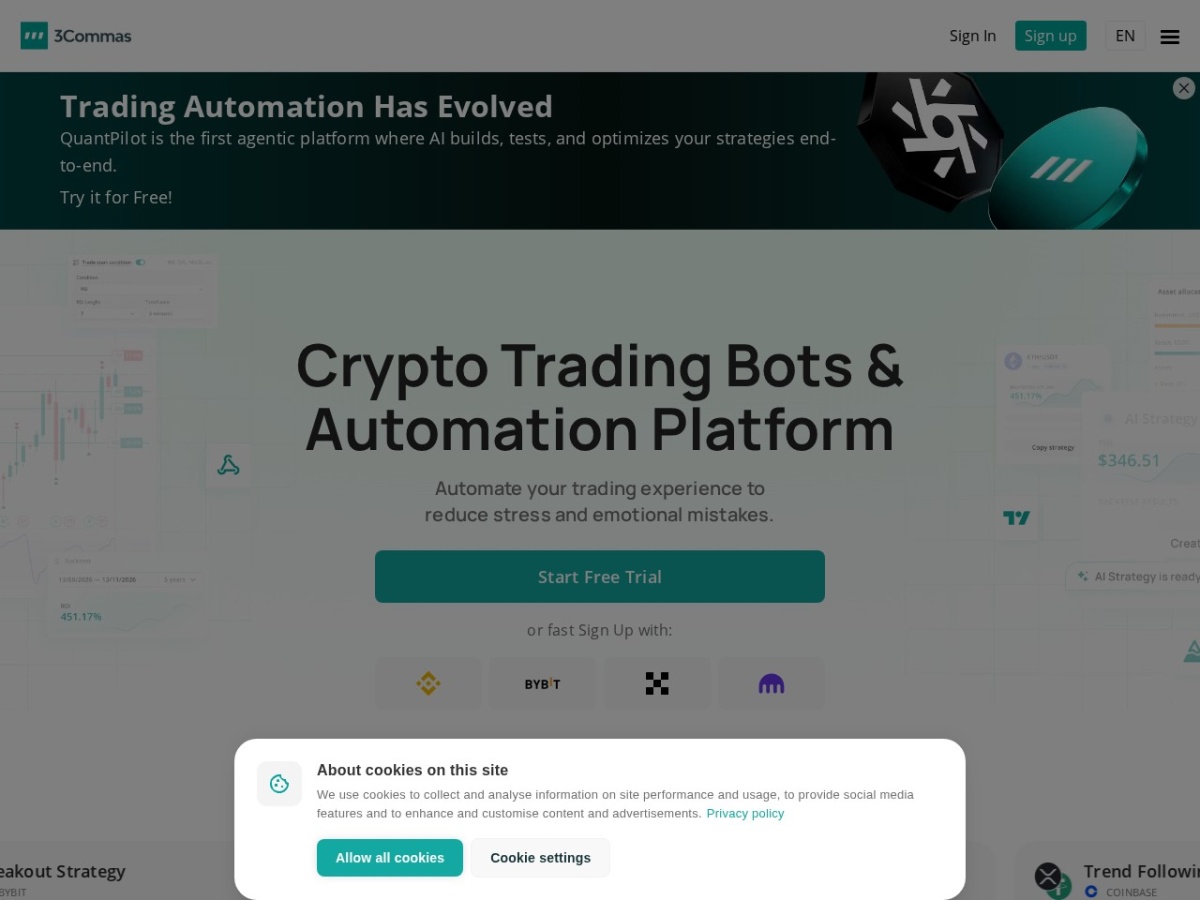
3Commas is a specialized automation ecosystem designed for traders who want to move beyond manual execution into structured, rule-based strategies. It functions as a central command center where you can build, backtest, and deploy bots across various crypto exchanges without writing custom code from scratch.
Features and automation
The platform focuses on two primary bot types: DCA (Dollar Cost Averaging) and Grid bots. DCA bots allow you to automatically average your entry price during market dips, while Grid bots profit from sideways volatility by buying and selling in a predefined price range. For those running custom logic, the TradingView webhook integration is a critical bridge. It allows you to send alerts from specific technical indicators or Pine Script strategies directly to the bot for immediate execution. This setup removes the latency of manual entry when a signal hits.
Integrations and coverage
Because the tool relies on API connections, it provides a unified interface to manage portfolios across multiple exchanges. The built-in backtesting engine is a practical starting point for bot development; it uses historical data to simulate how a specific configuration would have performed in past market cycles. This helps you identify if your take-profit percentages or safety order volumes are too aggressive before you commit real capital. While we focus on high-frequency execution in 5-minute and 15-minute markets at Polymtradebot, 3Commas provides the broader infrastructure needed for swing trading and long-term accumulation.
Observation. We noticed that many traders overcomplicate their initial bot settings by using too many safety orders. In volatile markets, a simpler DCA configuration with wider price deviations often prevents the bot from getting "stuck" with a full position during a deep correction.
Pricing and plans
The service operates on a tiered subscription model ranging from a Free version to $160 per month. The Free tier usually limits the number of active bots and features, making it a testing ground for beginners. As you scale to multiple concurrent strategies or require advanced features like the "Signal" bot, you move into the paid brackets. This transparency allows you to calculate your overhead costs—a vital step in ensuring your bot’s monthly profit actually covers its operating expenses.
Who it is for
This tool is built for intermediate traders who understand market mechanics but lack the time or desire to monitor charts 24/7. It is also a fit for signal users who want to automate the output of third-party analysts. If you are looking for a bridge between basic exchange tools and fully custom Python scripts, this platform fills that gap by providing a visual interface for complex logic.
4. Cryptohopper
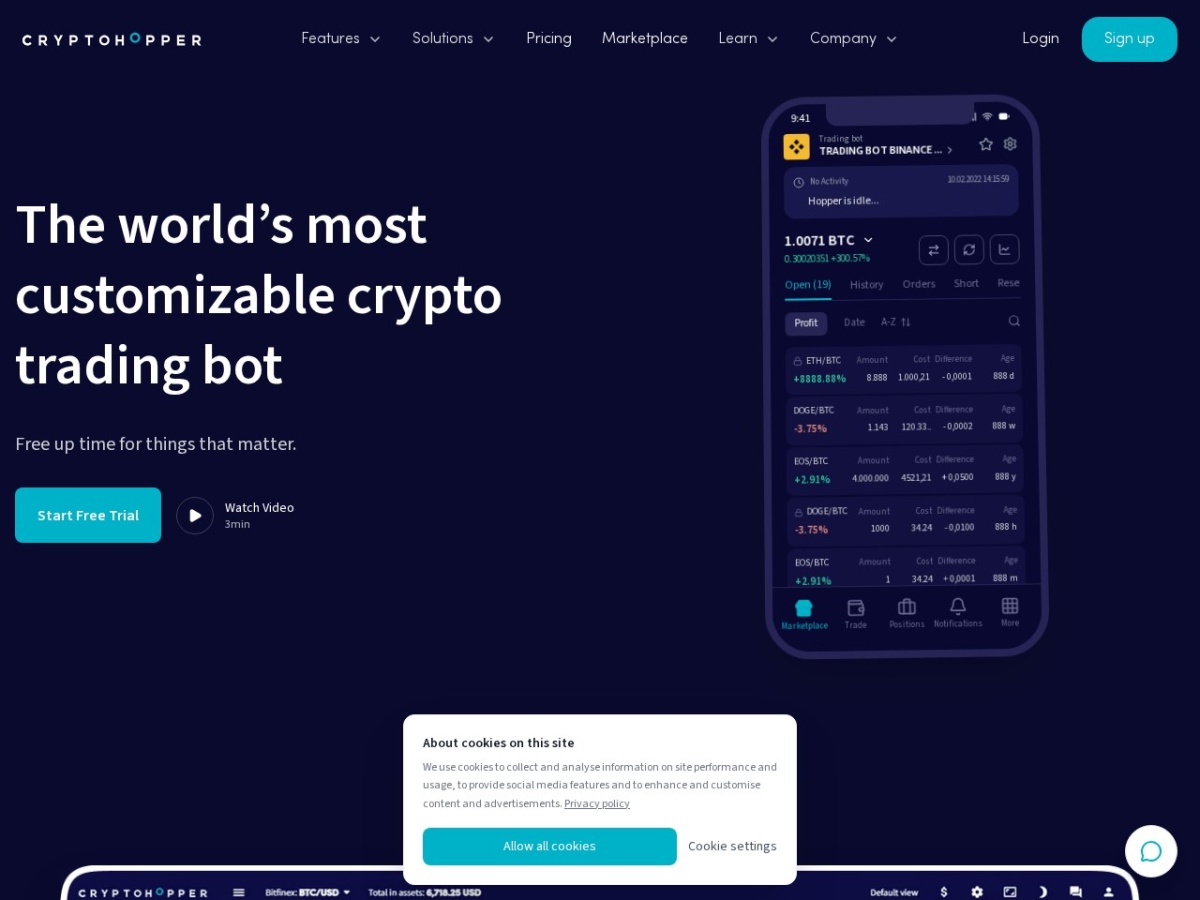
Cryptohopper is a cloud-based automated trading platform designed for users who want to build and test strategies without managing their own server infrastructure. It bridges the gap between manual trading and complex coding by providing a visual interface for logic design and a marketplace for pre-built components.
Features and automation
The platform centers on an AI Strategy Designer that uses automated pattern recognition to evaluate various technical indicators simultaneously. Instead of you manually backtesting every combination of RSI and Moving Averages, the AI scans historical data to identify which configurations have the highest probability of success in current market conditions. For those who want more control, the Developer API allows for custom app extensions, enabling you to feed external data into your bot's decision-making process.
Marketplace and signals
If you aren't ready to build a logic flow from scratch, the internal marketplace serves as a repository for trading signals and strategy templates. You can subscribe to professional signalers who push buy and sell alerts directly to your bot, or purchase "blueprints" that define specific entry and exit rules. This modular approach lets you treat bot building like an assembly line—combining a third-party signal with your own risk management settings.
Pricing and plans
Access starts with a Free "Pioneer" plan, which is limited to manual trading and portfolio management. To use the automated "Hopper" bots and the AI strategy designer, tiers scale up to $108/mo. Each level increases the number of concurrent positions the bot can manage and reduces the interval at which the bot checks the market for new trades.
Who it's for
This tool is best for traders who prioritize AI-assisted strategy design but do not want to write raw Python code. It suits those who need a 24/7 cloud presence without the technical overhead of configuring a private server.
Observation. In our practice developing the Polymtradebot script, we found that while cloud builders like Cryptohopper offer great accessibility, high-frequency markets—like the 5-minute Bitcoin intervals on Polymarket—often require the lower latency and execution control found in dedicated Python scripts.
While Cryptohopper handles the complexity of API integrations across major exchanges, it remains a "black box" compared to local scripts. If your goal is to deploy a strategy quickly using a library of existing indicators, the platform’s visual builder is a logical starting point.
5. Gunbot
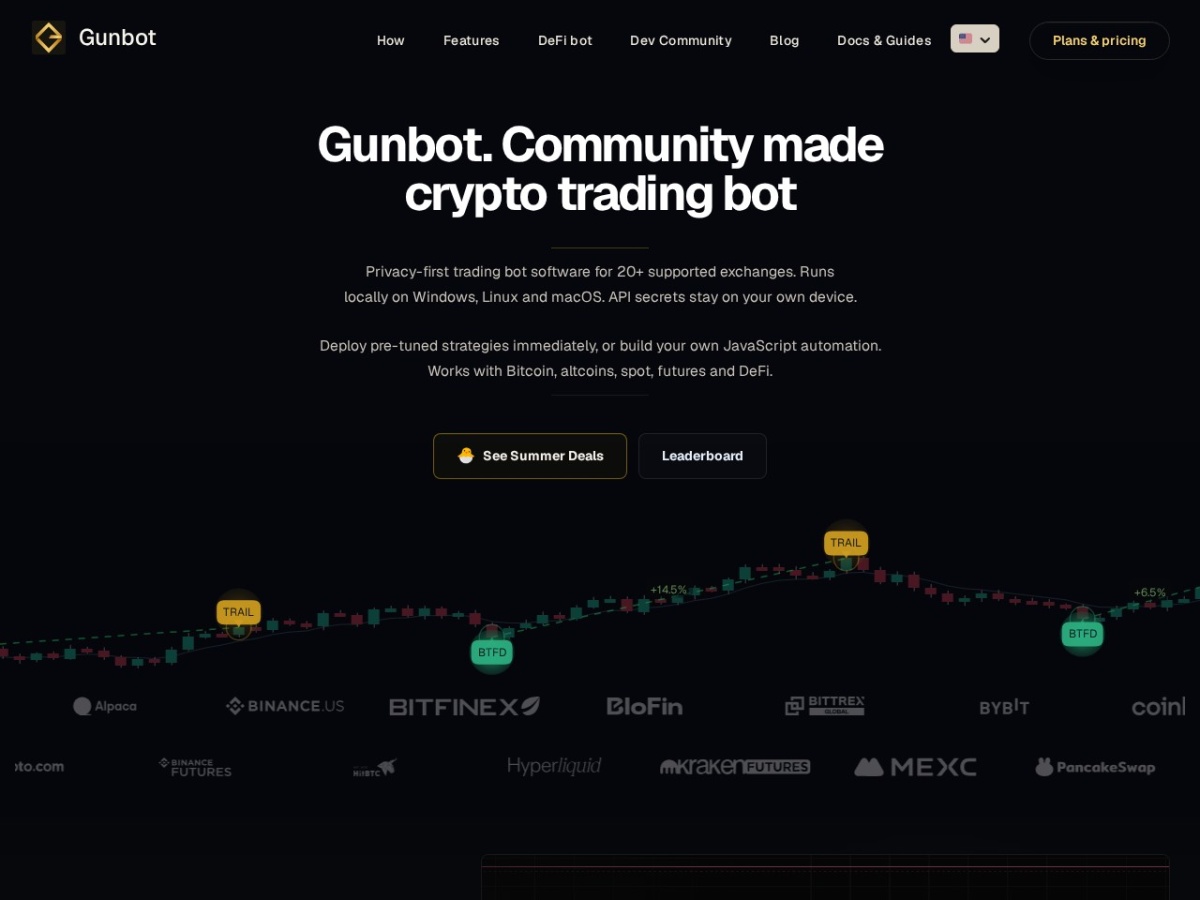
Gunbot is a self-hosted trading platform designed for developers who prioritize data privacy and local execution. Unlike cloud-based tools that store your API keys and strategy logic on their servers, this software runs on your own hardware or VPS, giving you total control over your trading environment.
Custom strategy development
The core of the platform is its custom JavaScript engine. While it includes pre-built strategies, the real value for bot builders lies in the ability to write bespoke code to handle complex market conditions. You can define specific entry and exit logic, integrate external data, and execute trades based on your own proprietary math. Because the environment is local, you don't face the latency or "black box" risks associated with shared web platforms.
Integrations and coverage
The software connects to over 100 exchanges, including major centralized platforms and various decentralized exchanges (DEXs). This broad connectivity is useful if you are looking to run arbitrage strategies across different liquidity pools or move between niche assets that aren't listed on primary exchanges. It uses a Node.js runtime to manage these connections, ensuring that the bot remains responsive even when monitoring dozens of pairs simultaneously.
Our case. When building bots for Polymarket’s 5-minute Bitcoin markets at polymtradebot.com, we found that execution speed and local control are the only ways to manage high-frequency risk effectively.
Pricing and plans
The pricing model follows a one-time lifetime license structure ranging from $199 to $499. This differs from the industry-standard monthly subscription, making it a predictable expense for long-term projects. Higher-tier licenses typically unlock more exchange slots and advanced features like the mobile app or specific DeFi integrations.
Who it's for
This tool is built for privacy-conscious developers who have the technical skill to manage their own server uptime. If you are comfortable with JavaScript and want to ensure your trading strategies never leave your local machine, it provides the necessary infrastructure without the recurring overhead of a SaaS platform. It is less a "plug-and-play" bot and more a professional framework for building your own financial tools.
6. Kryll.io

Kryll.io serves as a visual development environment for traders who want to build logic-heavy bots without writing Python or Javascript. It functions as a web-based "canvas" where you drag and drop functional blocks—such as price triggers, technical indicators, and Boolean operators—to define how a bot reacts to market shifts.
Visual logic and automation
The core of the platform is its "WYSIWYT" (What You See Is What You Trade) editor. Instead of managing syntax, you connect blocks that represent market conditions or actions. For example, you can link a Relative Strength Index (RSI) block to a "Wait" block, followed by a "Sell" block, creating a sequence that only executes when specific momentum thresholds are met. Because the execution is cloud-based, the bot runs 24/7 on Kryll’s infrastructure, removing the need for you to maintain a local server or a dedicated Raspberry Pi.
Strategy marketplace
If you prefer not to build from scratch, the platform includes a marketplace where community members share their tested strategies. You can browse these setups, view their historical performance logs, and rent the logic for your own use. This peer-to-peer exchange allows you to see how others handle complex risk management, such as trailing stop-losses or multi-level take-profits, which you can then adapt into your own visual flow.
Pay-per-use model
The pricing structure differs from standard monthly subscriptions. The platform is free to use for building and backtesting, but live execution requires KRL tokens. You pay based on the capital the bot manages; the platform consumes a small amount of KRL over time as the bot operates. This makes it accessible for testing small-scale ideas without committing to a flat $50 or $100 monthly fee.
Who it is for
This tool is specifically designed for non-coders who have a deep understanding of market technicals but lack the interest in manual coding. It bridges the gap between basic exchange "limit orders" and full-scale algorithmic trading. If your strategy requires "If-This-Then-That" logic—such as "If BTC drops 2% and volume spikes, then buy SOL"—Kryll allows you to map that flow visually in minutes.
Observation. In our practice building ready-to-use scripts for Polymarket trading, we’ve seen that while visual builders are excellent for standard exchange logic, high-speed 5-minute Bitcoin prediction markets often require the lower latency and specific API calls found in direct Python scripts.
7. Pionex
Pionex serves as a specialized cryptocurrency exchange that integrates automated trading tools directly into its interface, eliminating the need for external API configurations. It targets traders who want to deploy standard algorithmic strategies, such as grid trading or arbitrage, without managing a separate bot server or writing custom code.
Features and automation
The platform provides 16 built-in trading bots that operate natively on the exchange. The most common tool is the Grid Trading Bot, which profits from market volatility by placing a series of buy and sell orders within a defined price range. For those looking to capitalize on price discrepancies between markets, the Spot-Futures Arbitrage bot targets the funding rate, aiming for delta-neutral returns. Unlike custom scripts where you must define every parameter, these bots offer an AI-guided setup. This system suggests configurations based on 30-day backtested data, allowing you to launch a strategy by following historical performance trends rather than manual estimation.
Pricing and fees
Access to the automated tools is free, as the platform generates revenue through trading activity rather than subscriptions. Users pay a flat 0.05% trading fee on all transactions executed by the bots. This low-fee structure is specifically designed for high-frequency strategies where high turnover could otherwise erode profit margins. Because the bots are part of the exchange, there are no additional costs for third-party hosting or data feeds.
Who it is for
Pionex is built for beginners and cost-conscious traders who prefer a "set and forget" approach to standard strategies. It removes the technical barrier of connecting an exchange to a bot via API keys, which reduces the risk of configuration errors or security leaks. While it lacks the deep customization of a Python-based script, it provides a stable environment for executing proven mathematical models.
Observation. While Pionex is efficient for broad market volatility, we noticed that traders seeking high-frequency edges in prediction markets often require faster execution than general exchange bots provide. For 5-minute Bitcoin intervals on Polymarket, we find that dedicated scripts like ours offer the specific timing needed to capture rapid price shifts.
If your goal is to move beyond general grid trading and focus on specific prediction market outcomes, tools like the Polymtradebot provide the specialized logic required for binary "Up or Down" contracts that standard exchange bots cannot execute.
Conclusion
Building a bot for 5-minute Bitcoin markets requires a shift from general trend analysis to low-latency execution. While platforms like 3Commas or Cryptohopper work for long-term spot positions, they often lag when Polymarket prices shift in seconds. We found that success in these micro-intervals depends on how fast your script reacts to order book imbalances rather than just following RSI or MACD signals.
The tools listed provide a spectrum from plug-and-play SaaS to custom Python environments. If you want to skip the months of debugging API connections and slippage logic, using a specialized script like Polymtradebot allows you to focus on strategy refinement. It handles the execution and risk management for BTC, ETH, and SOL markets out of the box so you can start testing arbitrage theories in real-time.
Evaluate your technical capacity and choose a tool that matches your required timeframes. Deploy the Polymtradebot script to automate your 5-minute market strategies and minimize manual execution errors.
FAQ
What is the average cost of maintaining a self-hosted crypto prediction bot versus using a cloud-based SaaS platform?
Self-hosting costs roughly $10 to $40 monthly for a reliable VPS, whereas cloud-based SaaS platforms typically charge $50 to $100 for high-frequency features. While self-hosting requires manual security updates, it eliminates the "success tax" or volume-based fees common in subscription models. You also gain direct control over server location to reduce latency.
How do these tools handle API latency and slippage when executing high-frequency trades on prediction markets like Polymarket?
Most tools use WebSocket connections to stream real-time price data and execute orders within 100 to 300 milliseconds. To combat slippage, advanced scripts like Polymtradebot implement limit orders with specific offsets rather than market orders. This ensures you don't enter a "Bitcoin Up" position at a price that erases your potential profit margin.
Which programming languages and libraries are essential for customizing these prediction bot scripts for 5-minute market intervals?
Python is the standard choice due to libraries like Pandas for data manipulation and CCXT for connecting to multiple exchange APIs. For 5-minute intervals, you should also master the Web3.py library to interact directly with blockchain-based prediction markets. These tools allow you to calculate volatility and execute trades before the market window closes.