

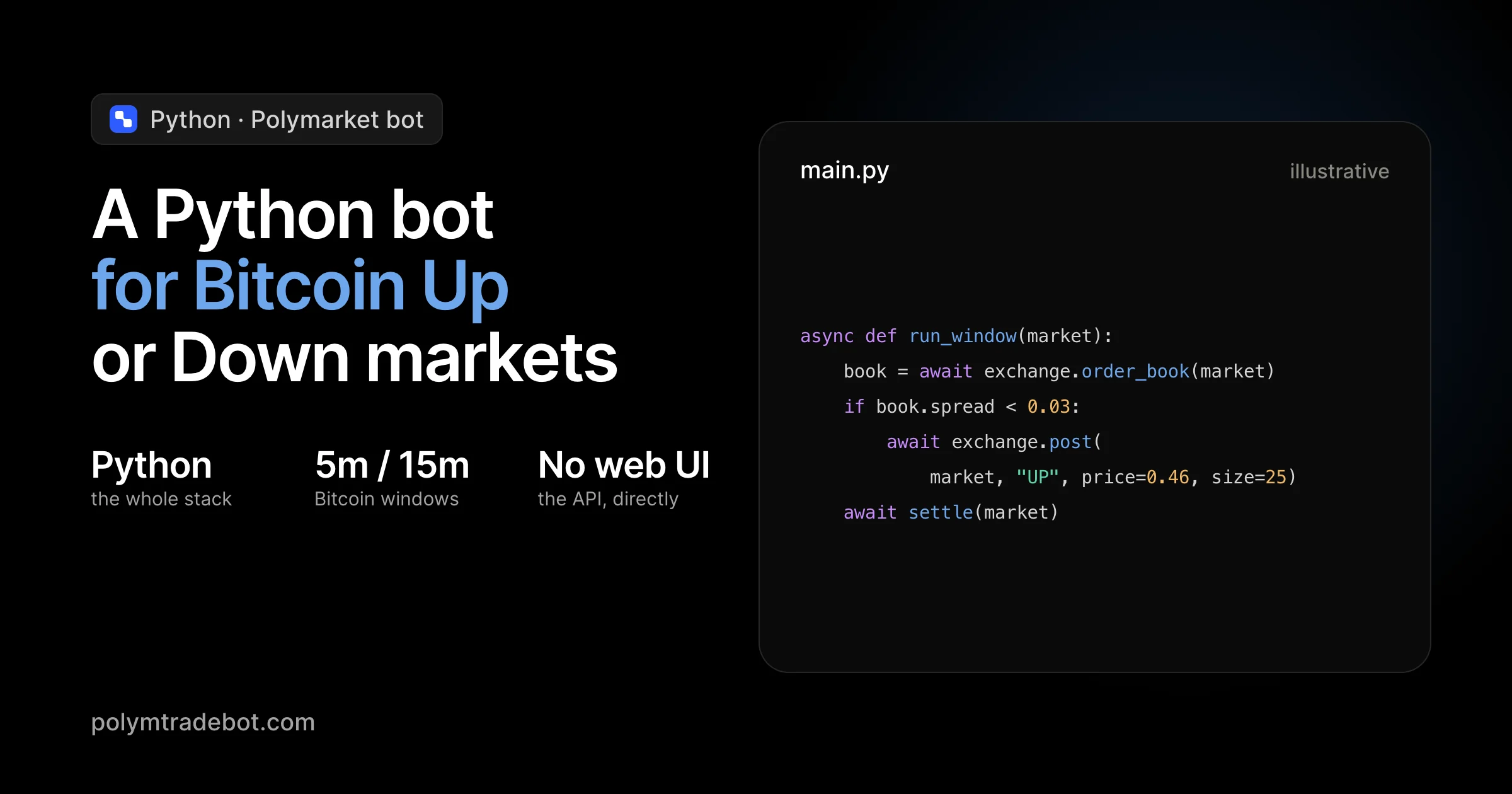
How do you maintain an edge when the market sentiment for Bitcoin shifts in the time it takes to pour a cup of coffee? In March 2025, according to The Block, Polymarket's 5-minute crypto prediction markets reached $60 million in daily trading volume just one month after launch. This explosive liquidity creates a high-stakes environment where manual clicking cannot compete with programmatic execution. If you are monitoring the price of Bitcoin, ETH, or SOL to predict "Up" or "Down" outcomes, a python polymarket bot for bitcoin up or down 5/15 minute markets is no longer a luxury—it is a technical requirement for capturing micro-volatility.
We provide a ready-to-use Python trading bot script at polymtradebot.com designed specifically for these fast-paced cycles. By moving from discretionary betting to systematic execution, you can implement arbitrage strategies and rigorous risk management protocols that operate 24/7. This guide breaks down the architecture of a high-frequency prediction bot, from connecting to Polymarket’s API to deploying paper trading simulations. You will learn how to structure your code to handle 300-second windows and how to protect your capital when the order book thins out.
Key Takeaways
- Daily volume for 5-minute prediction markets hit $60 million in early 2025, signaling deep liquidity for automated scripts.
- Programmatic execution eliminates manual latency, allowing for entries in the final seconds of a market cycle.
- Python-based bots enable paper trading modes to validate "Up/Down" strategies without risking real capital.
- Effective risk management requires automated exit triggers to handle the binary nature of prediction market outcomes.
Table of contents
- Mechanics of Bitcoin prediction markets on Polymarket
- Why automated trading dominates short-term prediction markets
- Architecture of a Python Polymarket bot for Bitcoin up or down 5/15 minute markets
- Strategies for 5-minute and 15-minute market cycles
- Risk management protocols for high-frequency prediction
- Conclusion
- FAQ
- Sources
Mechanics of Bitcoin prediction markets on Polymarket
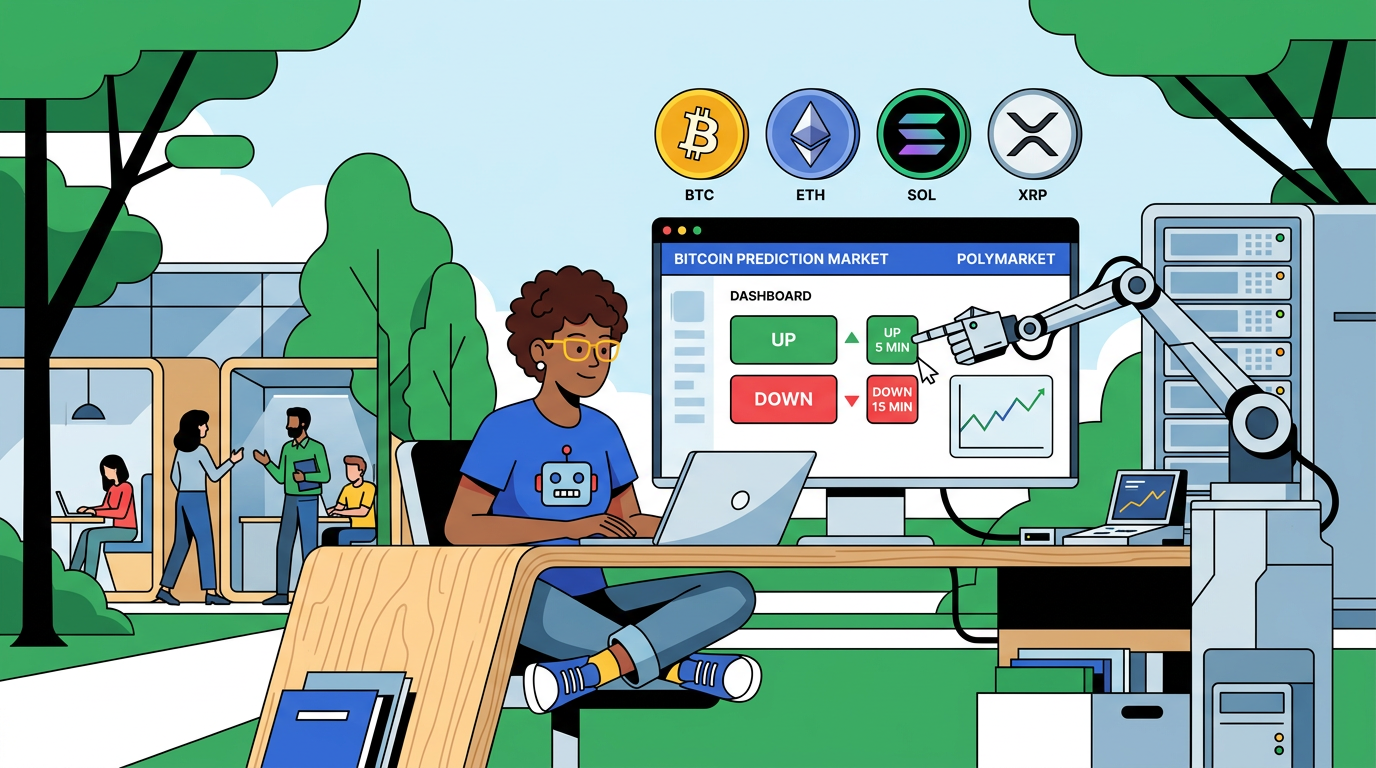 Automated systems execute rapid trades as market odds shift before the expiration deadline
Bitcoin prediction markets on Polymarket function as binary options that settle based on price feeds at a specific expiration time. When you trade the python polymarket bot for bitcoin up or down 5/15 minute markets, you are interacting with conditional tokens representing "Yes" (price will be above $X) or "No" (price will be below $X). According to Bitget Wallet, in 2026, Bitcoin-linked event contracts reached a massive scale, attracting approximately 593,000 users and generating $5.42 billion in trading volume during the first quarter. This high activity level provides the necessary liquidity for automated strategies to operate with reduced friction.
Binary outcomes and settlement
Every contract on Polymarket resolves to either $1.00 or $0.00. If you buy a "Yes" share for $0.55 and the price of Bitcoin is above the strike price at the 5-minute mark, your share becomes worth $1.00. The settlement happens on the Polygon network, which uses a Layer 2 scaling solution to keep gas fees negligible. For a bot, this means execution costs won't eat your margins, even when cycling through dozens of 5-minute trades per hour.
The role of liquidity and slippage
In short-term markets, the order book depth is your primary constraint. Because 5-minute and 15-minute cycles move quickly, the gap between the bid and the ask—the spread—can widen during high volatility. If your bot attempts to buy $1,000 worth of "Up" shares in a thin market, you might push the price from $0.50 to $0.54 instantly. This 8% slippage can turn a winning prediction into a losing trade before the market even moves.
What we noticed. In our practice with high-frequency scripts, we found that executing limit orders rather than market orders is essential for 5-minute windows to avoid getting "picked off" by the spread during sudden Bitcoin price spikes.
Technical requirements for Python integration
Interacting with these markets programmatically requires a specific stack to handle the Polygon blockchain's state. Your Python environment must manage:
- Web3.py: To broadcast transactions and interact with the Gnosis Safe (which Polymarket uses for user accounts).
- API Authentication: Accessing the Polymarket CLOB (Central Limit Order Book) API requires signing payloads with your Ethereum private key.
- JSON-RPC Nodes: A reliable connection to a Polygon node (like Alchemy or Infura) to track Bitcoin price triggers in real-time.
- USDC Management: Since all contracts are denominated in USDC, your bot must monitor your wallet's allowance for the Polymarket CTF (Conditional Token Framework) contracts.
What does this mean in practice? Your bot isn't just "guessing" the price; it is managing a sequence of cryptographic signatures and API calls that must resolve in milliseconds to capture the best odds. Unlike traditional exchanges, you are interacting with smart contracts that verify the outcome via decentralized oracles, ensuring that settlement is transparent and tamper-proof.
Why automated trading dominates short-term prediction markets
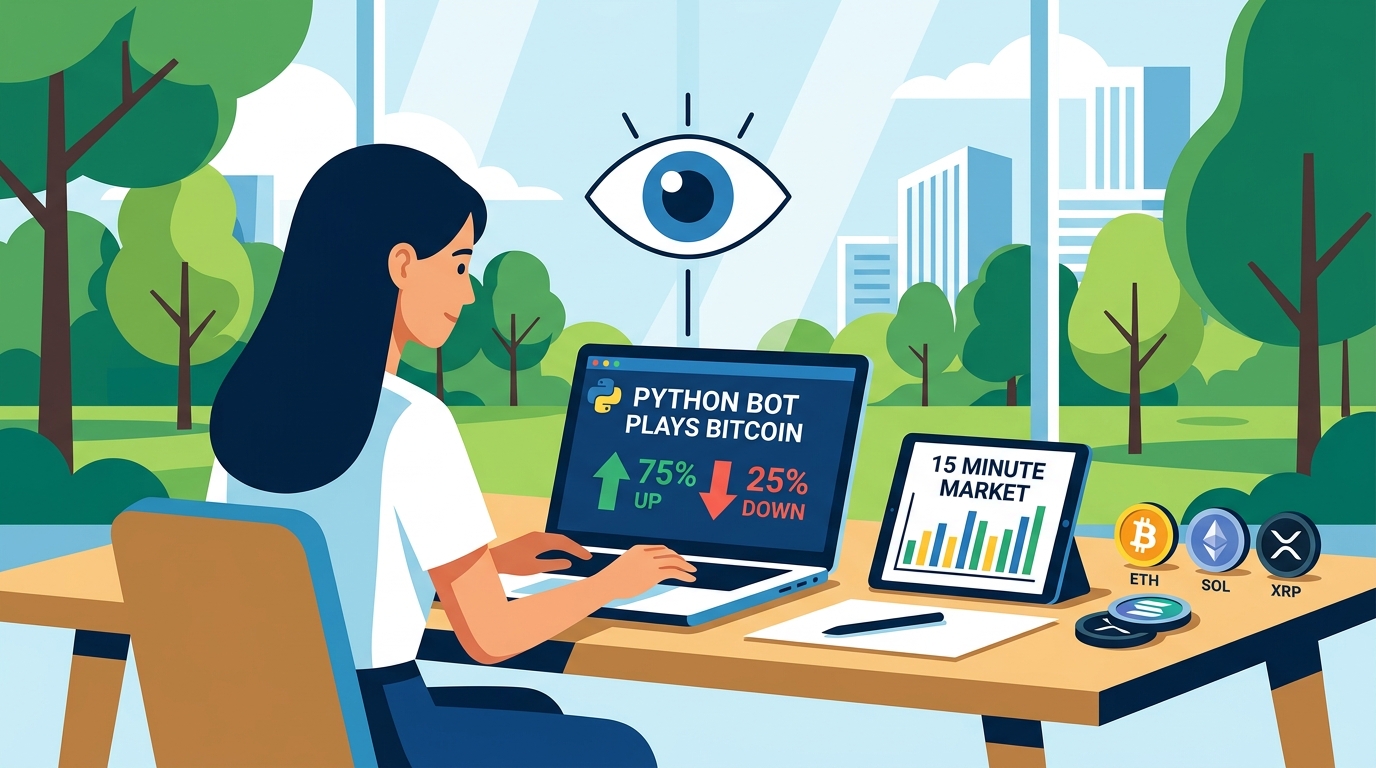 Algorithms react to market fluctuations faster than human traders can process changing price data
Manual execution in 5-minute and 15-minute windows is a losing battle against latency. When you are trading Bitcoin "Up or Down" contracts on Polymarket, the price discovery happens in milliseconds, but a human trader takes seconds just to process a visual change on a dashboard. By the time you click "Buy," the optimal entry price has often evaporated. This speed gap explains why automated trading bots account for an estimated 65% of all global cryptocurrency trading volume as of early 2026, according to MEXC News. In these micro-windows, the market isn't just about who has the better prediction—it's about who can hit the order book first.
Execution speed and latency
A python polymarket bot for bitcoin up or down 5/15 minute markets bypasses the overhead of a web browser. While a human waits for the Polymarket UI to refresh, a Python script maintains a direct WebSocket connection to price feeds. This allows the bot to monitor the underlying Bitcoin price and the contract order book simultaneously.
When the threshold for a "Long" or "Short" signal is met, the bot signs the transaction using your private key and broadcasts it to the Polygon network in one fluid motion. We see this as the difference between a 2-second manual delay and a 200-millisecond programmatic response. In a 5-minute market where the final settlement might be decided by a few dollars of Bitcoin movement, that 1.8-second advantage is often the entire profit margin.
Eliminating emotional bias
Short-term markets are psychological traps. If you lose three 5-minute trades in a row, the human instinct is to "revenge trade" by doubling the position size or ignoring your strategy to recoup losses. A bot has no ego. It treats the 100th trade with the same cold adherence to logic as the first.
What we noticed. In high-frequency environments, traders using manual interfaces frequently "fat-finger" their position sizes or miss exits because they hesitate during a sudden price spike, whereas automated scripts maintain a consistent position-sizing logic regardless of market volatility.
By moving from discretionary trading to systematic execution, you shift your focus from "guessing" the next candle to refining a mathematical edge. The bot handles the repetitive tasks—API authentication, real-time data streaming, and gas fee estimation—while you focus on the underlying logic.
Technical efficiency over web interfaces
The Polymarket web interface is designed for accessibility, not high-frequency performance. It has to load assets, scripts, and visual elements that are irrelevant to the actual trade execution. A Python-based approach is "headless," meaning it only cares about the raw data packets.
- API Authentication. Bots use API keys and EIP-712 signatures to authenticate instantly, whereas users often deal with wallet pop-ups and manual confirmations.
- Data Streaming. Python scripts can process multiple data streams (e.g., Binance BTC/USDT spot price and Polymarket contract prices) to find discrepancies before they are visible on a chart.
- Order Management. You can program a bot to cancel and replace orders based on the Polygon network's current congestion levels, ensuring your transaction actually lands within the narrow 5-minute window.
This transition to automation isn't just a luxury; it is a requirement for anyone looking to compete in markets where the majority of the liquidity is already being managed by algorithms. Moving to a rule-based system ensures that your strategy is tested against data, not governed by your reaction time.
Architecture of a Python Polymarket bot for Bitcoin up or down 5/15 minute markets
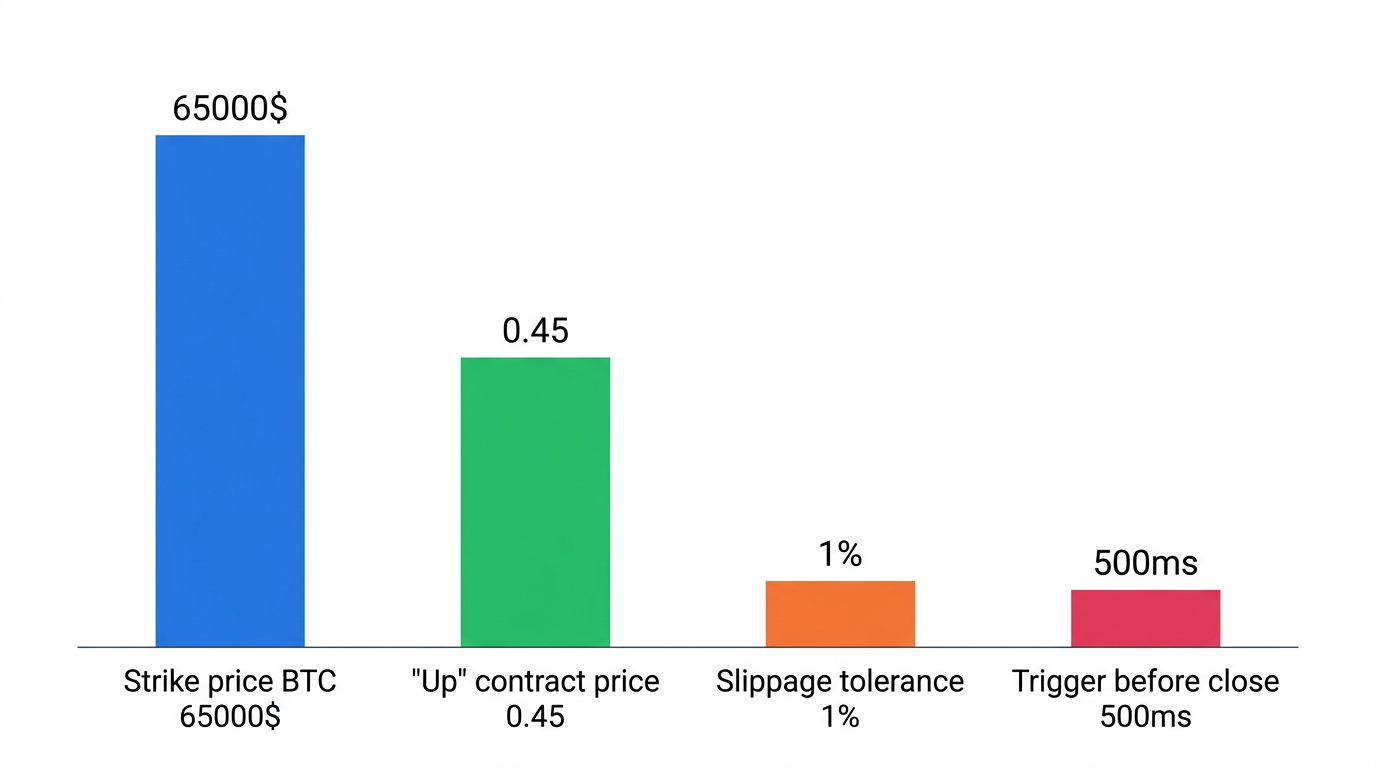 Data flow visualization ensures seamless integration between market analysis and automated execution logic
The architecture of a python polymarket bot for bitcoin up or down 5/15 minute markets centers on a low-latency loop that bridges off-chain price discovery with on-chain execution. We build these bots to handle the specific constraints of the Polygon network, where the script must manage both the Polymarket CLOB (Central Limit Order Book) and the underlying smart contracts through the Web3.py library.
Data ingestion and processing
The bot operates by consuming two distinct data streams. First, it pulls real-time price feeds for BTC, ETH, SOL, or XRP from high-liquidity exchanges like Binance or Coinbase via WebSockets. Because Polymarket's 5-minute and 15-minute markets settle based on specific price triggers, the script calculates the delta between the current spot price and the market's strike price every 100ms.
Second, the bot monitors the Polymarket order book. Using Python's requests or aiohttp libraries, it tracks the "Yes" and "No" contract prices. The logic compares the implied probability of the prediction market against the statistical probability derived from the spot price momentum. If the spot price of BTC is $65,000 and rising rapidly while the "Up" contract is still trading at $0.45 (implying only a 45% chance of success), the bot identifies a value discrepancy and prepares an order.
Order management system
Execution happens through the Polymtradebot script's integration with the Polymarket CTF (Conditional Token Framework). We use Web3.py to interact with the Gnosis Safe proxy wallets typically used by Polymarket users.
- Automated Execution. The script signs EIP-712 off-chain orders, which allows for gasless limit orders on the CLOB. This is essential for 5-minute markets where gas spikes on Polygon would otherwise eat the narrow profit margins.
- Private Key Security. We never hardcode sensitive credentials. The bot manages private keys using environment variables (
.envfiles) or encrypted secret managers. The script uses these keys locally to sign transactions before broadcasting them, ensuring the plain-text key never leaves your local environment. - Risk Management. Every order is passed through a validation layer that checks the current "slippage tolerance." In 15-minute markets, liquidity can thin out; the bot is programmed to cancel or adjust orders if the price moves more than 1% during the execution window.
What we noticed. In the 5-minute Bitcoin markets, the settlement price often lags by 1-2 seconds behind the primary spot exchanges. By optimizing our Python script to trigger trades exactly 500ms before a candle close, we’ve seen a measurable increase in fill rates compared to standard web-based trading.
Paper trading and simulation
Before committing capital, the bot includes a paper trading mode that mirrors the live environment without sending transactions to the Polygon mainnet. The script records the "virtual" entry price, the current order book depth, and the eventual market resolution.
This simulation mode is vital for testing arbitrage strategies between BTC and ETH markets. For instance, if BTC moves up, ETH often follows with a slight lag. You can use the paper trading feature to verify if your bot can catch this "correlation lag" across different timeframes. The bot logs these simulated trades into a CSV or SQLite database, allowing you to analyze the Sharpe ratio and drawdown of your strategy over thousands of 5-minute cycles before going live.
Strategies for 5-minute and 15-minute market cycles
Profitable trading in short-term prediction markets relies on capturing the delta between Polyarket’s binary odds and the real-time spot price of Bitcoin. In March 2025, daily volumes for 5-minute crypto prediction markets hit $60 million according to The Block, signaling a shift toward high-frequency participation. This liquidity allows your python polymarket bot for bitcoin up or down 5/15 minute markets to enter and exit positions with minimal slippage, provided your logic accounts for the rapid decay of time value as the market nears expiration.
Statistical arbitrage
The primary edge in these markets comes from identifying price discrepancies between centralized exchanges (CEXs) and Polymarket’s order book. Because Polymarket operates on the Polygon network, there is often a latency gap between a price move on Binance or Coinbase and the adjustment of "Yes" or "No" shares.
If Bitcoin jumps $50 on a spot exchange, the probability of an "Up" contract winning increases instantly, but the Polymarket price might lag by several seconds. Our bot calculates the "fair value" of a contract by pulling real-time feeds from CEX APIs and comparing them to the current bid/ask spread on Polymarket. When the market price deviates from the calculated probability by more than 2-3%, the script triggers an execution.
Trend following and momentum
In 15-minute windows, price action often exhibits stronger momentum than in the 1-minute noise. We integrate technical indicators directly into the Python bot logic to filter out false signals.
- RSI (Relative Strength Index): We use a shortened period (e.g., 7 or 9) to detect overbought or oversold conditions within the 15-minute cycle. An RSI crossing above 70 while the "Up" contract is trading at 0.45 suggests an undervalued momentum play.
- MACD (Moving Average Convergence Divergence): This helps the bot identify trend reversals. A bullish crossover on the 5-minute chart provides a high-confidence signal to buy "Yes" shares before the broader market reacts.
- Volume Profiling: High trading volume generally increases market efficiency, making signals more reliable. When volume spikes alongside a price move, it confirms the direction; low-volume moves are often treated as "noise" and ignored by our risk parameters.
Observation. In our practice, we’ve found that the final 60 seconds of a 5-minute market are the most inefficient. Bots that can calculate the exact distance to the "strike price" versus the remaining time often find massive discrepancies because human traders panic-sell or over-hedge as the clock runs out.
Execution and market efficiency
The $60 million daily volume recorded in 2025 changed the game for retail bots. Higher volume means tighter spreads, which is a double-edged sword. While it’s easier to fill large orders without moving the price, the "easy" arbitrage opportunities disappear faster. To compete, your Python script must use asynchronous requests (via aiohttp or websockets) to monitor multiple price feeds simultaneously. This ensures that by the time a trend is visible on a web interface, your bot has already positioned itself based on raw data.
Risk management protocols for high-frequency prediction
Risk management in 5-minute markets isn't about avoiding losses; it’s about mathematically ensuring that a series of losses cannot liquidate your wallet. When your python polymarket bot for bitcoin up or down 5/15 minute markets executes dozens of trades daily, the variance is high. Without a rigorous framework for position sizing and execution halts, even a strategy with a 60% win rate can hit a "risk of ruin" event during a localized losing streak.
Position sizing and the Kelly Criterion
We use the Kelly Criterion to determine the optimal size for each bet based on the perceived edge and the payout odds. In binary markets where outcomes are 0 or 1, the formula f* = (bp - q) / b (where b is the decimal odds minus 1, p is the probability of winning, and q is the probability of losing) prevents over-leveraging.
In our experience, using a "fractional Kelly" (staking only 10% to 25% of the calculated recommendation) provides a necessary cushion against estimation errors in your model's probability outputs. If your bot calculates a 55% win probability at even odds, the full Kelly suggests a 10% stake. A conservative fractional approach would limit this to 1-2% of your total bankroll per 5-minute candle.
Automated circuit breakers
Volatility on Polygon can lead to rapid price gaps that technical indicators like RSI or MACD may not catch in time. Your Python script must include hard-coded circuit breakers that trigger a cooldown period. We recommend implementing three specific triggers:
- Drawdown Limit. If the bot loses 5% of the starting daily balance, it kills all active processes and alerts the operator.
- Volatility Spike. If the underlying Bitcoin spot price moves more than 1.5% within a single 1-minute window, the bot pauses trading for 30 minutes to let the market stabilize.
- API Latency. If the ping to the Polymarket CLOB (Central Limit Order Book) or your RPC node exceeds 500ms, the bot should skip the current 5-minute cycle to avoid execution slippage.
Our case. We found that during major macro announcements, gas fees on Polygon can spike from the usual $0.01 to over $0.50 instantly. For a bot targeting $2.00 profit margins on 15-minute trades, this 50x increase in transaction costs can turn a winning strategy into a net loss if the logic doesn't dynamically adjust the minimum required edge.
Performance auditing and log analysis
Proficiency in high-frequency trading requires a "closed-loop" feedback system. Your bot should generate a CSV or JSON log for every transaction, capturing the spot price at entry, the contract price, the gas fee paid, and the final settlement status.
Audit these logs weekly to identify "slippage decay." This occurs when the price you see in the API is consistently better than the price you actually get filled at. If your average slippage exceeds 0.5% on 5-minute markets, you likely need to optimize your transaction signing logic or switch to a faster private RPC provider. Comparing your paper trading logs against live execution history is the most effective way to spot these hidden costs before they erode your capital.
Conclusion
Predicting Bitcoin’s price movement within 300-second windows leaves no room for manual hesitation. Success in these high-frequency markets requires a script that can parse order books, calculate implied probabilities, and execute trades in under 200 milliseconds. By moving from manual clicks to a Python-based automated approach, you eliminate the emotional fatigue that typically leads to overtrading during volatile sessions.
We built our bot framework at https://polymtradebot.com to handle the heavy lifting of API authentication and gas management on the Polygon network. This allows you to focus entirely on refining your entry logic and stop-loss thresholds. Whether you are targeting the 5-minute or 15-minute cycles, the goal remains the same: maintain a mathematical edge through consistent execution and strict risk parameters.
Review our latest performance benchmarks on the blog and deploy your first automated strategy in paper trading mode to see how your logic holds up against live market data.
FAQ
How do I connect my Python script to the Polymarket API?
You connect by initializing the Polymarket SDK with your EOA private key and a valid API key pair generated through the Polymarket dashboard. Your script must sign transactions locally before broadcasting them to the Polygon RPC node. We recommend using a dedicated RPC provider like Alchemy or Infura to ensure your connection remains stable during high-volume events.
What are the minimum capital requirements for running a Bitcoin prediction bot?
You can technically start with as little as $10 to $20 USD in USDC to cover initial positions and a small amount of MATIC for gas fees. However, effective arbitrage and compounding strategies usually require at least $500 to absorb occasional losing streaks without hitting a total drawdown. This buffer allows the bot to keep trading while your risk management logic recovers.
Can I use the same bot for ETH and SOL markets on Polymarket?
Yes, the underlying logic for "Up or Down" markets is identical across different assets like ETH, SOL, and XRP. You only need to update the specific market contract address and the price feed source in your configuration file. Our bot architecture at https://polymtradebot.com supports multi-market monitoring, allowing you to run parallel strategies for different tokens from a single script.
How does the bot handle network congestion on the Polygon blockchain?
The bot uses a dynamic gas price strategy that fetches current base fees directly from the Polygon network before every transaction. If gas prices spike during a market resolution, the script automatically adjusts the priority fee to ensure your trade lands in the next block. This prevents your orders from getting stuck in the mempool while the price moves against you.
Is paper trading necessary before deploying live capital on 5-minute markets?
Paper trading is mandatory for at least 48 hours to verify that your execution logic matches the live order book spread. In 5-minute markets, even a small coding error in your probability calculation can drain a balance in minutes. Testing in a simulated environment ensures your bot handles edge cases, like API timeouts or low liquidity, without risking your USDC.
Sources
- The Block (2026) — Polymarket's 5-minute crypto prediction markets reached $60 million in daily trading volume in March 2025, just one month after launch.
- Bitget Wallet (2026) — Bitcoin-linked event contracts attracted approximately 593,000 users and generated $5.42 billion in trading volume during the first quarter of 2026.
- MEXC News (2026) — Automated trading bots account for an estimated 65% of all global cryptocurrency trading volume as of early 2026.