

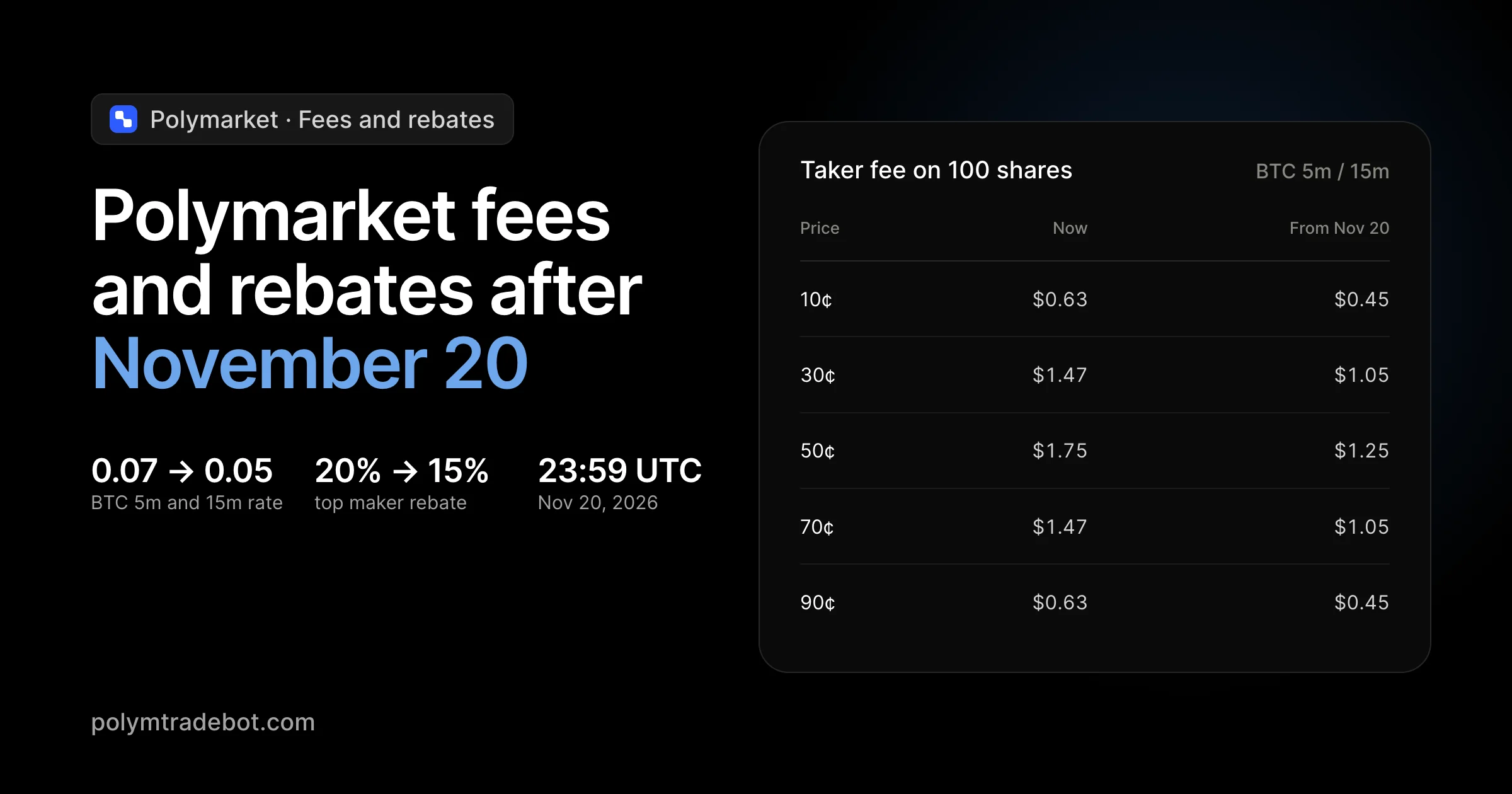
Polymarket charges only takers, at match time, with one formula: fee = shares × rate × price × (1 − price). Makers pay nothing, deposits and withdrawals cost nothing on Polymarket's side, and geopolitics markets are free. On November 20, 2026 at 23:59 UTC the rates and both rebate programs change. The Bitcoin 5- and 15-minute markets drop from 0.07 to 0.05, the other crypto markets from 0.07 to 0.01, and the 20% maker rebate pool is replaced by volume tiers that pay nothing below $200,000 of 30-day weighted volume. Lower fees sound like good news, and for most traders they are. We replayed four weeks of real trading under the new schedule to see who pays for it.
The replay uses the data from our study of 2,500 Polymarket bots: every fill of the Bitcoin Up or Down 5- and 15-minute markets from September 6 to October 3, 2026, 14.6 million trades from 53,321 wallets. Same trades, same prices, two fee schedules. Below: the formula, every category's old and new rate, how both rebate programs work before and after, what the change does to each kind of trader, and Python to compute your own fees. It is also the arithmetic our Polymarket trading bot runs before every order. Last updated November 19, 2026.
Key takeaways
- One formula covers every market:
shares × rate × price × (1 − price). The fee in dollars peaks at 50¢ and falls toward 0¢ and $1. - Bitcoin 5- and 15-minute markets: the peak fee falls from 1.75¢ to 1.25¢ per share, and the break-even at 50¢ from 51.75% to 51.25%.
- Every other crypto market, including hourly, 4-hour and daily, falls to 0.01, one seventh of today's fee. Finance, tech and election markets go up from 0.04 to 0.05.
- Maker rebates shrink. Today makers share 20% of crypto taker fees; from November 20 they get 3% to 15% of the fees their fills generate, and nothing below $200,000 of 30-day weighted volume.
- Taker rebates lose their bottom two tiers. Under $200,000 of weighted volume a taker earns no rebate, and crypto loses its 2.3× weight, so the same trading counts for less.
- In the replay traders pay $1.31 million less in fees and get $1.50 million less in rebates. 88% of wallets come out ahead, Polymarket keeps 7% more, and the bots that fill as makers lose most.
Table of contents
- How Polymarket fees work
- Polymarket fees by category, before and after November 20
- What a trade costs: fee tables and break-even
- Maker rebates: from a daily pool to tiers
- Taker rebates: fewer tiers, no category weights
- What the change does to real trading
- What to change in your strategy or bot
- Polymarket fee calculator in Python
- FAQ
- Methodology and sources
How Polymarket fees work
Every Polymarket market has two kinds of order. A taker order fills right away against an order already in the book: a market order, or a limit order priced to cross the spread. A maker order rests in the book until someone else trades against it. Only takers pay.
The fee is set by the protocol when the trade matches, so you do not put it in the order:
fee = C × feeRate × p × (1 − p)
C is the number of shares, p is the price of the share in dollars, and feeRate is a coefficient set per market category. The fee is rounded to five decimal places, with 0.00001 pUSD the smallest fee charged, so very small trades near 0¢ or $1 can pay nothing at all.
The p × (1 − p) term is what makes Polymarket fees unusual. It is largest at 50¢ and shrinks toward both ends, so the fee in dollars is the same at 30¢ as at 70¢. As a share of the money you put in it is feeRate × (1 − p), which means cheap long shots pay the most per dollar and near-certain favorites the least. On today's crypto rate, a 10¢ share costs 6.3% of the stake in fees and a 90¢ share 0.7%.
Some things cost nothing on Polymarket's side:
- Maker fills. Makers are never charged.
- Deposits and withdrawals. Polymarket charges nothing; an exchange, card provider or bridge you use on the way may.
- Geopolitics and world events markets. Fee-free before and after November 20.
- Settlement. The published schedule charges taker fills at match time. It lists no fee on redeeming winning shares.
Combos (multi-leg bets) have their own rate of 0.05, whatever their legs are.
Polymarket fees by category, before and after November 20
The changes apply to Polymarket.com, which Polymarket calls Polymarket DeFi, from November 20, 2026 at 23:59 UTC. Polymarket US, the separately regulated app, has its own schedule and is not covered here.
| Category | Fee rate now | From Nov 20 | Change | Peak fee per 100 shares now → Nov 20 |
|---|---|---|---|---|
| Crypto: BTC 5-minute and 15-minute Up or Down | 0.07 | 0.05 | −29% | $1.75 → $1.25 |
| Crypto: all other markets | 0.07 | 0.01 | −86% | $1.75 → $0.25 |
| Sports | 0.05 | 0.05 | none | $1.25 → $1.25 |
| Finance | 0.04 | 0.05 | +25% | $1.00 → $1.25 |
| Tech | 0.04 | 0.05 | +25% | $1.00 → $1.25 |
| Politics: elections | 0.04 | 0.05 | +25% | $1.00 → $1.25 |
| Politics: other, except geopolitics | 0.04 | 0.01 | −75% | $1.00 → $0.25 |
| Economics | 0.05 | 0.01 | −80% | $1.25 → $0.25 |
| Culture | 0.05 | 0.01 | −80% | $1.25 → $0.25 |
| Weather | 0.05 | 0.01 | −80% | $1.25 → $0.25 |
| Mentions | 0.04 | 0.01 | −75% | $1.00 → $0.25 |
| Other / General | 0.05 | 0.05 | none | $1.25 → $1.25 |
| Combos | 0.05 | 0.05 | none | $1.25 → $1.25 |
| Geopolitics | 0 | 0 | free | $0 → $0 |
The peak is the fee on 100 shares bought at 50¢, a $50 trade. A rate is a coefficient in the formula, not a percentage of the trade: 0.05 means 2.5% of the stake at 50¢, not 5%.
Three things stand out. The Bitcoin 5- and 15-minute markets, where most of the fast trading happens, get a modest cut, while every other crypto market becomes nearly free. Economics, culture, weather and mentions markets drop to the same 0.01. And three categories get more expensive: finance, tech and election markets. If you trade elections as a taker, your fees go up by a quarter.
To check the rate of a specific market rather than rely on a table, read its feeSchedule from the market data; the Python section shows how.
What a trade costs: fee tables and break-even
For the Bitcoin 5- and 15-minute markets, here is the fee on 100 shares and the win rate a taker needs just to break even:
| Price | Trade value | Fee now (0.07) | Fee from Nov 20 (0.05) | Fee as % of stake, now → Nov 20 | Break-even win rate, now → Nov 20 |
|---|---|---|---|---|---|
| 5¢ | $5 | $0.33 | $0.24 | 6.65% → 4.75% | 5.33% → 5.24% |
| 10¢ | $10 | $0.63 | $0.45 | 6.30% → 4.50% | 10.63% → 10.45% |
| 20¢ | $20 | $1.12 | $0.80 | 5.60% → 4.00% | 21.12% → 20.80% |
| 30¢ | $30 | $1.47 | $1.05 | 4.90% → 3.50% | 31.47% → 31.05% |
| 40¢ | $40 | $1.68 | $1.20 | 4.20% → 3.00% | 41.68% → 41.20% |
| 50¢ | $50 | $1.75 | $1.25 | 3.50% → 2.50% | 51.75% → 51.25% |
| 60¢ | $60 | $1.68 | $1.20 | 2.80% → 2.00% | 61.68% → 61.20% |
| 70¢ | $70 | $1.47 | $1.05 | 2.10% → 1.50% | 71.47% → 71.05% |
| 80¢ | $80 | $1.12 | $0.80 | 1.40% → 1.00% | 81.12% → 80.80% |
| 90¢ | $90 | $0.63 | $0.45 | 0.70% → 0.50% | 90.63% → 90.45% |
| 95¢ | $95 | $0.33 | $0.24 | 0.35% → 0.25% | 95.33% → 95.24% |
| 99¢ | $99 | $0.07 | $0.05 | 0.07% → 0.05% | 99.07% → 99.05% |
The break-even is the price plus the fee per share: a taker who pays 50¢ plus 1.25¢ needs the share to pay out more than 51.25% of the time. A maker filled at the same price needs only 50%.
A $100 example. At 50¢, $100 buys 200 shares. Today the fee is 200 × 0.07 × 0.5 × 0.5 = $3.50; from November 20 it is $2.50. In an hourly or daily Bitcoin market it falls to $0.50.
The cut matters most in the middle of the price range, which is where a coin-flip window opens. It matters very little to the late-favorite trade, buying the obvious winner at 95 to 99¢: the fee there was already a fraction of a cent, and the risk is the one loss that wipes out dozens of wins, not the fee. Our 15-minute strategy study works through that trade with real win rates.
Maker rebates: from a daily pool to tiers
Taker fees fund a rebate to the makers whose orders were hit. The rebate is what has made quoting in these markets profitable for many bots, and it is the part of the schedule that changes most.
Until November 20. Every day Polymarket puts a share of each market's taker fees into a pool: 20% in crypto, 15% in sports and 25% in the other fee-enabled categories. The pool is split among that market's makers by fee-equivalent, the fee their fills would have paid as takers: C × feeRate × p × (1 − p). You compete only with the other makers in the same market, any maker with a fill gets a share, and payouts are made daily in pUSD once you have accrued at least $1. Across a market, the makers' fee-equivalents add up to the taker fees, so a maker's rebate works out to about 20% of its own fee-equivalent in crypto. A 100-share maker fill at 50¢ in a Bitcoin market earns about 35¢.
From November 20. The pool is gone. Each maker fill earns a fixed percentage of the taker fee it generates, set by your maker weighted volume over the last 30 days:
| Maker tier | 30-day maker weighted volume | Rebate on the taker fees your fills generate | Rebate on a 100-share fill at 50¢ (BTC 5m/15m) |
|---|---|---|---|
| None | Under $200,000 | 0% | $0 |
| Tier 1 | $200,000 to $1 million | 3% | $0.04 |
| Tier 2 | $1 million to $4 million | 7% | $0.09 |
| Tier 3 | $4 million to $10 million | 10% | $0.13 |
| Tier 4 | $10 million and up | 15% | $0.19 |
Weighted volume is shares × price × (1 − price) summed over your maker fills; maker fills count only toward the maker tier. $200,000 of it is roughly $400,000 a month of maker fills at prices near 50¢, and far more if you quote near the extremes: each dollar of fills at 90¢ adds only 10¢ of weighted volume, so it takes about $2 million.
Put the two schedules side by side and the cut is steep. The same 100-share fill at 50¢ that earns about 35¢ today earns 19¢ at the top tier, 4¢ at Tier 1 and nothing below $200,000. In our four weeks of data only 73 of the 53,321 wallets would have reached any maker tier, and none reached Tier 3 or 4. Those 73 wallets did 62% of the maker fee-equivalent, so the change does not wipe out the market makers who matter most; it ends the rebate for everyone smaller. Combos and fee-free trades earn no maker rebate, and the separate liquidity rewards program stays as it is.
Taker rebates: fewer tiers, no category weights
High-volume takers also get part of their fees back, on a ladder set by 30-day taker weighted volume. Only taker fills that pay a fee count toward the taker tier.
| Tier | 30-day taker weighted volume | Rebate now | Rebate from Nov 20 |
|---|---|---|---|
| None | Under $2,000 | 0% | 0% |
| Bronze | $2,000 | 3% | removed: 0% |
| Silver | $20,000 | 8% | removed: 0% |
| Gold | $200,000 | 18% | 10% |
| Platinum | $1 million | 32% | 25% |
| Diamond | $4 million | 44% | 40% |
| Obsidian | $10 million | 50% | 50% (up to $75 million) |
| Onyx (new) | $75 million and up | none | 60% |
Two changes sit under the table.
The definition of weighted volume changes. Today it is trade size × (1 − entry price) × category weight, with crypto weighted 2.3, economics, culture and weather 1.7, politics, finance, mentions and tech 1.3, and sports 1.0. From November 20 it is shares × price × (1 − price) in every category. Trade size times (1 − price) is the same thing as shares × price × (1 − price), so the only difference is the weight. A crypto trader who sits exactly on the Gold threshold today will have 2.3 times less weighted volume tomorrow for the same trading, and drops to no tier at all. Polymarket's own note warns that your tier may change even if you trade the same amount.
The small tiers and the bonuses go away. Bronze and Silver are removed, so a taker below $200,000 of weighted volume gets nothing back. The one-time level-up bonuses, $10 for Bronze up to $25,000 for Obsidian, end.
Rebates under both programs are paid daily at midnight UTC in pUSD, with a $1 minimum.
What the change does to real trading
To see the effect on actual trading rather than on a single 100-share fill, we took the 28 days of fills from our bot study and charged them twice: once under the current schedule and once under the November schedule. The trades, prices and outcomes are identical, so the difference is the fee schedule alone. Tiers are worked out from each wallet's weighted volume in these markets, scaled from 28 to 30 days.
| Current schedule | From November 20 | Change | |
|---|---|---|---|
| Taker fees paid | $4,600,905 | $3,286,361 | −$1,314,544 |
| Maker rebates | $919,932 | $96,554 | −$823,378 |
| Taker rebates | $845,878 | $167,599 | −$678,279 |
| Kept by Polymarket (fees minus rebates) | $2,835,095 | $3,022,208 | +$187,113 |
| Wallets in profit after fees and rebates | 25.7% | 26.8% | +1.1 points |
| Wallets better off under the new schedule | 88.5% |
Fees fall by $1.31 million and rebates by $1.50 million, so as a whole the traders end up $187,000 worse off and Polymarket keeps 7% more. Yet 88.5% of the wallets come out ahead. Both are true because the fees were paid by everyone and the rebates went to a few. Most wallets never earned a meaningful rebate, so for them the change is simply a 29% fee cut. The losses are concentrated in the wallets that lived on rebates.
By group, using the same definitions as the bot study:
| Group | Wallets | Result now | Result from Nov 20 | In profit now → Nov 20 | Median now → Nov 20 |
|---|---|---|---|---|---|
| Always-on bots | 2,500 | +$190,394 | −$386,763 | 32% → 33% | −$59 → −$53 |
| Regular traders | 7,398 | −$2,014,441 | −$1,757,620 | 23% → 25% | −$48 → −$40 |
| Occasional traders | 43,423 | −$1,011,047 | −$877,825 | 26% → 27% | −$4 → −$4 |
The bots as a group go from a small profit to a $387,000 loss over four weeks, while the typical bot does slightly better. The split is clearest when the bots are sorted by how they fill:
| Bots by share of volume filled as taker | Bots | In profit now → Nov 20 | Result now → Nov 20 | Maker rebates now → Nov 20 |
|---|---|---|---|---|
| Under 10% (makers) | 608 | 48.5% → 40.1% | +$444,292 → −$14,370 | $523,041 → $59,736 |
| 10% to 50% | 299 | 34.4% → 30.1% | +$467,245 → +$290,473 | $214,926 → $28,993 |
| 50% to 90% | 466 | 22.1% → 24.7% | +$10,901 → −$47,199 | $68,697 → $6,974 |
| Over 90% (takers) | 1,127 | 26.3% → 32.5% | −$732,045 → −$615,667 | $4,359 → $0 |
In the bot study the makers were the bots most likely to make money: 49% were in profit against 26% of the pure takers. Under the new schedule that gap nearly closes, 40% against 33%. The makers' rebates fall by nine tenths, and as a group the 608 maker bots go from $444,000 of profit to a small loss. The pure takers pay 29% less in fees and gain the most.
Among the ten most profitable bots, all ten stay in profit. The one that loses most is a wallet that traded $13.7 million and lost money before rebates: it goes from +$50,857 to +$19,540. Our own account in the same data, 0xc533...69a9, mostly a taker, goes from +$78,146 to +$72,010: it pays less in fees and gets back less in taker rebates.
Read the replay as an estimate of the first-order effect, not a forecast. Nobody trades the same way after the rules change. Makers who lose their rebate will quote wider or stop quoting, which makes the spread more expensive for the takers who just got a fee cut, and some trading will move to the crypto markets that now cost 0.01. Where a wallet also trades elsewhere on Polymarket its real tier can be higher than these markets alone show; counting its fees in other markets as well barely moves the totals (the bots finish at −$361,370 instead of −$386,763).
What to change in your strategy or bot
If you take liquidity in the Bitcoin 5- and 15-minute markets, your costs fall by 29%. A strategy that needed a 51.75% hit rate at 50¢ now needs 51.25%, and an edge of a cent or two per share, like the lead-pricing strategies in our 5-minute and 15-minute studies, becomes easier to clear. Recompute your minimum edge with 0.05 rather than assuming the old buffer.
If you quote as a maker, the rebate is no longer a reliable part of your income. Below $200,000 of 30-day maker weighted volume it is zero, and above it it is less than half of what the pool pays today. A quoting strategy has to make money on the spread and on getting the direction right, with any rebate as a bonus. Work out where your weighted volume puts you before you count on a tier.
If you trade other crypto markets, economics, culture, weather or mentions, taker fees fall to 0.01, a quarter of a cent per share at 50¢. Strategies that were not worth running at 0.07 may be now. The maker rebate in those markets is small for the same reason: a percentage of a small fee.
If you trade elections, finance or tech as a taker, your fees rise by a quarter. Recheck your break-even.
If you run a bot, do not hard-code a fee rate. Read each market's feeSchedule before computing an edge, because the rate now depends on the market as well as the category: two crypto markets can carry 0.05 and 0.01. Check that your profit and loss tracking does not assume a 20% maker rebate or a Bronze or Silver taker rebate that no longer exists.
If you are watching a bot's record, results before November 20 were earned under a richer rebate schedule. A maker bot that was profitable in October may not be in December. Our guide on checking whether a Polymarket bot works shows how to read a wallet's real result.
Polymarket fee calculator in Python
The fee, the break-even and an estimate of the rebate, using the November schedule:
# Polymarket fee schedule from November 20, 2026, 23:59 UTC.
FEE_RATES = {
    "crypto_btc_5m_15m": 0.05,
    "crypto_other": 0.01,
    "sports": 0.05,
    "finance": 0.05,
    "tech": 0.05,
    "politics_elections": 0.05,
    "politics_other": 0.01,
    "economics": 0.01,
    "culture": 0.01,
    "weather": 0.01,
    "mentions": 0.01,
    "other": 0.05,
    "combos": 0.05,
    "geopolitics": 0.0,
}

# (threshold of 30-day weighted volume, rebate rate)
MAKER_TIERS = [(10_000_000, 0.15), (4_000_000, 0.10), (1_000_000, 0.07), (200_000, 0.03)]
TAKER_TIERS = [(75_000_000, 0.60), (10_000_000, 0.50), (4_000_000, 0.40),
               (1_000_000, 0.25), (200_000, 0.10)]


def taker_fee(shares, price, rate):
    """Fee in dollars, charged to the taker at match time."""
    return round(shares * rate * price * (1 - price), 5)


def break_even(price, rate):
    """Win rate a taker needs at this price to break even."""
    return price + rate * price * (1 - price)


def weighted_volume(shares, price):
    """What one fill adds to your 30-day weighted volume."""
    return shares * price * (1 - price)


def tier_rate(weighted_volume_30d, tiers):
    for threshold, rate in tiers:
        if weighted_volume_30d >= threshold:
            return rate
    return 0.0


def maker_rebate(shares, price, rate, maker_wv_30d):
    """Rebate on one maker fill: your tier's share of the taker fee it generates."""
    return tier_rate(maker_wv_30d, MAKER_TIERS) * taker_fee(shares, price, rate)


rate = FEE_RATES["crypto_btc_5m_15m"]
print(taker_fee(200, 0.50, rate))              # 2.5    -> $2.50 on a $100 buy at 50c
print(f"{break_even(0.50, rate):.2%}")          # 51.25%
print(maker_rebate(100, 0.50, rate, 150_000))   # 0.0    -> below $200,000, no rebate
print(maker_rebate(100, 0.50, rate, 2_000_000)) # 0.0875 -> Tier 2, 7%
Hard-coded rates go stale, as this change shows. In a bot, take the rate from the market itself:
import time
import requests

start = int(time.time()) // 900 * 900          # the 15-minute window open now
slug = f"btc-updown-15m-{start}"
event = requests.get("https://gamma-api.polymarket.com/events",
                     params={"slug": slug}, timeout=10).json()[0]
fees = event["markets"][0]["feeSchedule"]
print(slug, fees["rate"], fees["rebateRate"])  # before Nov 20: 0.07 0.2
rate is the coefficient in the fee formula. rebateRate is the maker pool share under the current schedule; after November 20 the maker rebate depends on your tier instead, so check how the field is filled once the new schedule is live.
To reconcile the maker rebates you were actually paid for a day, the CLOB has a public endpoint:
curl -G "https://clob.polymarket.com/rebates/current" \
  --data-urlencode "date=2026-11-21" \
  --data-urlencode "maker_address=0xYourMakerAddress"
It returns one row per market with rebated_fees_usdc, or null if there is nothing for that date.
FAQ
What fees does Polymarket charge?
Only takers pay, at match time: shares × rate × price × (1 − price). The rate depends on the market. From November 20, 2026 it is 0.05 for the Bitcoin 5- and 15-minute markets, sports, finance, tech, election and general markets, 0.01 for other crypto, non-election politics, economics, culture, weather and mentions, and 0 for geopolitics. Makers pay nothing, and Polymarket charges nothing to deposit or withdraw.
How much is the Polymarket fee on a $100 trade?
It depends on the price. At 50¢, $100 buys 200 shares and the fee in a Bitcoin 5- or 15-minute market is $3.50 today and $2.50 from November 20. At 90¢ the same $100 pays $0.70 today and $0.50 after. In other crypto markets from November 20 it is $0.50 at 50¢.
Does Polymarket charge makers?
No. A resting limit order that someone else fills pays no fee. Makers can earn a rebate funded by taker fees: today a share of a 20% pool in crypto, and from November 20 between 3% and 15% of the taker fees their fills generate, once their 30-day maker weighted volume reaches $200,000.
What changes in Polymarket fees on November 20, 2026?
At 23:59 UTC the fee rates change by category, the daily maker rebate pool is replaced by four maker tiers starting at $200,000 of 30-day weighted volume, the Bronze and Silver taker tiers are removed, the Gold, Platinum and Diamond taker rebates fall to 10%, 25% and 40%, a 60% Onyx tier is added above $75 million, category weights are dropped from weighted volume, and level-up bonuses end. The fee formula itself stays the same.
What is weighted volume on Polymarket?
The measure that sets your rebate tier. From November 20 each fee-paying fill adds shares × price × (1 − price), summed over 30 days, separately for maker and taker fills. It is smaller than dollar volume: $100 traded at 50¢ adds $50 of weighted volume, and $100 at 90¢ adds $10.
Are Polymarket's 15-minute crypto markets still worth trading after the fee change?
The fee is lower: the break-even for a taker at 50¢ falls from 51.75% to 51.25%. Whether a strategy is worth it depends on its edge after the fee and the spread. Most traders in these markets lose money with or without fees; in our data 26% of wallets were in profit over four weeks. The makers lose most of their rebate, so expect wider spreads.
Which Polymarket markets have no fees?
Geopolitics and world events markets are fee-free before and after November 20. Any market can also be made fee-free for a time, a fee holiday, and fills on a market with a 0% fee earn no rebates. Check a market's feeSchedule to be sure.
Does Polymarket charge a fee on winnings or withdrawals?
The published schedule charges only taker fills at match time and lists no fee on redeeming winning shares. Polymarket charges nothing to deposit or withdraw, though an intermediary such as an exchange or card provider may charge its own fee.
Methodology and sources
Data. Every fill of Polymarket's Bitcoin Up or Down 5- and 15-minute markets that opened from September 6 to October 3, 2026: 8,064 five-minute and 2,688 fifteen-minute windows, 14.6 million trades and 53,321 wallets, downloaded from Polymarket's public data API for our bot study, where the method is described in full.
Current schedule. Taker fees at 0.07. Maker rebates as 20% of each wallet's maker fee-equivalent, the published pool formula. Taker rebates as actually paid to each wallet, counted in proportion to the share of its fees paid in these markets; one-time bonuses left out.
November schedule. The same fills with taker fees at 0.05. Maker and taker tiers from each wallet's weighted volume, shares × price × (1 − price), in these markets over the 28 days, scaled by 30/28. Maker rebates as the tier's percentage of the taker fees the wallet's maker fills generate; taker rebates as the tier's percentage of the wallet's new fees. The upper-bound figure scales each wallet's taker weighted volume by its fees across all of Polymarket.
Limits. The replay holds trading fixed. It measures what the new schedule would have charged and paid on the same trades, not how traders will respond. Tiers are computed from the Bitcoin 5- and 15-minute markets only, which understates them for wallets active elsewhere. A wallet is not a person, and one operator can run several.
Sources. Upcoming fee and rebate changes, November 2026; Polymarket trading fees; Maker Rebates Program; Taker Rebate Program; Polymarket changelog. The replay script is design/blog/polymarket-fees-and-rebates/study.py in our repository.
Polymarket's fees and rebates are set by Polymarket and can change without notice. Check the current schedule before you trade. This article is not financial advice.