

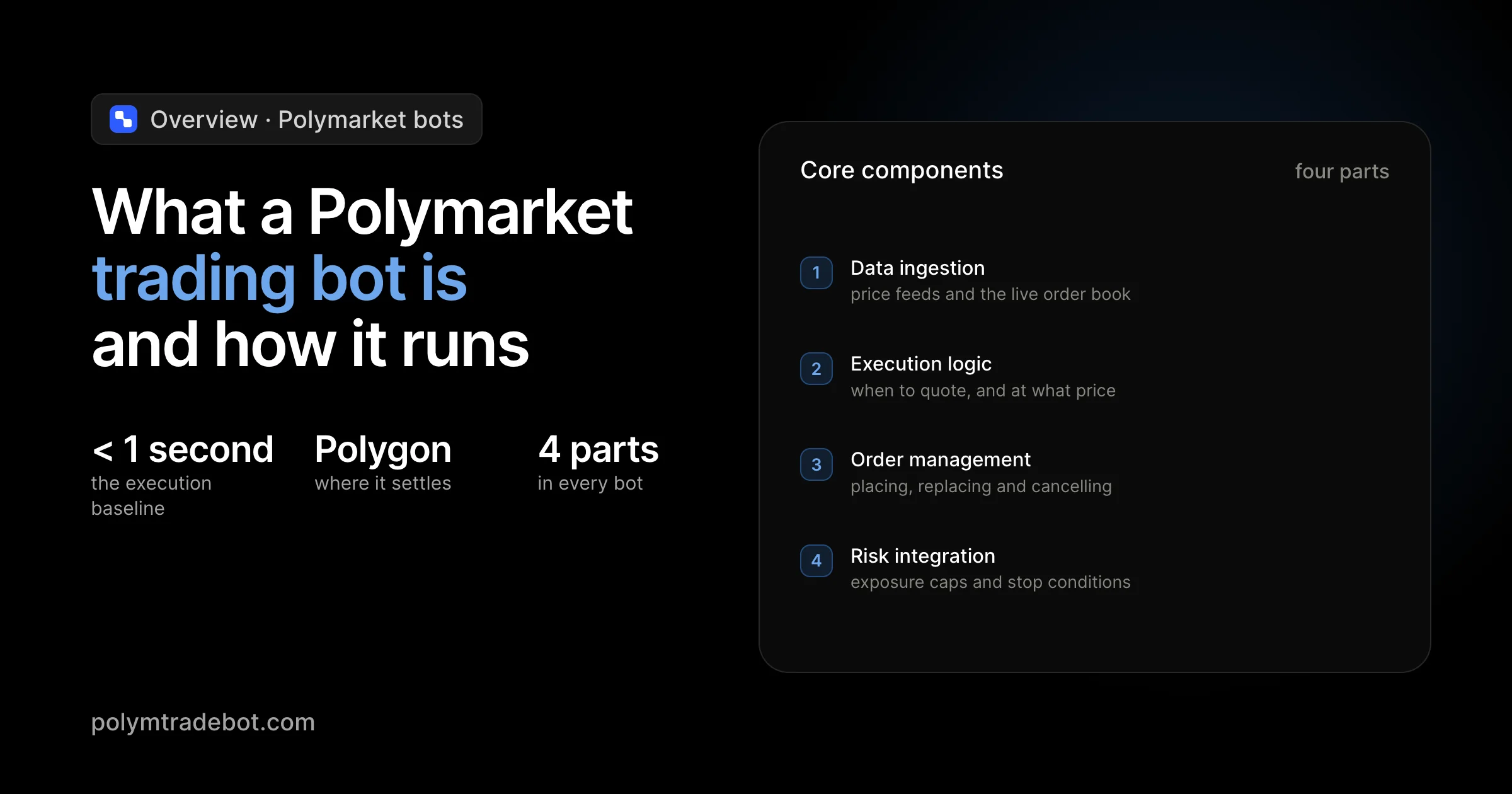
Does your manual trading strategy on Polymarket struggle to keep pace with high-frequency shifts in Bitcoin price action? By the time you spot a discrepancy in the 5-minute "Bitcoin Up or Down" market and click to confirm your position, the opportunity often evaporates. This latency isn't just a minor inconvenience; it represents a structural disadvantage against programmatic participants who execute trades in milliseconds. A Polymarket trading bot is a specialized software tool designed to automate prediction market strategies by executing high-frequency trades on binary outcomes using real-time price data and programmatic execution. Instead of watching a screen for hours, you use a script to monitor the order book and execute positions based on predefined logic.
In our practice building the Polymtradebot framework, we found that Python-based automation is the most effective way to bridge the gap between centralized exchange data and decentralized prediction markets. You will learn how a functional script handles automated execution, manages risk through hard-coded limits, and utilizes arbitrage strategies to capture price differences between Polymarket and platforms like Binance or Coinbase. We focus on the practical application of these tools for Bitcoin, ETH, SOL, and XRP markets, moving beyond theory into the mechanics of paper trading and live deployment. Using these systems allows you to maintain a consistent presence in the 5-minute and 15-minute intervals where manual entry is too slow to be profitable.
Key Takeaways
- Polymarket bots eliminate execution latency in 5-minute and 15-minute binary markets.
- Python scripts enable automated arbitrage by comparing Polymarket odds with real-time CEX price feeds.
- Paper trading modes allow for strategy validation without risking capital in live prediction pools.
- Automated risk management prevents catastrophic losses by enforcing strict position sizing on every trade.
Table of contents
- What a Polymarket trading bot is and why it matters
- Core components of a functional prediction market script
- 4 strategies that drive automated Polymarket returns
- How to evaluate bot performance: 5 marks of quality
- Risk management for automated prediction trading
- Polymarket vs centralized exchanges: which to automate
- Checklist: what to verify before deploying a Python script
- Final Steps for Your Prediction Strategy
- FAQ
What a Polymarket trading bot is and why it matters
 Automated tools execute rapid prediction market trades to capture fleeting price advantages
Technically, a Polymarket trading bot is a software wrapper—written in Python or JavaScript—that interfaces directly with the Polymarket Central Limit Order Book (CLOB) API. Unlike the web interface, which relies on manual clicks and visual updates, a bot interacts with the exchange via programmatic requests. It monitors order books, calculates spreads, and executes trades based on logic defined in its script.
The shift from manual betting to algorithmic trading
Manual participants often treat Polymarket like a traditional sportsbook, but the underlying structure is a financial exchange. In the fast-moving "Bitcoin Up or Down" markets, price discovery happens in seconds. If you are manually refreshing a browser to bet on a 5-minute BTC outcome, you are likely reacting to stale data.
A bot bridges this gap by reacting to price shifts in the underlying asset—Bitcoin, ETH, or SOL—long before the market sentiment reflects that change in the shares' price. This speed is the difference between capturing a 2% arbitrage gap and missing the entry entirely.
How bots interact with the Polygon blockchain
Polymarket operates on the Polygon network and utilizes the Conditional Tokens Framework, a standard developed by Gnosis. This framework is more complex than a standard Automated Market Maker (AMM) like Uniswap. Instead of just swapping Token A for Token B, the bot must manage "conditional" assets that only hold value if a specific event occurs.
Precision is mandatory here because the order book is off-chain, while the settlement happens on-chain. A bot must handle:
- API Authentication: Signing requests with your EOA (Externally Owned Account) or API keys.
- Order Matching: Interacting with the CLOB to find liquidity without causing massive slippage.
- Binary Outcomes: Calculating the implied probability of "Yes" or "No" shares and comparing them to real-time spot prices.
What we noticed. In the 5-minute Bitcoin markets, the price of "Up" shares often lags behind the Binance or Coinbase spot price by 500 to 1,500 milliseconds. Our Python scripts exploit this latency, entering positions before the Polymarket order book adjusts to the new spot reality.
Why sub-second execution is the baseline
In 5-minute and 15-minute markets, the window for profit is narrow. If a bot takes 2 seconds to process a signal, the opportunity has likely vanished. High-performance scripts use WebSocket connections to stream live order book updates, allowing for execution in under 200ms. This matters because automated liquidity providers often "front-run" manual sentiment, moving the price to its efficient equilibrium before a human can move their mouse.
By automating this process, you remove the emotional friction of "betting" and replace it with a systematic approach to market making and arbitrage. You aren't just predicting the future; you are trading the discrepancy between two data points.
Core components of a functional prediction market script
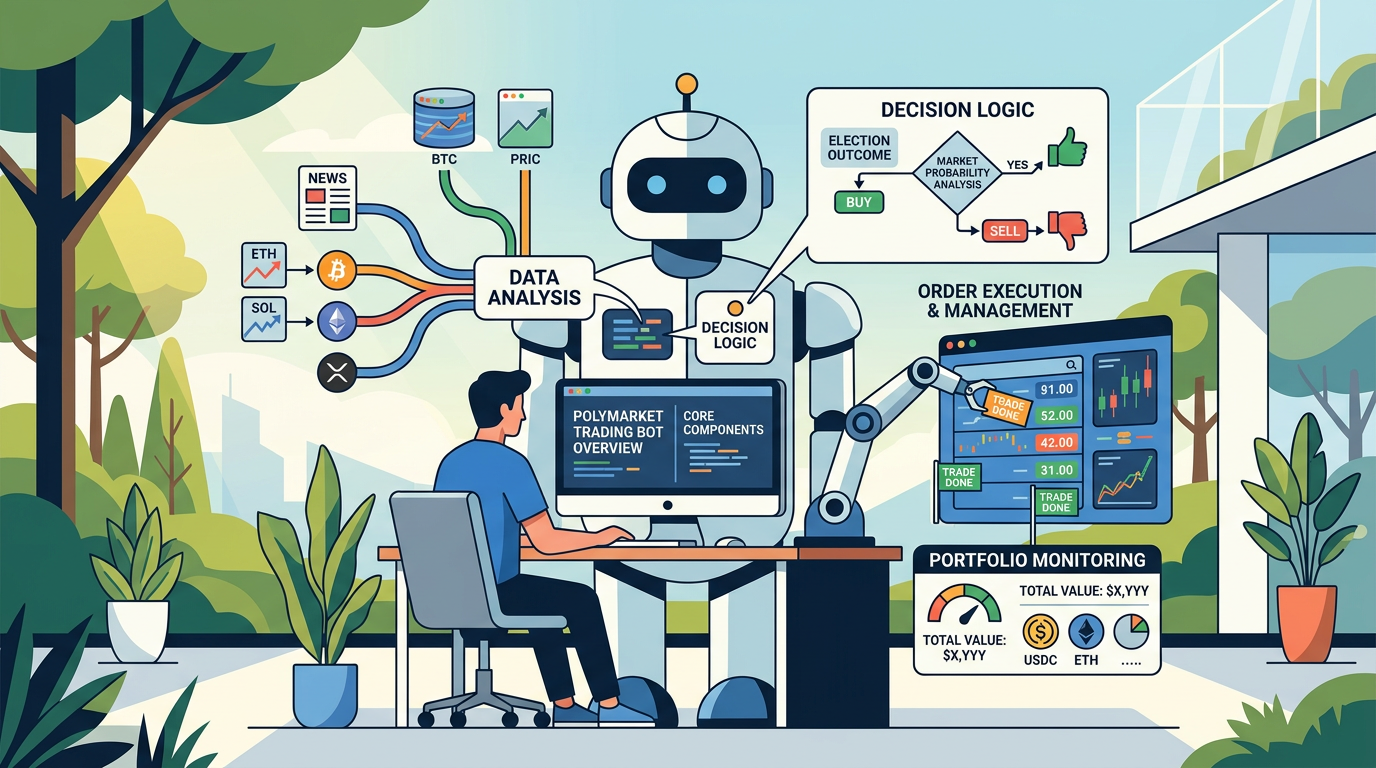 Essential modules working together to execute automated trades based on real-time data
A functional script for Polymarket must bridge the gap between the platform's binary outcomes and the liquid spot markets of major cryptocurrencies. Because prediction markets often lag behind centralized exchange (CEX) price action by several seconds, the bot's primary job is to ingest high-frequency data and execute before the order book adjusts.
Data ingestion and price feeds
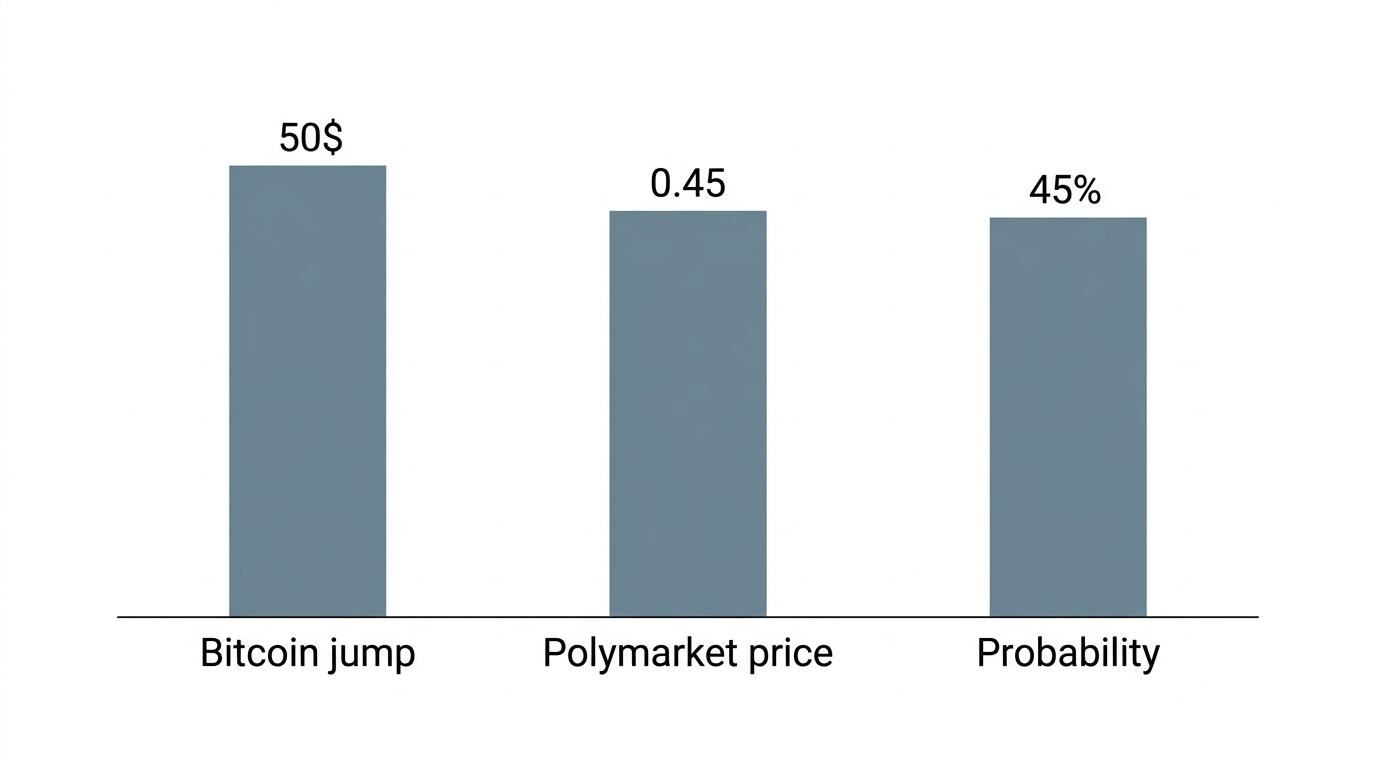
The bot relies on external price oracles to determine the "fair value" of a 5-minute Bitcoin Up or Down contract. If Bitcoin jumps $50 on Binance, the Polymarket "Yes" contract price should rise immediately. We program our Python scripts to pull sub-second WebSocket feeds for Bitcoin, ETH, SOL, and XRP.
By comparing the real-time CEX price to the Polymarket Central Limit Order Book (CLOB), the bot identifies discrepancies. For example, if the oracle shows Bitcoin trending upward but the Polymarket "Up" contract is still trading at $0.45, the bot calculates the expected value and triggers an entry. This requires a low-latency connection to avoid "getting picked off" by other automated participants.
Execution logic and order management
Automated execution on Polymarket happens through the Polygon network, requiring precise interaction with the Conditional Tokens Framework. Unlike a simple swap, the bot must manage internal state to track open positions across 5-minute and 15-minute windows.
- Private key security. The script requires access to a private key to sign transactions. In our practice at Polymtradebot, we emphasize using environment variables or dedicated secret managers rather than hardcoding keys into the
.pyfile. This prevents accidental exposure if the code is uploaded to a cloud environment. - API secret management. The Polymarket CLOB requires an API key, secret, and passphrase. The bot uses these to authenticate requests to the
POST /ordersendpoint, allowing for programmatic buys and sells without manual confirmation. - Paper trading mode. Before committing capital, we use a simulation layer that mirrors the live order book depth. This "paper trading" mode calculates slippage and fees as if the trades were real. It’s the only way to verify if a strategy can beat the spread in a high-volatility environment without losing actual USDC.
Observation. We noticed that bots relying on REST API polling instead of WebSocket streams frequently miss the entry price by 1-2%, which is often the entire profit margin for a 5-minute Bitcoin market trade.
Risk management integration
The script isn't just about entering trades; it’s about knowing when to stay out. A functional bot includes logic to pause execution during "flash crashes" or when liquidity in the order book is too thin to support the desired position size. By setting a maximum "slippage tolerance" in the Python config, you ensure the bot doesn't fill an order at a price that guarantees a mathematical loss.
4 strategies that drive automated Polymarket returns
 Smart algorithms execute complex logic to capture consistent profit from prediction markets
Automating a prediction market strategy moves you away from "betting" and toward systematic execution. While a manual trader spends minutes calculating implied probability, a Python script like the one we provide at Polymtradebot processes order book updates in milliseconds to exploit temporary market inefficiencies.
Arbitrage between platforms
The most reliable returns often come from price discrepancies between Polymarket and centralized exchanges (CEXs) like Binance or Coinbase. In the 5-minute Bitcoin Up or Down markets, Polymarket prices often lag behind the spot or futures movements on major exchanges.
If Bitcoin jumps $50 on Binance, the "Yes" shares for a price increase on Polymarket may still be trading at 0.45 (45% probability). Our bot identifies this gap, calculates the expected value, and executes the trade before the rest of the market adjusts. This isn't about predicting the future; it's about reacting to data that already exists elsewhere.
Market making to capture the spread
High-volume 15-minute intervals generate significant "churn." Market making involves placing both buy and sell orders simultaneously to capture the bid-ask spread. On Polymarket’s central limit order book (CLOB), liquidity providers earn the difference between what buyers pay and sellers receive.
Automation is mandatory here because spreads shift rapidly. A bot maintains your position at the top of the book, moving orders as the underlying price of ETH or SOL fluctuates. This strategy thrives on volatility—the more the price bounces within that 15-minute window, the more trades your script completes.
Observation. In our testing of SOL and XRP markets, we noticed that liquidity is often thinner than in Bitcoin pairs, leading to wider spreads that are highly profitable for bots but too risky for manual traders to track.
Automated hedging across assets
Predicting specific movements in volatile assets like SOL and XRP is difficult, but you can use automation to offset that exposure. A bot can execute a "delta-neutral" approach: if you hold a large "Yes" position on a SOL price increase on Polymarket, the script can automatically open a short position on a CEX.
This protects your capital. If the market drops, the profit from your short hedge covers the loss on your Polymarket shares. We see this used most effectively during high-impact events, such as SEC filings or protocol upgrades, where the direction is uncertain but the volume is guaranteed.
Mean reversion in short-term markets
Short-term crypto markets frequently overextend. When Bitcoin spikes aggressively within a 5-minute window, Polymarket participants often overreact, pushing the "Yes" shares to an irrational premium.
A mean reversion strategy uses the Relative Strength Index (RSI) or Bollinger Bands to identify these overbought conditions. The bot then takes the contrarian position, betting that the price will stabilize or "revert" to its average before the market resolves. Because these windows are so tight, the bot exits the position the moment the price touches the mean, securing small but frequent gains that are impossible to capture by hand.
How to evaluate bot performance: 5 marks of quality
Evaluating a trading bot goes beyond looking at a backtested profit curve; it requires auditing how the script handles the technical friction of the Gnosis Chain and Polymarket’s order book. High-performance execution depends on how the code manages the gap between a price signal and a confirmed transaction.
1. Latency and RPC health
In the 5-minute Bitcoin Up or Down markets, a delay of two seconds can turn a winning arbitrage entry into a losing position. We measure quality by the bot's ability to maintain sub-200ms response times when interacting with the blockchain. This requires using dedicated RPC nodes rather than public endpoints, which often throttle requests during high-volume events.
2. Slippage and liquidity filters
Low liquidity in specific prediction brackets can lead to massive price impact. A professional-grade bot calculates the effective price—the average price for the entire order size—rather than just the top-of-book price. If the slippage exceeds your defined tolerance (e.g., 0.5% or 1%), the bot must kill the order instantly to protect your principal.
3. Rate limit management
Polymarket’s CLOB API and the underlying Gnosis infrastructure impose strict rate limits. A poorly written script will spam requests and trigger a 429 error, locking you out of the market during peak volatility. We look for "exponential backoff" logic: if the bot hits a limit, it waits for a calculated duration before retrying, ensuring continuous uptime without a permanent ban.
From our practice. When trading high-frequency intervals for SOL or XRP, we’ve noticed that network congestion on Gnosis can occasionally spike block times; our Polymtradebot scripts use a "gas price buffer" to ensure transactions are prioritized even when the chain is busy.
4. Error handling and state recovery
What happens if your internet drops or the API returns a 500 error? A quality bot maintains a local "state" of your open positions. If the connection breaks, the script should re-sync with the blockchain on restart, identifying orphaned orders and closing them if they no longer align with your strategy. Without this, you risk "ghost positions" that drain your wallet while you're offline.
5. Execution vs. Simulation parity
The most dangerous trap in evaluating what is a polymarket trading bot: a complete overview is the gap between paper trading and live execution. A bot earns its keep when its paper trading mode accurately accounts for gas fees and the Conditional Tokens Framework logic. If your simulation shows a 10% gain but ignores the $0.05 gas fee per trade, your live deployment will bleed money. Always verify that the bot's simulation engine mirrors real-world transaction costs.
Risk management for automated prediction trading
Risk management in prediction markets is the difference between a profitable script and a drained wallet. Because Polymarket uses binary outcomes, your bot deals with "all-or-nothing" scenarios where the price of a share (from $0.01 to $0.99) represents the market's probability of an event. If your bot buys "Bitcoin Up" at $0.70 and the price drops to $0.00 at expiry, you lose 100% of the position.
Position sizing with the Kelly Criterion
Blindly betting 10% of your balance on every 5-minute Bitcoin market is a fast track to ruin. We use the Kelly Criterion to calculate the mathematically optimal bet size based on your "edge"—the difference between the price your bot finds and the actual probability of the outcome.
If your script identifies a discrepancy where Polymarket prices a "BTC Up" event at 60% ($0.60) but your external feed from Binance suggests a 65% probability, the Kelly formula helps you decide exactly how much capital to commit.
Observation. In our practice, using a "Fractional Kelly" (betting only 25% or 50% of the suggested amount) is safer for 5-minute markets. It accounts for the fact that price oracles aren't perfect and protects you against a string of unexpected outcomes in high-volatility windows.
Hard limits and drawdown protection
Automated scripts can fail due to API lag, bad oracle data, or logic loops. To prevent a "catastrophic failure" where a bot keeps doubling down on a losing streak, you must hard-code daily drawdown limits into your Python logic.
- Daily Stop-Loss. If the total wallet balance drops by 5% within a 24-hour window, the script should kill all active processes and send an alert.
- Max Exposure Per Market. Never allow the bot to concentrate more than a fixed percentage (e.g., 2-3%) of the total bankroll in a single 15-minute ETH or SOL interval.
- Cooldown Timers. If the bot loses three consecutive trades, implement a 30-minute "circuit breaker" to wait for market volatility to settle.
Monitoring gas and transaction costs
Polymarket operates on the Polygon network. While fees are low compared to Ethereum mainnet, they are not zero. When running high-frequency arbitrage strategies, transaction costs can silently erase your margins.
A bot might spot a $0.02 price gap between Polymarket and an external exchange. However, if the gas cost to execute the trade is $0.01 and the slippage is $0.015, the trade is a net loss. Your script must query the gasPrice from the Polygon RPC provider before every execution. If the network is congested and fees spike, the bot should automatically pass on low-margin opportunities until gas returns to baseline levels. This ensures you aren't "picking up pennies in front of a steamroller."
Polymarket vs centralized exchanges: which to automate
Automating on Polymarket requires a shift in logic from traditional limit order book trading on Binance or Coinbase. While centralized exchanges (CEXs) focus on continuous price discovery of a perpetual asset, Polymarket operates on the Conditional Tokens Framework, where every contract resolves to a binary 0 or 1. This means your bot isn't just chasing a price trend; it is pricing the probability of a specific event occurring within a hard deadline.
Binary outcomes vs. perpetual futures
On a CEX, if you buy Bitcoin at $65,000 and it drops to $64,000, you hold a drawdown. On Polymarket’s 5-minute "Bitcoin Up or Down" markets, if the price is $1 below your strike at the expiration timestamp, your position goes to zero instantly.
Our Python scripts account for this "all-or-nothing" risk by focusing on execution speed in the final 60 seconds of a candle. While CEX bots often use grid trading or mean reversion over hours, a Polymarket bot thrives on micro-arbitrage—sniping the difference between the live spot price on Binance and the lagging probability price on the prediction market.
Event-based sentiment and oracles
Polymarket offers a unique "sentiment alpha" that CEXs lack. When ETH or SOL experiences a flash crash, CEX liquidations happen in milliseconds. Polymarket participants often react slower, creating a 2–3 second window where the "Yes" shares for a price-up outcome are overpriced relative to the new spot reality.
A bot using the Polymarket CLOB API can scan these discrepancies across BTC, ETH, SOL, and XRP simultaneously. You get an edge by treating Polymarket as a reactive layer to the primary CEX markets.
What we noticed. In high-volatility 5-minute windows, the Polymarket order book often lags the Binance spot price by up to 1.5 seconds, allowing our automated scripts to lock in arbitrage before the liquidity providers adjust their quotes.
Non-custodial execution vs. API keys
The technical architecture of your bot changes significantly when moving away from a CEX.
- CEX: You generate API keys with "Trade" permissions and keep your funds in the exchange's wallet.
- Polymarket: Your bot interacts directly with the Polygon network. You must manage a private key for a non-custodial wallet.
This means your script doesn't just send a "Buy" command; it signs a transaction that interacts with Gnosis Chain or Polygon smart contracts. You aren't just fighting exchange latency; you are optimizing for blockchain gas fees and block times. Because Polymarket is non-custodial, you maintain control of the underlying USDC, but your bot must be robust enough to handle "stuck" transactions during network congestion—a problem you rarely face on a centralized server.
Checklist: what to verify before deploying a Python script
A single logic error in your execution script can drain a wallet faster than any market downturn. Before transitioning from a local environment to live Polymarket CLOB interaction, you must validate the technical bridge between your Python logic and the Polygon blockchain.
Smart contract and market validation
Polymarket doesn't use a single global order book; each event has a unique Conditional Token address. If your bot targets the Bitcoin "Up" market for a specific 5-minute window, you must verify that your script is calling the exact contract address for that specific timeframe and outcome.
- Confirm the Outcome ID: Ensure your script distinguishes between "Long" and "Short" tokens for the correct expiration.
- Verify the CTF: Check that your code interacts correctly with the Conditional Tokens Framework to handle the split and merge logic required for binary outcomes.
- Gas Strategy: Set a hard cap on gas prices. On Polygon, a sudden spike in network activity can turn a profitable arbitrage trade into a net loss if your script overpays for execution.
Stress testing and connectivity
Backtesting on historical data is a start, but it doesn't account for the latency of the Central Limit Order Book (CLOB). You need to run your bot in a paper trading environment for at least 100 cycles to observe how it handles skipped heartbeats or API rate limits.
What we noticed. In our practice, bots often fail not because of bad strategy, but because of "stale" price data during the 500ms window between a Binance price move and the Polymarket API update.
Your local environment requires a stable, low-latency connection to the Polymarket API. If your internet drops for even three seconds during a 5-minute Bitcoin market, the bot might miss the exit signal, leaving you in a directional trade you never intended to hold. Use a dedicated VPS (Virtual Private Server) located near the API's primary data centers to minimize round-trip time.
Security and fail-safes
Hard-coding private keys is the most common path to total loss. Use environment variables or an encrypted vault to manage your credentials. Furthermore, implement a "kill switch" that halts all trading if the bot loses its connection to the external price oracles for BTC, ETH, or SOL. If the bot can't see the underlying price, it should not be allowed to bet on it.
Final Steps for Your Prediction Strategy
Automating your Polymarket activity shifts the focus from emotional guessing to systematic execution. By using a Python-based bot, you eliminate the latency of manual clicks and the bias of "gut feelings" during high-volatility events. We see that traders who prioritize risk management and paper trading over raw speed tend to maintain more stable equity curves in the 5-minute Bitcoin markets.
Success relies on the quality of your script and the logic behind your arbitrage or trend-following signals. Whether you are targeting Bitcoin, ETH, or SOL, the goal is to capture small, frequent inefficiencies rather than betting on single large outcomes. You can refine your approach by reviewing our blog for technical updates or exploring our ready-to-use bot pricing to deploy a tested framework immediately.
Deploy your first strategy in paper trading mode to verify your logic before committing capital to live markets.
FAQ
Do I need advanced coding skills to use a Polymarket trading bot?
No, you do not need to be a senior developer to run a pre-configured Python script. While basic knowledge of terminal commands helps with setup, our ready-to-use bot at polymtradebot.com handles the complex API interactions and execution logic for you. You only need to configure your private keys and strategy parameters in a simple environment file.
Can a bot trade on political events or just crypto prices?
Bots can trade on any market with an active order book, including political or pop-culture events. However, most automated strategies focus on crypto price markets like Bitcoin "Up or Down" because they offer higher liquidity and predictable 5-minute settlement cycles. High-frequency logic requires the constant data feeds found in price-based markets to remain profitable.
How does the bot handle the 5-minute settlement process?
The bot monitors the market timer and executes trades based on the remaining time in the candle. It uses the Polymarket API to check the final price at the moment of settlement and automatically calculates the outcome to update your balance. Our script includes a buffer to stop placing new orders seconds before the window closes to avoid slippage.
Is it possible to run multiple strategies on one account?
Yes, you can run multiple strategy instances simultaneously by managing different sub-processes or separate script configurations. One instance might focus on 5-minute Bitcoin arbitrage while another tracks 15-minute ETH trends. We recommend monitoring your total collateral closely, as multiple active strategies draw from the same USDC balance on your Polymarket or Proxy wallet.
What are the typical API restrictions for high-frequency trading on Polymarket?
Polymarket imposes rate limits on its API to maintain network stability, typically restricting the number of requests per second. Our bot manages these limits by batching orders and using efficient WebSocket connections for real-time price updates. Exceeding these limits can result in temporary IP bans, so the script includes built-in "cool-down" periods to stay within safe thresholds.
Article written using SeoSync.