

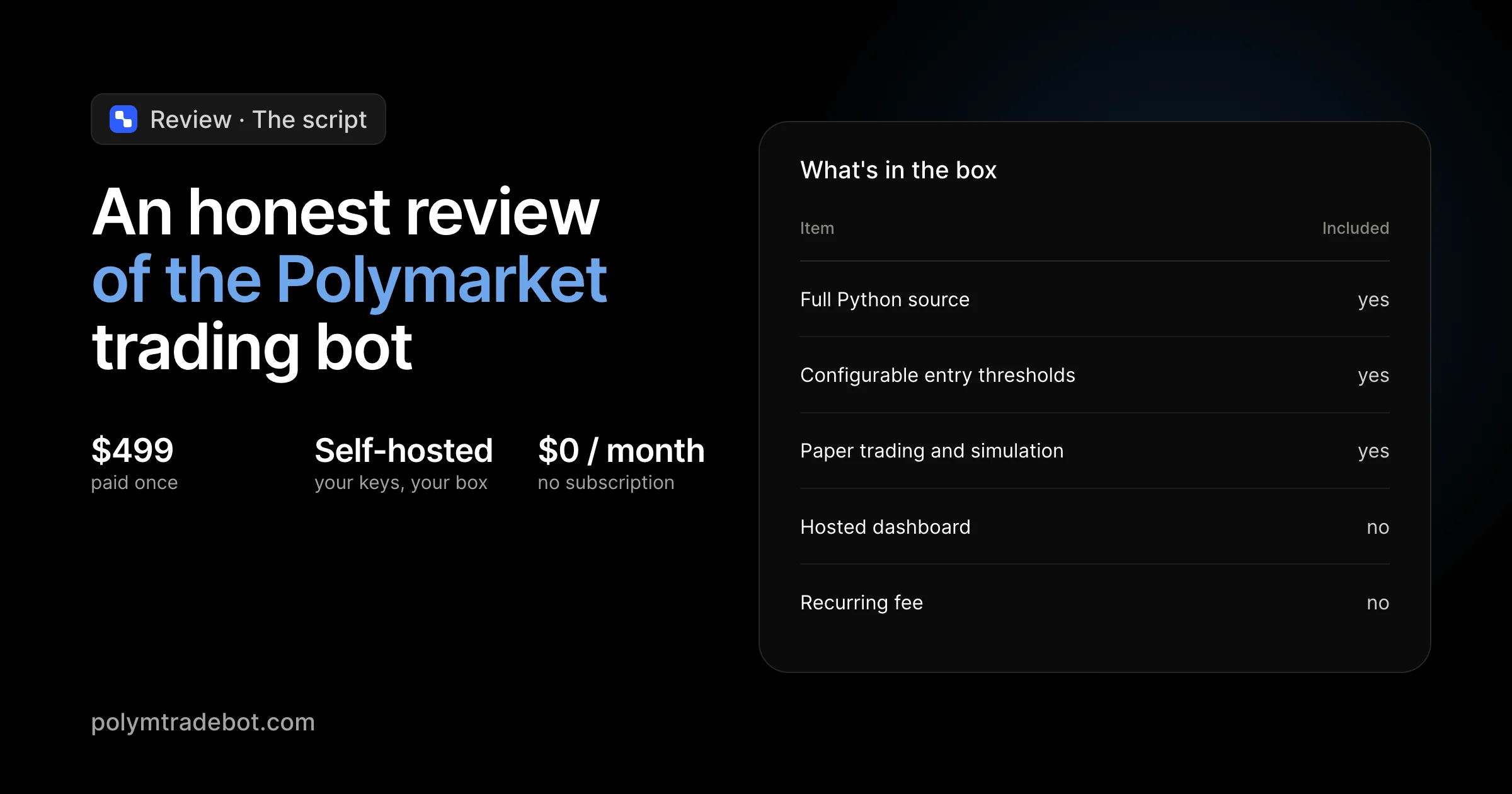
Polymarket reached a record monthly trading volume of 9 billion dollars in April 2026, according to the Pew Research Center, highlighting a massive shift toward decentralized prediction platforms. While the liquidity is there, the window for profit in the 5-minute and 15-minute Bitcoin "Up or Down" markets is often too narrow for manual execution. Traders frequently lose their edge to latency or emotional hesitation when prices fluctuate. This review of the polymarket trading bot script examines whether moving from manual clicks to automated Python execution can solve these consistency issues. If you have ever missed a high-probability entry because the interface lagged or the spread widened during a localized spike, you know that speed is a prerequisite, not a luxury.
We developed Polymtradebot to provide a transparent alternative to the "black box" trading tools currently saturating the market. This script gives you direct access to the Python source code, allowing you to audit the logic and run the bot on your own hardware. You will learn how the bot handles automated arbitrage and hedging across Bitcoin, ETH, SOL, and XRP markets. By using the built-in paper trading mode, you can simulate strategies against live order books without risking capital. This approach shifts the focus from guessing outcomes to managing probability and execution speed through a self-hosted environment.
Key Takeaways
- Polymarket volume hit 9 billion dollars in April 2026, creating high-liquidity opportunities for automated scripts.
- Polymtradebot provides full Python source code for transparent, self-hosted automation on 5 and 15-minute crypto markets.
- Built-in arbitrage and hedging strategies allow for complex risk management across BTC, ETH, SOL, and XRP.
- Paper trading mode enables strategy validation against live market data before committing real funds.
Table of contents
- What Polymtradebot is and why it matters for crypto traders
- Key features of the Polymarket trading bot script
- Pros of using a self-hosted Python script
- Cons and limitations to consider before purchase
- Who should use Polymtradebot and who should avoid it
- The bottom line on Polymarket automation
- FAQ
- Sources
What Polymtradebot is and why it matters for crypto traders
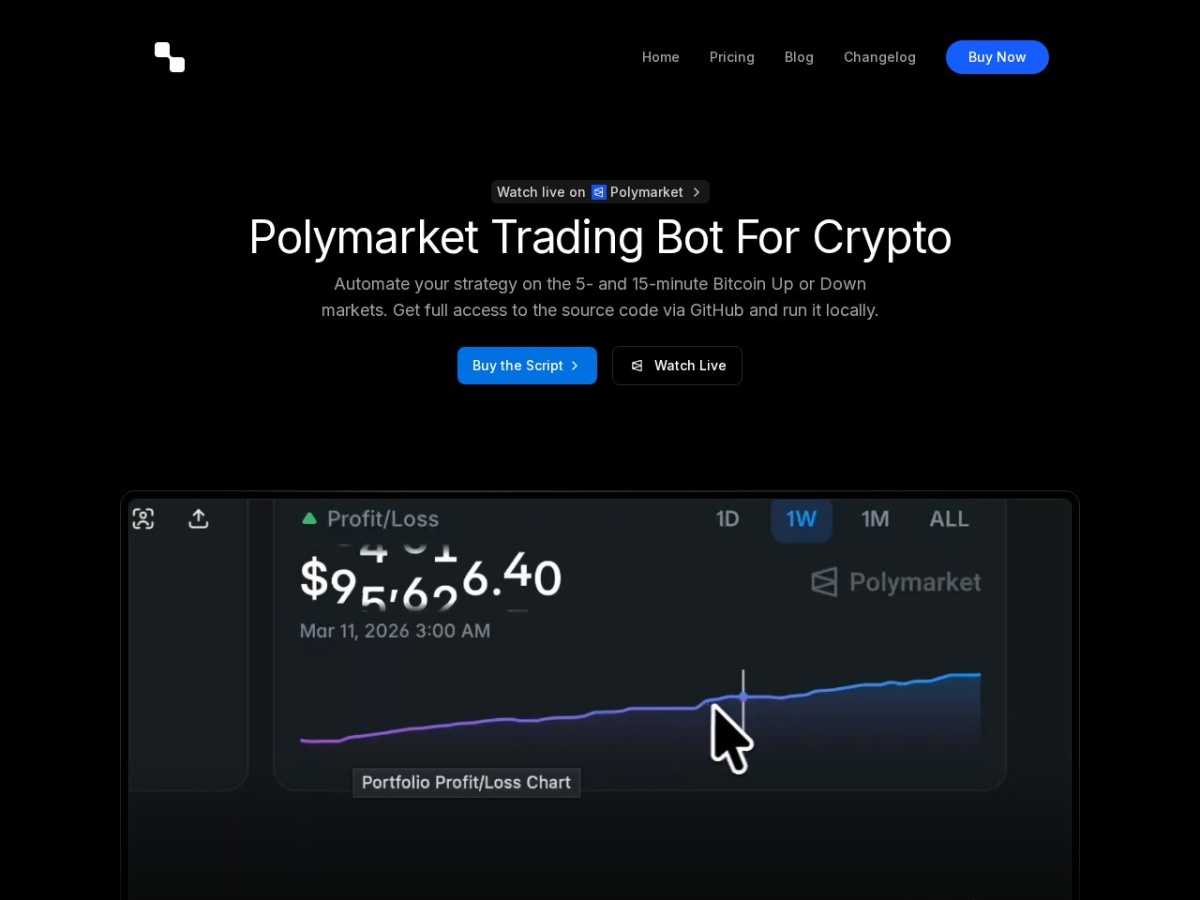
Polymtradebot is a self-hosted Python script designed to execute high-frequency trades on Polymarket’s binary "Up or Down" crypto markets. Unlike typical trading bots that connect to standard spot exchanges, this tool targets the prediction market niche, specifically automating positions on 5-minute and 15-minute price cycles for Bitcoin and Ethereum.
The timing is significant. As of February 17, 2026, the number of monthly active addresses on Polymarket reached a new all-time high of 679,000 according to Token Terminal. This surge in liquidity makes automated execution viable for retail traders who previously could not compete with manual entry speeds. When a market expires every 300 seconds, the window to identify a price discrepancy and execute a trade is often less than two seconds.
The shift toward decentralized forecasting
The prediction market landscape has fundamentally changed over the last year. In 2025, Kalshi and Polymarket dominated with 97.5 percent of the market share as reported by KuCoin. This duopoly has concentrated liquidity, turning what used to be a niche "betting" activity into a sophisticated financial instrument for hedging and arbitrage.
For a trader, this concentration means tighter spreads but also requires faster reaction times. If the price of Bitcoin drops on Binance, the "Bitcoin Up" shares on Polymarket should theoretically drop in value instantly. Manual traders often miss this micro-window; Polymtradebot closes it by monitoring the underlying price feeds and the order book simultaneously.
Automating short-term prediction markets
The core value of the script lies in its transparency. Because you receive the full Python source code, you aren't tethered to a black-box "signal" service or a monthly subscription that could vanish. You host the script on your own machine or VPS, ensuring that your API keys and strategy parameters remain private.
Why does this matter for Bitcoin and ETH markets? These 5-minute cycles are essentially volatility captures. The script allows you to set:
- Probability thresholds: Only enter a trade if the implied probability on Polymarket deviates from the real-time spot price by a specific percentage.
- Automated Arbitrage: Identify when the "Yes" and "No" contracts are mispriced relative to each other or external exchanges.
- Risk Management: Define maximum stake per cycle to prevent a single outlier event from wiping out your balance.
Observation. In our practice, we have found that the 15-minute markets offer a more stable environment for arbitrage than the 5-minute cycles, as the latter often suffer from extreme slippage during high-volatility news events.
By moving away from manual clicks, you eliminate the emotional hesitation that often leads to "revenge trading" after a lost cycle. The bot follows the logic you define—whether that is a simple trend-following strategy or a complex hedging play across multiple assets like SOL and XRP. This level of automation was once reserved for institutional desks, but accessible Python scripts have brought these capabilities to independent traders.
Key features of the Polymarket trading bot script
The Polymtradebot script operates as a self-hosted Python environment that interfaces directly with Polymarket’s CLOB (Central Limit Order Book) API. This architecture eliminates the latency found in web-based interfaces and gives you raw control over execution in the "Bitcoin Up or Down" markets. As monthly active addresses on Polymarket reached 679,000 in February 2026 according to Token Terminal, the competition for liquidity in 5-minute and 15-minute windows has intensified, making programmatic execution a necessity rather than a luxury.
Automated execution and arbitrage
We designed the script to handle high-frequency fluctuations across various crypto pairs, including Bitcoin, ETH, SOL, and XRP. Instead of manually watching price charts, you can deploy automated arbitrage strategies that capitalize on price discrepancies between Polymarket’s prediction outcomes and external spot or futures prices.
The bot monitors the order book in real-time, looking for "mispriced" shares. For example, if the broader market signals a high probability of a price recovery for SOL, but the Polymarket "Up" shares are trading at a discount, the script can execute a buy order instantly. You can also use the script for hedging; if you hold a long position in XRP, the bot can auto-purchase "Down" shares on Polymarket to offset potential downside risk during volatile sessions.
Configurable probability and entry thresholds
The heart of the Python script lies in its logic for defining entry and exit signals. You aren't stuck with a one-size-fits-all algorithm. You can configure specific probability thresholds—expressed as a percentage or a decimal—that must be met before the bot commits capital.
- Entry Thresholds. Set the minimum "odds" required to trigger a trade. If you only want to enter 5-minute Bitcoin markets when the implied probability is below 60%, you adjust a single variable in the code.
- Exit Logic. Define when to take profits or cut losses. The script can automatically sell shares if the market moves against your position by a predetermined margin.
- Spread Filters. Avoid getting "chopped" by wide bid-ask spreads. The bot can be set to ignore markets where the liquidity is too thin to support a profitable exit.
Observation. In our practice, we’ve found that setting a minimum liquidity filter is more important than the probability threshold itself; in 5-minute markets, even a "correct" prediction can result in a loss if the spread eats 5% of your position on both sides.
Risk management and simulation
Trading short-term prediction markets is inherently high-risk due to the "all-or-nothing" nature of the contracts. To mitigate this, the script includes a dedicated paper trading mode. This allows you to run your Python logic against live market data without spending a single USDC. It is the only way to see if your strategy for SOL or ETH markets actually survives real-world slippage and fee structures.
What matters most is the transparency of the risk settings. Unlike black-box platforms, you can see exactly how the script calculates position sizing. You can hard-code maximum bet limits per market or use a percentage of your total balance. This ensures that a single 15-minute outlier in the Bitcoin price doesn't wipe out your entire trading wallet. Since you have the full source code, you can verify that there are no hidden "backdoors" or hard-coded logic that could lead to unexpected liquidations.
Pros of using a self-hosted Python script
Running a self-hosted script like Polymtradebot shifts the control of the trading stack from a third-party service provider directly to the trader. This architectural choice eliminates the "black box" risk common in managed platforms, where users cannot see how orders are routed or why specific slippage occurs. By owning the source code, you gain the ability to audit every logic gate and execution trigger before a single dollar enters the liquidity pool.
Operational efficiency and latency
In 5-minute and 15-minute prediction markets, the difference between a profitable entry and a missed opportunity is often measured in milliseconds. Managed bot services usually introduce an extra hop: the market data travels from Polymarket to the service's server, then to their UI, and finally back to the exchange.
With a Python script running on your own hardware or a private VPS, you cut out the middleman. You can co-locate your execution environment closer to the exchange’s API endpoints, reducing network round-trip times. This setup is particularly effective for high-volume environments. As prediction markets continue to scale—reaching a 9 billion dollar monthly volume in April 2026—the ability to execute trades without platform-induced delays becomes a structural advantage.
Transparency and customization
Most "out-of-the-box" bots lock you into fixed strategies. With Polymtradebot, you have direct access to the Python source code, allowing you to tweak the math behind the machine. You aren't stuck with a generic risk profile; you can modify the hedge ratio and risk parameters to match your specific bankroll management strategy.
- Direct Code Modification. Adjust entry thresholds or exit logic based on your own backtesting results.
- Custom Risk Logic. Hardcode your own stop-losses or position-sizing rules that the bot must follow, regardless of market volatility.
- Arbitrage Flexibility. Fine-tune how the script identifies price discrepancies between Bitcoin, ETH, SOL, and XRP markets.
Observation. We noticed that traders who move from managed subscription bots to self-hosted scripts often see an immediate improvement in net ROI simply by eliminating the 1-2% "success fees" or monthly premiums charged by SaaS platforms.
Long-term cost-effectiveness
While managed bots often charge recurring monthly fees or a percentage of your trading profits, a one-time paid script like Polymtradebot removes these ongoing drains on your capital. This is especially relevant for high-frequency traders. If you are cycling capital every 5 minutes, those small platform fees compound into significant losses over a month.
By paying for the script once, your only ongoing costs are your own server hosting and the standard transaction fees on the Polygon network. This "buy once, run forever" model ensures that as your trading volume grows, your overhead stays flat. You effectively scale your operation without scaling your expenses.
Privacy and Security
Using a self-hosted script means you never share your private keys or API secrets with a third-party web interface. Your credentials stay on your machine. In an industry where platform hacks are a constant threat, maintaining local control over your execution environment is a fundamental security practice. You are responsible for your own security, but you also remove the risk of a platform-wide breach affecting your funds.
Cons and limitations to consider before purchase
While the Polymtradebot script provides a high degree of transparency and control, it is not a "plug-and-play" consumer app. Using a self-hosted Python script requires you to manage the technical environment and execution risks that are usually hidden behind the interface of a managed service.
Technical requirements and deployment
To deploy the script effectively, you need a functional understanding of Python. You are responsible for installing dependencies, managing environment variables, and securely handling your private keys. Because the bot lacks a graphical user interface (GUI), all configurations happen directly within the code or configuration files. If you are uncomfortable using a terminal or editing .py files, the learning curve will be steep.
Execution depends entirely on your setup. If your local machine loses internet or your VPS provider experience downtime, your bot stops. You must also account for the stability of the Polygon network and the uptime of Polymarket’s own API. During periods of extreme network congestion, transaction internal latency can increase, which may impact the timing of entries in 5-minute market windows.
Market-specific risks and liquidity
Automating high-frequency trades in short-term markets introduces specific execution challenges:
- Slippage. In 5-minute and 15-minute "Up or Down" markets, liquidity can thin out rapidly. Large orders might move the price against you, eroding the slim margins required for successful arbitrage.
- Probability Thresholds. Setting entry triggers too tight may result in zero trades, while setting them too loose can lead to over-trading in "noisy" sideways markets.
- Capital Management. The script executes based on your parameters, but it cannot account for sudden external "black swan" events that defy historical probability. You must monitor your risk settings to ensure the bot doesn't compound losses during erratic price swings.
Observation. We noticed that traders often underestimate the impact of gas spikes on the Polygon network. Even though fees are low, a sudden jump from 30 to 500 gwei during high-volatility events can turn a profitable 5-minute arbitrage trade into a net loss if your script isn't configured to cap gas prices.
Licensing and Pricing
Polymtradebot is a paid product. Access to the source code and the automated strategies requires a license purchase; see the site for current details on pricing tiers and what is included in each package. Unlike subscription-based platforms that take a percentage of your trade volume, this is a direct software purchase, which shifts the responsibility of maintenance and optimization entirely to the user.
Who should use Polymtradebot and who should avoid it
Choosing Polymtradebot depends entirely on your technical comfort level and your specific intent within the prediction market ecosystem. This script is a precision instrument for the 5-minute and 15-minute Bitcoin Up or Down markets, designed for those who view trading as a logic-driven engineering problem rather than a casual side activity.
Ideal user profiles
The script serves a specific demographic of quantitative traders who prioritize transparency and execution speed over a polished interface. If you fall into the following categories, the tool aligns with your workflow:
- Python-literate traders. Since you receive the full source code, you can audit the logic and modify the hedge ratios yourself. This is vital for anyone who refuses to trust a "black box" with their capital.
- Short-cycle specialists. The bot is optimized for the high-velocity 5-minute and 15-minute windows. If your strategy relies on capturing micro-inefficiencies in Bitcoin, ETH, SOL, or XRP price movements, automated execution is a requirement, not a luxury.
- Risk managers. With the built-in paper trading mode, you can validate your probability thresholds against live market data without losing a single USDC. This allows for rigorous backtesting before moving to live execution.
- Arbitrageurs. The script is built to handle automated arbitrage and hedging. If you are looking to offset directional risk across different prediction pairs, the direct API integration provides the low-latency response needed to catch these spreads.
Scenarios for alternative tools
Polymtradebot is not a universal solution for every Polymarket participant. Certain users will find the overhead of managing a Python script counterproductive to their goals.
- Retail "Mobile-First" users. If you prefer trading via a smartphone app with buttons and charts, this is not the tool for you. There is no graphical user interface (GUI); management happens in the terminal and the code editor.
- Long-term political bettors. Those trading on the outcome of elections or yearly events do not need high-frequency automation. A script designed for 5-minute cycles offers no advantage for markets that settle months from now.
- Non-technical beginners. While the script is ready-to-use, you still need to know how to set up a Python environment and manage your API keys. If "environment variables" or "pip install" sound like a foreign language, the learning curve may be too steep.
Self-hosting vs. managed signal providers
A major fork in the road for traders is whether to host their own script or subscribe to a managed signal service. Managed services often charge recurring monthly fees and keep their execution logic hidden. By using a self-hosted script like Polymtradebot, you eliminate those recurring platform costs in favor of a one-time purchase.
Control is the deciding factor. When you host the script on your own VPS or local machine, you aren't competing for execution priority with thousands of other users on the same server. You control the hardware, the uptime, and the exact moment an order hits the Polygon network.
Observation. In our practice, we have seen that traders using self-hosted scripts often avoid the "crowded trade" phenomenon where managed bot providers trigger hundreds of identical orders at the same millisecond, leading to significant slippage in low-liquidity 5-minute markets.
Ultimately, this script is for the trader who wants to own their infrastructure. It trades the convenience of a managed app for the raw power and transparency of direct code execution. See the site for current details on pricing and technical requirements.
The bottom line on Polymarket automation
Using a Python-based approach via Polymtradebot shifts the trading burden from manual clicking to logic-driven execution. By running your own script, you eliminate the latency of browser interfaces and gain the ability to hedge positions across 5-minute and 15-minute markets simultaneously. This setup works best for those who prioritize transparency and want to see exactly why a trade was triggered.
Success in prediction markets depends on managing the math rather than chasing the hype. The inclusion of paper trading and configurable probability thresholds allows you to stress-test strategies against real Bitcoin or ETH price movements without losing capital to slippage. While no script guarantees profit, moving to a self-hosted bot provides the data-driven edge needed to compete in high-frequency environments.
Download the source code from the pricing page to begin configuring your local trading environment.
FAQ
Does the script require a constant internet connection to execute trades?
Yes, the script must maintain a stable connection to the Polymarket API and blockchain nodes to monitor order books and execute trades in real-time. If your local connection drops, the bot cannot update its position or exit trades during the 5-minute windows. Most users run the Python script on a VPS to ensure 24/7 uptime.
Can I use the bot for sports betting markets on Polymarket?
No, this specific script is optimized for the Bitcoin, ETH, SOL, and XRP "Up or Down" prediction markets. The logic relies on price feeds and volatility metrics specific to crypto assets rather than the binary outcomes of sporting events. You should only use it for the supported crypto markets listed on the Polymtradebot site.
What are the minimum system requirements to run the Python script?
You can run the script on any system supporting Python 3.x, including a basic VPS with 1GB of RAM and a single-core CPU. Since the bot focuses on API requests rather than heavy local computation, it does not require a high-end GPU or significant storage. Ensure your OS is Linux, Windows, or macOS with updated security patches.
How does the paper trading mode simulate real market slippage?
The paper trading mode tracks the real-time order book spread and applies execution delays to mimic the time it takes for a transaction to hit the blockchain. It calculates potential returns based on the actual "Yes" or "No" prices available at that microsecond. This prevents the simulation from showing unrealistic profits that wouldn't exist in live markets.
Is there a limit to the number of trading pairs the bot can monitor simultaneously?
The script can monitor all supported pairs including BTC, ETH, SOL, and XRP at once, provided your API rate limits allow it. Each additional pair increases the number of requests sent to Polymarket, so you must configure the polling interval to avoid being throttled. Check the blog for current optimization tips on managing high-frequency requests across multiple markets.
Sources
- Pew Research Center (2026) — Polymarket reached a record monthly trading volume of 9 billion dollars in April 2026, with sports betting accounting for 4 billion.
- Token Terminal (2026) — The number of monthly active addresses on Polymarket reached a new all-time high of 679,000 as of February 17, 2026.
- KuCoin (2026) — In 2025, Kalshi and Polymarket dominated the sector, controlling 97.5 percent of the prediction market with a combined volume of 458 billion.