

In 2025, a Columbia University study found that approximately 25% of Polymarket's total trading volume was attributed to artificial wash trading activity. For serious participants, this statistic highlights a noisy environment where manual execution often fails against faster, automated competition. Professional desks no longer click buttons to predict if Bitcoin will be "Up" or "Down" in the next five minutes. Instead, they deploy code to handle the heavy lifting. Understanding how algorithmic traders use the Polymarket bot is now a requirement for anyone looking to maintain an edge in these short-term binary markets. When prices on Binance or Coinbase shift, the window to capture a price discrepancy on a prediction market closes in milliseconds.
This guide breaks down the mechanics of automated execution across Bitcoin, ETH, SOL, and XRP markets. You will see how traders move beyond simple direction bets to implement high-frequency strategies and cross-platform arbitrage. We focus on the practical application of the Polymtradebot script, specifically for the 5-minute and 15-minute intervals where volatility creates the highest profit potential. By moving execution to a Python-based environment, you can run simulations in paper trading mode to verify logic before committing capital, ensuring your risk management parameters survive real-world price swings. You will gain a clear framework for managing liquidity and protecting your principal in a market where speed defines the winner.
Table of contents
- What the Polymarket bot is and how it functions
- How algorithmic traders use the polymarket bot for execution
- Arbitrage strategies in prediction markets
- Risk management and capital preservation
- Market integrity and the impact of wash trading
- Checklist: Verifying bot performance and security
- Execution and the Path Forward
- FAQ
- Sources
What the Polymarket bot is and how it functions
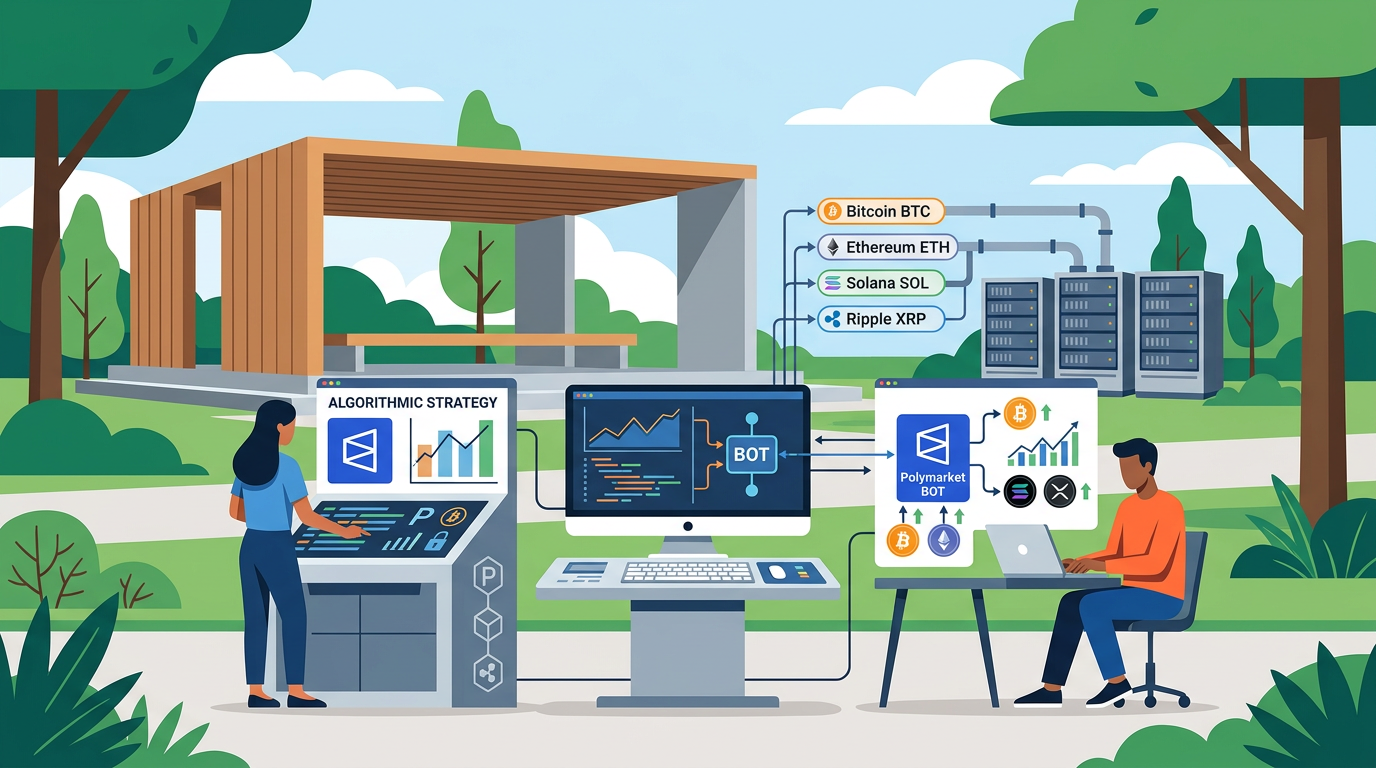 Automated scripts process market data to execute prediction trades with millisecond precision
The Polymarket bot is a ready-to-use Python script designed to automate the trading of binary outcomes on the world’s largest decentralized prediction market. According to RootData, Polymarket recorded $25.7 billion in trading volume in March 2026, showcasing a massive liquidity pool that algorithmic traders can now tap into without manual intervention. The bot monitors price fluctuations in real-time and executes trades based on pre-defined logic, specifically targeting high-velocity 5-minute and 15-minute markets for Bitcoin, ETH, SOL, and XRP.
Core architecture and CLOB interaction
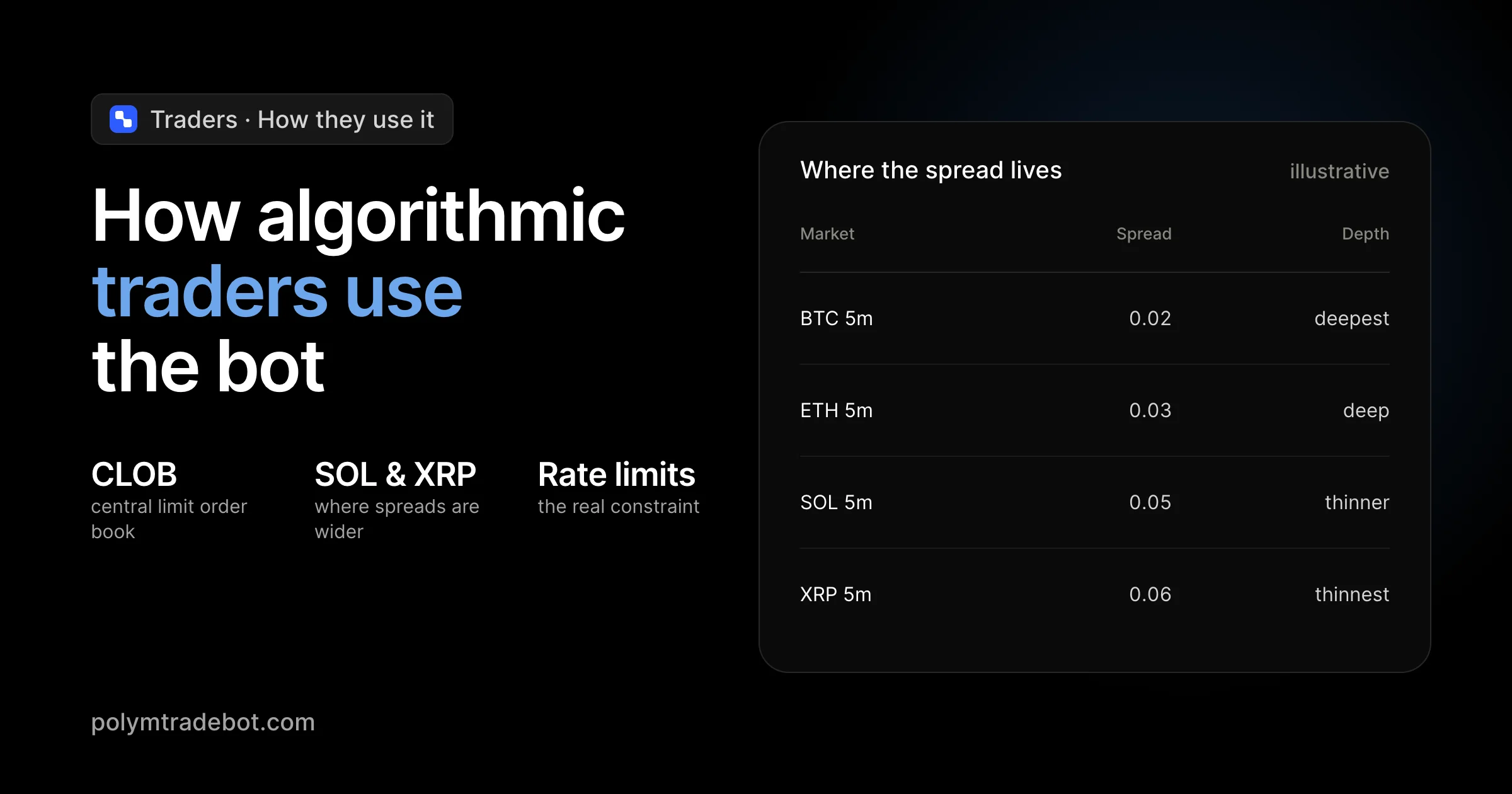
Unlike traditional AMMs (Automated Market Makers) that rely on liquidity pools, Polymarket utilizes a Central Limit Order Book (CLOB). Our Python script interacts directly with this CLOB via the Polymarket API. The bot scans the order book for bid-ask spreads and volume imbalances, allowing it to place limit or market orders programmatically.
By using Python, we provide a transparent environment where you can see exactly how the bot parses JSON responses from the API and translates them into trade signals. This architecture ensures that the bot isn't just "guessing" but reacting to the actual depth of the market.
Integration with the Polygon network
The heavy lifting of settlement happens on the Polygon network. When the bot triggers a trade, it interacts with smart contracts that lock in the "Yes" or "No" shares for a specific event, such as "Bitcoin above $70,000 at 4:00 PM."
Because Polygon offers low transaction fees, the bot can execute frequent trades in 5-minute windows without gas costs eating the entire profit margin. The smart contracts handle the escrow and eventual payout automatically once the market resolves, ensuring that the bot’s primary job is simply timing the entry and exit.
Managing API rate limits and connectivity
Maintaining a consistent connection to the exchange is the biggest hurdle for any algorithmic trader. Polymarket enforces strict rate limits to prevent spam. Our bot includes a built-in management layer that staggers requests and uses exponential backoff.
Observation. We noticed that during high-volatility events—like a sudden $2,000 Bitcoin candle—API latency often spikes; our script uses a "heartbeat" check to verify connectivity before attempting to fire orders into a stale book.
This ensures the bot stays online during peak trading hours without getting its API key temporarily blacklisted. It maintains a steady stream of data for the 5-minute and 15-minute markets, allowing for precise execution even when the broader network is congested.
How algorithmic traders use the polymarket bot for execution
 Automated bots execute high-frequency trades to capture fleeting price discrepancies in prediction markets
Algorithmic traders use the polymarket bot for rapid entry and exit to capitalize on price discrepancies that vanish in seconds. By automating the interaction with the Polygon-based central limit order book (CLOB), the script bypasses the latency of manual web interfaces. This speed is critical when trading 5-minute Bitcoin markets where a delay of ten seconds can mean the difference between a profitable entry and being trapped in a decaying position. In April 2026, Chainalysis deployed on-chain monitoring tools to flag manipulative patterns, making clean, programmatic execution even more vital for traders who want to remain compliant while staying competitive.
Capturing the spread in SOL and XRP
While Bitcoin and ETH markets see the highest volume, specialized traders often target the wider spreads found in SOL and XRP prediction markets. Because these markets are less liquid, the gap between the "Yes" and "No" price is frequently large enough to allow for market-making strategies. We use the bot to place limit orders on both sides of the spread. Instead of crossing the spread and paying the "taker" price, the bot sits on the order book, waiting for retail participants to hit our standing orders. This turns the volatility of SOL and XRP into a source of passive yield through the bid-ask spread.
Managing depth and slippage
Execution quality depends heavily on order book depth. During high-volatility events—such as a sudden move in the underlying price of BTC—liquidity can thin out instantly. If you send a large market order into a thin book, you suffer significant slippage, drastically altering your expected value (EV).
Our Python script manages this by:
- Slicing orders: Breaking a large position into smaller "child" orders to minimize market impact.
- Price ceilings: Setting hard limits so the bot won't execute if the price moves beyond a specific threshold during the API call.
- Real-time depth analysis: Checking the top three levels of the book before firing an execution command.
Strategy validation via paper trading
Before committing capital to the live 15-minute Bitcoin Up or Down markets, we use the paper trading mode to validate our logic. This simulation environment mirrors the live CLOB, allowing the bot to "execute" trades against real-time price action without risking a single USDC.
Observation. We noticed that strategies performing well in backtests often fail in live markets due to execution latency; using paper trading mode for 48 hours usually reveals these timing gaps before they cost real money.
This phase is essential for testing "if-then" scenarios. For instance, you can verify if your bot correctly cancels an XRP limit order when the underlying price hits a stop-loss level on an external exchange like Binance. Only after the execution logs show zero missed opportunities and consistent entry prices do we switch the script from simulation to live production.
Arbitrage strategies in prediction markets
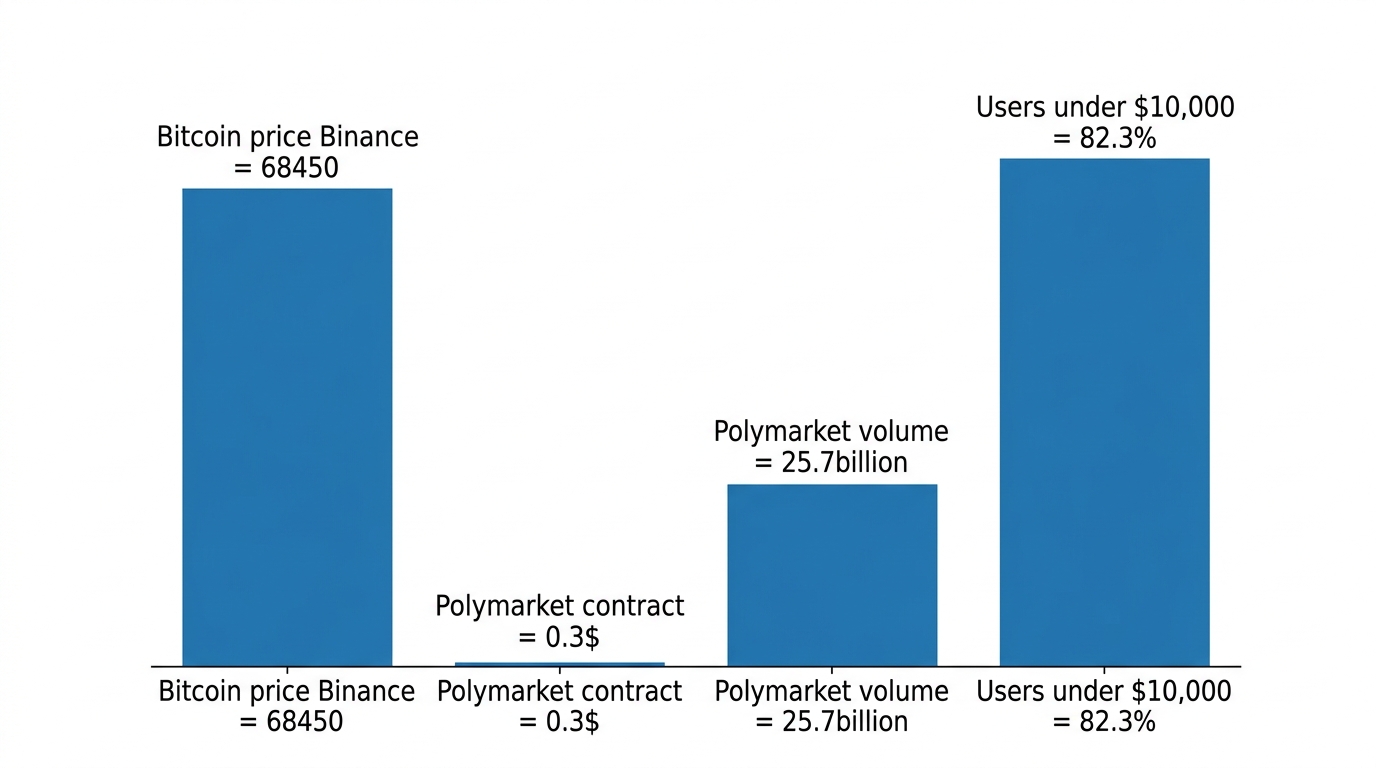 Automated bots capture price discrepancies between prediction markets and external exchanges in real time
Arbitrage in prediction markets relies on the price lag between Polymarket’s binary outcome contracts and the underlying asset's real-time value on centralized exchanges (CEXs). Because Polymarket prices represent a probability (e.g., $0.55 for "Bitcoin Up" equals a 55% implied probability), any deviation from the mathematical probability suggested by the perpetual futures price creates an immediate entry point.
Cross-exchange price discrepancies
The most common strategy involves exploiting the gap between Polymarket odds and CEX perpetual futures. If Bitcoin is trading at $68,450 on Binance but the Polymarket "Bitcoin above $68,500" 5-minute contract is trading at $0.30 (30% probability), there is a disconnect. A bot can calculate the "fair value" of that contract based on current volatility and the time remaining.
Our Python script automates this by pulling order book data from both Polymarket and major CEXs simultaneously. When the bot detects that the 'Up' contract is undervalued relative to the spot price move, it executes a buy order. Traders often hedge this by taking a micro-short position on the CEX, locking in a profit regardless of the final candle close.
Internal market inefficiencies
Market participants often react slower than the underlying price action, especially in 5-minute and 15-minute windows. Algorithmic traders use the Polymarket API to monitor the Central Limit Order Book (CLOB) for "stale" limit orders. If a sudden price spike occurs on Bitget or Coinbase, the bot can sweep the remaining 'Down' contracts on Polymarket before the market makers update their quotes.
Observation. We noticed that during high-volatility sessions, Polymarket’s price discovery often lags the spot market by 1.5 to 3 seconds. By incorporating oracle latency into the bot logic, you can effectively "front-run" the price resolution by identifying moves that have already happened on the CEX but haven't yet reflected in the contract price.
Exploiting the retail-heavy environment
The prediction market landscape is currently dominated by retail participants rather than institutional liquidity. In 2026, Bitget Wallet and Polymarket reported $25.7 billion in volume, yet 82.3% of users traded with amounts under $10,000. For an algorithmic trader, this is an ideal environment.
Retail traders often trade based on sentiment or "gut feeling," leading to overbought or oversold contracts. High-frequency bots exploit this by:
- Identifying momentum exhaustion: Buying 'Down' contracts when retail pushes 'Up' odds to 95% on a move that hasn't cleared key resistance.
- Liquidity harvesting: Placing limit orders slightly inside the spread to capture the premium from impatient retail market-takers.
- Time-decay plays: Selling overvalued contracts as the 5-minute window expires, where retail often overestimates the chance of a last-second price reversal.
Because the Bitcoin and ETH markets on Polymarket are settled via smart contracts, the execution is transparent. The bot simply needs to be faster than the average manual user to capture the spread.
Risk management and capital preservation
Algorithmic traders treat Polymarket not as a gambling venue, but as a source of yield that requires strict capital controls. Because prediction markets for 5-minute or 15-minute Bitcoin intervals can be highly volatile, the Polymtradebot uses a dynamic position-sizing engine to protect the underlying wallet. Instead of static bets, the bot calculates exposure as a percentage of the total available balance, typically capping any single trade at 1% to 2% to survive long-tail losing streaks.
Position sizing and liquidity monitoring
The bot’s logic integrates real-time wallet auditing. Before executing a trade in the BTC or ETH "Up or Down" markets, the script checks the current balance and adjusts the order size based on the Kelly Criterion or a fixed-fractional model. This prevents a single "fat finger" error or a flash crash from wiping out the trading capital.
Beyond balance protection, the bot monitors on-chain health and order book depth. If the liquidity in a specific Polymarket pool dries up—indicated by a widening bid-ask spread—the bot is programmed to halt new entries and, if necessary, exit existing positions. This prevents "slippage traps" where the cost of exiting a trade exceeds the potential profit.
Observation. In our practice, we’ve seen that 5-minute markets often experience liquidity "holes" right before the contract expiry. Our bot handles this by shifting to "reduce-only" mode 60 seconds before settlement to avoid being stuck in a position with no exit path.
Delta-neutrality and automated hedging
Advanced traders use the bot to manage the "Greeks" of their prediction market portfolio. While Polymarket contracts are binary, they still carry a directional delta. To achieve a delta-neutral or market-neutral stance, the bot can be configured to execute offsetting trades on external platforms.
If the bot takes a heavy "Up" position on Bitcoin within Polymarket, it can simultaneously trigger a short position or sell spot holdings of highly correlated assets like SOL or XRP. This automated hedging ensures that the trader is betting on the accuracy of the prediction market's mispricing rather than the direction of the crypto market itself.
- Exposure Limits. Define the maximum USD value allowed in open contracts at any given time.
- Correlation Hedging. Use the bot to sell XRP or SOL spot when Polymarket exposure to BTC "Up" contracts exceeds a specific threshold.
- Paper Trading Validation. Use the built-in simulation mode to test how these hedges perform during high-volatility events without risking real assets.
By treating Polymarket positions as part of a broader portfolio, the bot allows you to capture alpha from retail sentiment while maintaining a professional risk profile. This systematic approach differentiates a high-frequency bot user from a manual speculator who might be blinded by short-term price action.
Market integrity and the impact of wash trading
Trading on Polymarket requires a shift in how you evaluate order book depth. While high volume usually signals a healthy market, prediction markets are prone to artificial activity that can trap algorithmic traders in illiquid positions. In 2025, a study by Columbia University revealed that approximately 25% of Polymarket's total volume was the result of artificial wash trading. For someone running a bot, this means the "liquidity" you see on the screen might vanish the moment you attempt a large exit.
Identifying artificial volume
Wash traders use scripts to buy and sell against themselves, creating the illusion of high interest to attract retail participants or farm platform rewards. When you use the Polymtradebot, you must distinguish between organic price discovery and these circular trades. Organic volume typically correlates with external news events—like a sudden shift in Bitcoin spot prices or a major political announcement. Wash trading, conversely, often appears as repetitive, same-sized clips that don't move the mid-price.
Observation. In our practice, we’ve seen that wash-heavy markets often exhibit "flat" volatility despite high turnover. If a Bitcoin 5-minute market shows $100k in volume but the spread never tightens below 2 cents, the liquidity is likely synthetic.
Adjusting for fake liquidity
To protect capital, algorithmic traders must adjust their slippage tolerance to account for this padded volume. If the bot assumes it can move $5,000 without price impact based on a wash-inflated book, it will likely face a "liquidity cliff" where the actual available depth is only $1,000.
We recommend these technical adjustments:
- Dynamic Slippage Caps. Set your Python script to reject execution if the projected price impact exceeds 1.5%, regardless of the displayed volume.
- Volume Weighting. Discount the reported 24-hour volume by at least 30% when calculating position sizes to ensure you aren't over-leveraged against ghost orders.
- On-chain Verification. Check the number of unique active addresses participating in a specific market. High volume with a low participant count is a primary red flag for manipulation.
Regulatory and platform responses
The environment is becoming more transparent as the platform matures. In 2026, Polymarket partnered with Chainalysis to deploy on-chain monitoring tools specifically designed to identify and flag manipulation patterns. These tools track the flow of funds between accounts to detect clusters of addresses controlled by the same entity.
As these monitoring tools improve, the "cost" of wash trading increases for bad actors, leading to more reliable data for your bot's decision-making engine. However, until these patterns are fully eradicated, maintaining a conservative execution logic remains the best defense against being on the wrong side of an artificial price spike.
Checklist: Verifying bot performance and security
Before deploying the Polymtradebot into live markets, you must validate that your technical environment and execution logic can handle the specific constraints of the Polygon network. High-frequency trading on prediction markets leaves no room for "good enough" setups; a single delayed transaction or a leaked key can wipe out your liquidity before the next 5-minute cycle begins.
Hardening the Python environment
Your bot's security starts with how you handle your private keys. Never hardcode your wallet's private key directly into the Python script. If you push that code to a private repository or share it with a colleague, you’ve created a permanent security hole.
Use a .env file to store sensitive credentials and load them using the python-dotenv library. Ensure your .gitignore file explicitly excludes this environment file. For institutional setups, we recommend using a dedicated secrets manager or an encrypted vault to inject keys at runtime. This keeps your capital safe even if the local codebase is compromised.
Stress testing with paper trading
We designed the Polymtradebot with a paper trading mode specifically to bridge the gap between backtesting and live execution. Run the bot for at least 100 cycles in the 5-minute Bitcoin market using simulated capital.
What are you looking for during these 100 cycles?
- Logic consistency. Does the bot execute "Down" contracts when your indicator hits the threshold, or is there a calculation lag?
- API stability. Does the connection to the Polymarket CLOB stay active through periods of high volatility?
- Slippage simulation. Compare the bot’s "fill price" against the actual order book depth during those 500 minutes of testing.
Observation. In our practice, traders who skip the 100-cycle simulation often fail to account for "stale" order books, where the top-of-book liquidity disappears the millisecond a price move occurs on Binance or Coinbase.
Oracle and price feed verification
The bot relies on accurate price data to determine if a contract is mispriced. If your bot thinks Bitcoin is at $65,000 but the Polymarket settlement oracle sees $64,980, you will consistently enter losing positions.
Cross-reference your primary price feed (typically a CEX WebSocket) against multiple external oracles like Chainlink or Pyth. If the deviation between your feed and the external oracle exceeds 0.05%, the bot should pause execution. This prevents "toxic" fills where you are trading against someone with a faster data pipeline.
Managing Polygon gas and execution speed
While Polygon is cheaper than Ethereum, gas spikes can still kill the profitability of a high-frequency strategy. During major market moves, the base fee on Polygon can jump 10x in seconds.
- Monitor Gas Prices. Set a maximum Gwei limit in your script. If the cost to execute a trade eats more than 10% of the expected profit, stay on the sidelines.
- Transaction Priority. Use "Fast" or "Rapid" gas settings to ensure your order hits the block immediately. A transaction that hangs for 30 seconds is useless in a 5-minute market.
- Latency Checks. Ping your RPC provider. If your latency to the Polygon nodes exceeds 150ms, you are likely too slow to capture arbitrage gaps before other bots close them.
Execution and the Path Forward
Successful trading on Polymarket requires more than just a directional bias; it demands a systematic approach to order entry and risk. By deploying the Polymtradebot script, you transition from reactive manual betting to proactive algorithmic execution. This shift allows you to capture price discrepancies in the 5-minute and 15-minute Bitcoin markets before the broader crowd can respond to the underlying price action on centralized exchanges.
The integration of automated Python scripts ensures that your strategy remains active during overnight sessions or high-volatility events when manual intervention is too slow. You gain the ability to run arbitrage loops and manage capital across BTC, ETH, SOL, and XRP markets with mathematical precision. This technical edge is what separates professional market participants from casual speculators in the prediction market ecosystem.
Review the pricing options to select a license that fits your trading volume and start running the script in paper trading mode to validate your strategy.
FAQ
Does the Polymarket bot support custom indicators for Bitcoin trading?
Yes, you can integrate any technical indicator available in Python libraries like Pandas or TA-Lib into the script. Since the bot is a ready-to-use Python file, you simply add your logic for moving averages, RSI, or MACD to trigger the execution functions. This allows the bot to trade 5-minute Bitcoin "Up" or "Down" markets based on your specific signal parameters.
Can I run the Python script on a cloud server for 24/7 operation?
You can host the script on any Virtual Private Server (VPS) that supports Python 3.x, such as AWS, DigitalOcean, or Google Cloud. Running the bot on a cloud server ensures constant uptime and lower latency compared to a home internet connection. This setup is essential for capturing opportunities in the 15-minute markets that settle around the clock.
How does the bot handle 15-minute market settlements during high volatility?
The bot monitors the Polymarket API for settlement status and uses pre-defined risk parameters to manage open positions during price spikes. If the underlying asset like Bitcoin moves sharply, the script executes stop-loss or take-profit orders based on the logic you have configured. This automated response prevents the emotional delays that often lead to losses during rapid market shifts.
Is the paper trading mode an accurate reflection of live market liquidity?
The paper trading mode simulates execution based on real-time order book data from Polymarket without risking actual capital. While it accurately reflects current price movements and spread widths, it cannot perfectly simulate the slippage of very large orders in illiquid markets. We recommend using this mode to test the logic of your arbitrage and execution timing before moving to live funds.
What are the minimum hardware requirements for running the Polymtradebot script?
The script is lightweight and runs efficiently on a machine with 2GB of RAM and a single-core CPU. Because it primarily handles API requests and basic mathematical calculations, you do not need a high-end GPU or extensive storage. A basic Raspberry Pi or the smallest available tier of a cloud VPS provides more than enough power for 24/7 operation.
Sources
- Columbia University (2025) — A Columbia University study found that approximately 25% of Polymarket's total trading volume was attributed to artificial wash trading activity.
- Bitget Wallet and Polymarket (2026) — Polymarket recorded $25.7 billion in trading volume in March 2026, with 82.3% of users maintaining volumes below $10,000.
- Chainalysis (2026) — Polymarket partnered with Chainalysis in April 2026 to deploy on-chain monitoring tools for identifying trading patterns consistent with market manipulation.