

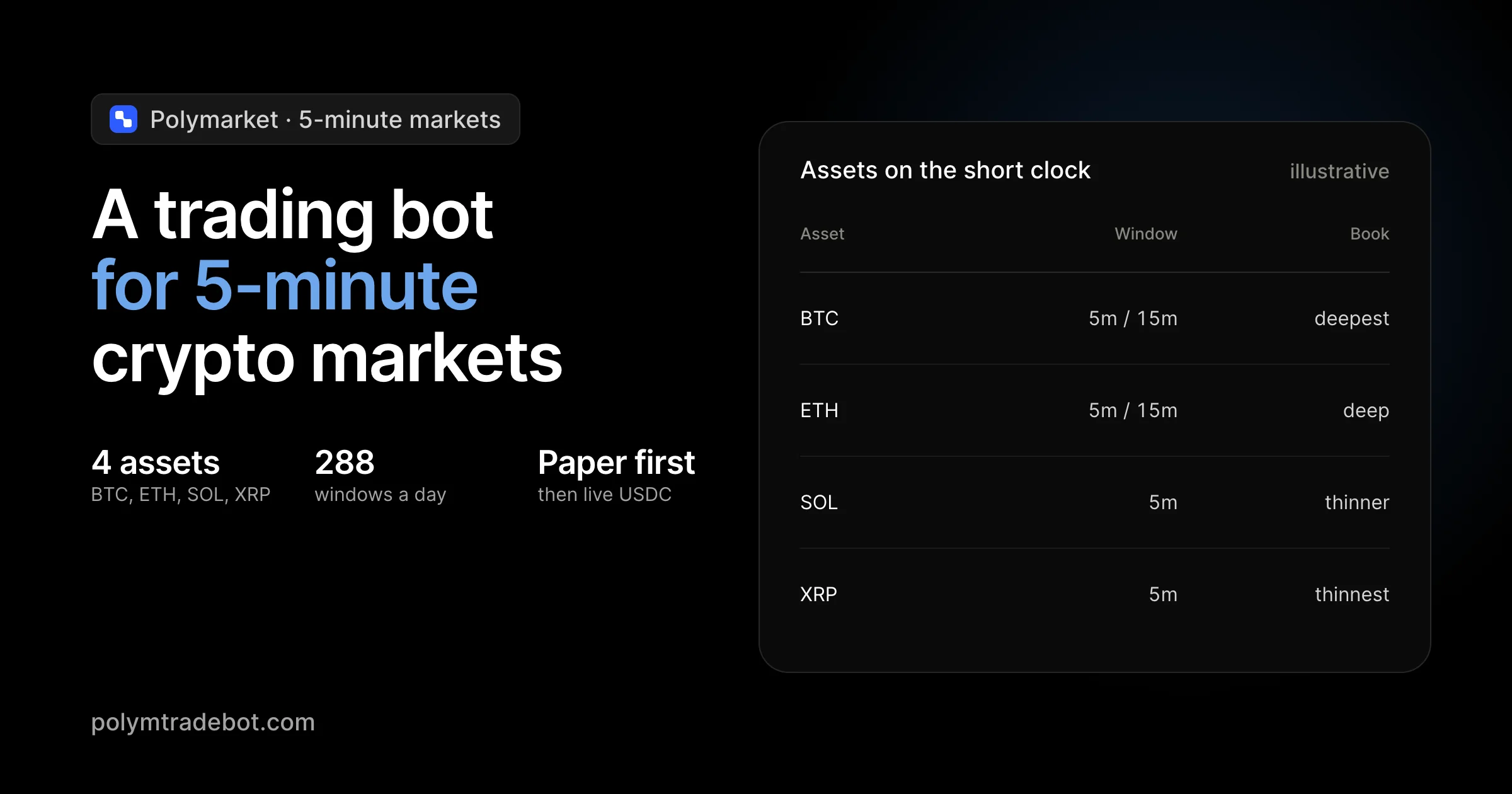
Short-horizon crypto markets on Polymarket move fast. In a 5-minute Bitcoin Up or Down market, a few seconds of hesitation can change the available price, reduce your edge, or leave an order unfilled. That is why many active traders look for a Polymarket trading bot instead of clicking manually.
A good bot is not magic and it is not a guaranteed-profit machine. It is an automation layer: it watches market data, applies predefined rules, places orders through the Polymarket API, and manages exposure faster than a human can react.
This guide explains how a Polymarket trading bot works for 5-minute and 15-minute crypto markets, what to check before running one, and why paper trading should come before live USDC execution.
What is a Polymarket trading bot?
A Polymarket trading bot is a script that automates trading decisions and order execution on Polymarket prediction markets. Instead of manually watching charts, order books, and market probabilities, the bot follows a configured strategy.
For crypto Up or Down markets, the bot usually focuses on questions such as:
- Is Bitcoin likely to finish above or below the target price at settlement?
- Is the current YES or NO price attractive enough to enter?
- Is there an arbitrage or hedging opportunity between both sides of the market?
- How much capital should be allocated to this trading window?
- When should the bot stop trading to avoid late-window volatility?
The main benefit is consistency. The bot does not get tired, hesitate, revenge trade, or miss a market because it looked away from the screen.
Why 5-minute crypto markets are different
The 5-minute Polymarket crypto markets are very different from slow political or sports markets. They are short, liquid, and sensitive to rapid price movement in the underlying asset.
That creates both opportunity and risk. A small move in Bitcoin, Ethereum, Solana, or XRP can quickly change market probabilities. If you are trading manually, you may see a good entry but lose it before your order is placed. A bot can monitor these changes continuously and react according to your rules.
The trade-off is that bad rules are also executed quickly. Automation makes a good strategy faster, but it also makes a weak strategy lose faster. This is why every setup should start with simulation.
Core features to look for
A practical Polymarket trading bot for crypto markets should include more than a simple buy command. At minimum, look for these features:
- Direct Polymarket API execution for faster order placement.
- Real-time order book monitoring so the bot can react to changing prices.
- Configurable entry thresholds instead of hard-coded guesses.
- Position sizing controls to limit exposure per market.
- Paper trading mode for testing without risking real funds.
- Clear logs so every trade can be reviewed after the session.
- Risk controls that stop the bot when market conditions are no longer favorable.
If you are evaluating a script, transparency matters. A full source-code bot is easier to inspect, modify, and run locally than a black-box web dashboard.
Example workflow for running the bot
A typical workflow starts before the market opens. First, you configure the bot with your market type, capital limits, and entry thresholds. Then you run it in paper mode and let it observe live markets without placing real orders.
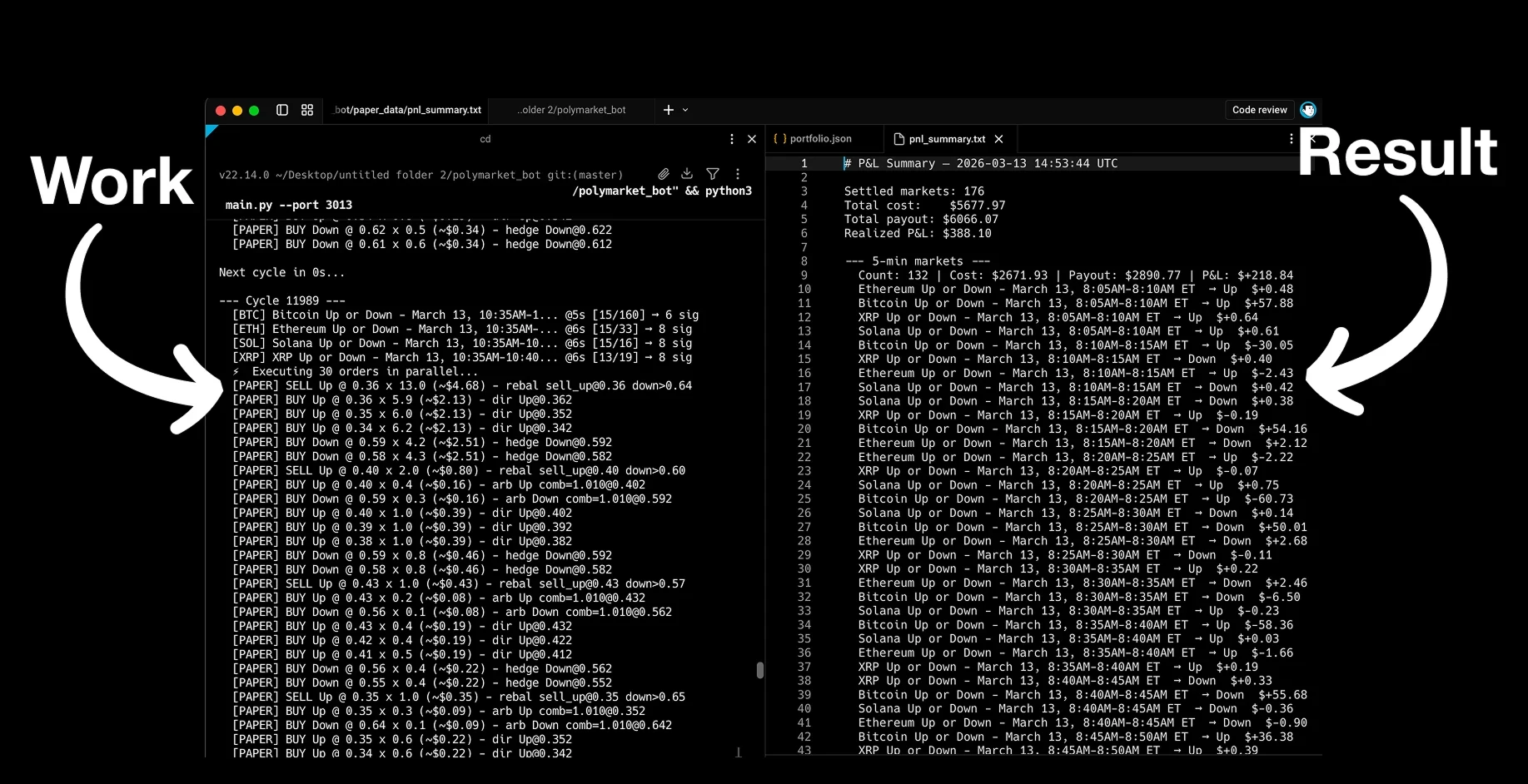
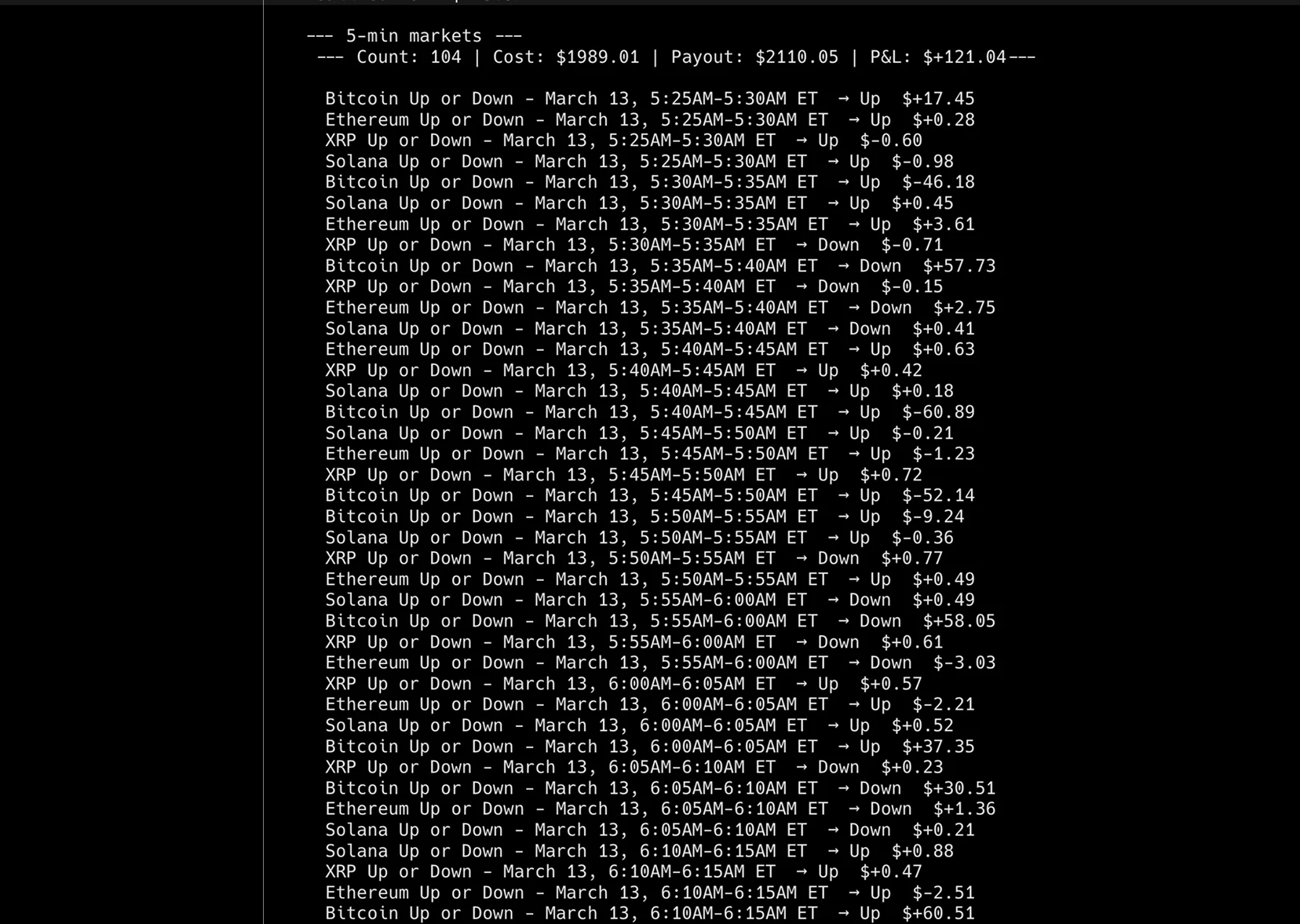
After a test session, review the logs. Look at entries, exits, skipped trades, simulated PnL, and the exact moments when the bot decided to act. If the rules make sense and the execution behaves as expected, you can consider moving to a small live test.
A conservative workflow looks like this:
- Run the bot in paper trading mode for several sessions.
- Check whether the strategy behaves logically in both calm and volatile markets.
- Lower trade size for the first live test.
- Monitor execution, fills, and wallet activity.
- Increase size only after the strategy has proven stable.
The goal is not to automate risk away. The goal is to make every risk explicit and configurable.
Paper trading before live USDC
Paper trading is one of the most important parts of any automated Polymarket setup. It lets you test the strategy on live market data without committing real USDC.
This is especially useful in 5-minute markets because the trading window is short enough to generate many examples quickly. You can see how the bot responds to price spikes, flat markets, sudden reversals, and thin order books.
Before using real capital, paper trading should answer these questions:
- Does the bot enter only when the configured conditions are met?
- Does it avoid overtrading during noisy periods?
- Are order sizes aligned with your risk budget?
- Are logs clear enough to debug mistakes?
- Does the bot stop when limits are reached?
If the answer to any of these questions is unclear, stay in simulation mode.
Risk management rules that matter
The fastest bot is not always the best bot. In short-term prediction markets, risk management is often more important than raw execution speed.
Useful controls include maximum exposure per market, maximum number of active positions, minimum expected edge, stop conditions near settlement, and a hard daily loss limit. These settings help prevent one bad market or one bad configuration from damaging the entire account.
It is also important to understand that market conditions change. A strategy that works during high volatility may perform poorly in a slow market. A transparent Python script makes it easier to adjust assumptions as conditions evolve.
Why source-code access helps
For many traders, the main advantage of owning the source code is control. You can inspect the strategy, change thresholds, add logging, connect notifications, or ask an AI coding assistant to explain each part of the script.
This is useful even if you are not a senior developer. Modern AI editors can help with installation, environment variables, dependency errors, and simple strategy changes. The key is that the code is available to you instead of hidden behind a subscription interface.
If you want a ready-to-run script for short-horizon crypto markets, the Polymarket Trading Bot provides full Python source code, paper trading mode, and configurable execution logic for 5-minute and 15-minute markets. You can review the setup and pricing on the homepage: Polymarket Trading Bot.
Final thoughts
A Polymarket trading bot can make short-horizon crypto trading faster and more disciplined, but it should be treated as trading infrastructure, not a promise of profit. The best approach is simple: start with transparent rules, test in paper mode, keep position sizes controlled, and only scale after the data supports it.
For 5-minute Bitcoin Up or Down markets, automation can be a real advantage. The traders who benefit most are usually the ones who combine speed with careful testing and strict risk limits.