

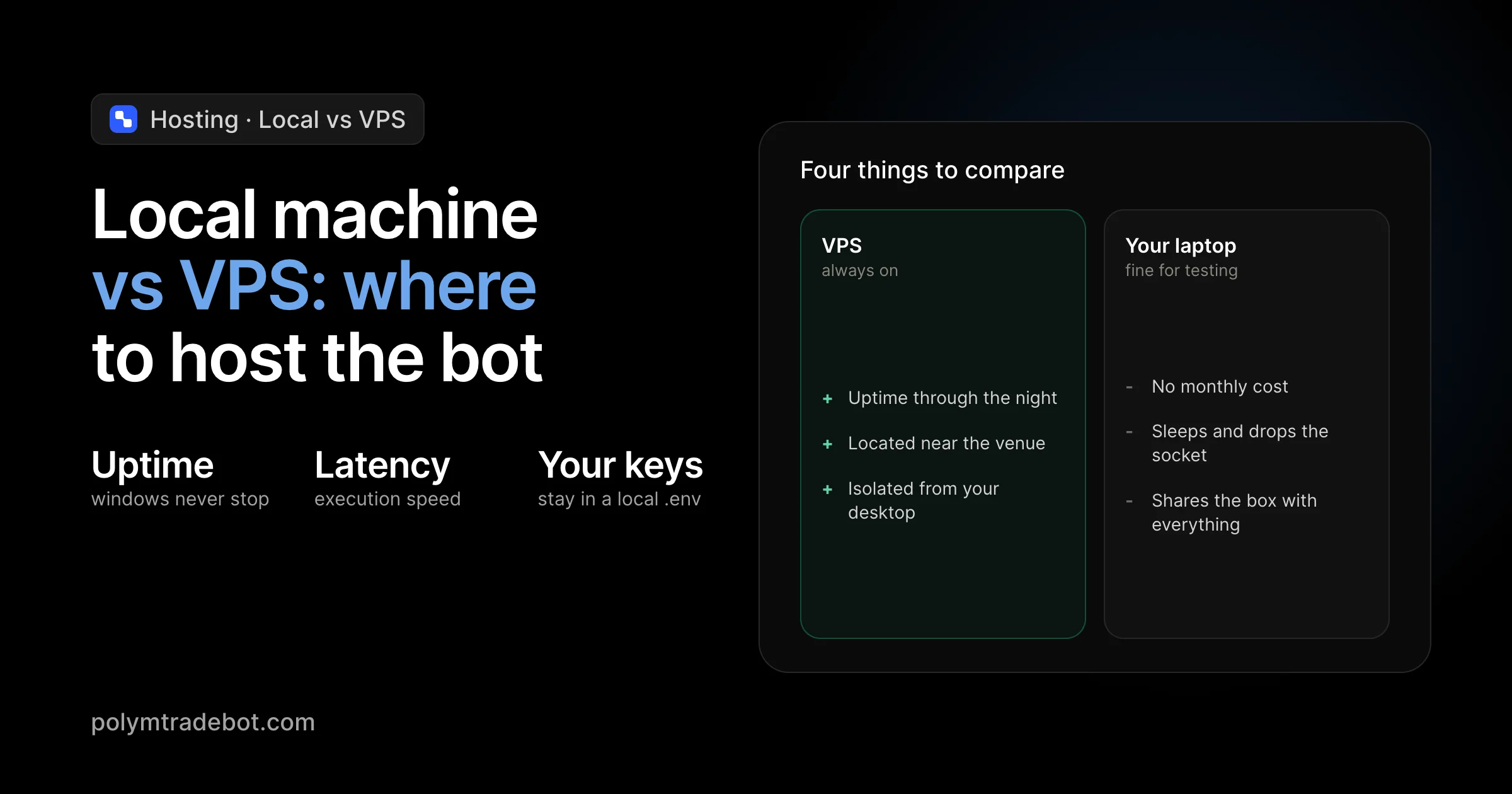
Managed services captured 67.85% of the virtual private server market share in 2025 as enterprises outsourced server monitoring and compliance, according to Mordor Intelligence. This shift highlights a critical tension for traders: do you maintain total control over your hardware or outsource the headache to a professional data center? When running a Polymarket trading bot for 5-minute or 15-minute Bitcoin markets, a single power outage or a 500ms lag spike can turn a profitable arbitrage opportunity into a missed execution. The debate over local machine vs VPS: where to host your bot isn't just about technical preference; it is a choice between zero-cost hardware access and the mission-critical uptime required for high-frequency crypto markets.
In our practice at Polymtradebot, we see users struggle with the hidden costs of running Python scripts on a home setup, from ISP throttling to unexpected OS updates. You will learn how to weigh the latency of your local network against the stability of a managed server. We break down which environment supports high-speed execution for SOL and ETH trades and where the risk management features of our script perform best. By comparing hardware overhead, connection reliability, and long-term costs, you can decide if your current desktop is a viable workstation or a bottleneck for your capital.
Key Takeaways
- Managed VPS services dominated 67.85% of the market in 2025 due to superior monitoring and uptime.
- Local machines offer zero monthly fees but risk execution failure during home internet or power outages.
- A VPS provides the low-latency environment necessary for 5-minute Polymarket interval strategies.
- Use a local machine for paper trading simulations before deploying to a dedicated server.
Table of contents
- Local machine vs VPS: what's the difference
- Criteria for comparing hosting environments
- Hosting on a local machine: pros and cons
- Hosting on a VPS: pros and cons
- Local machine vs VPS: breakdown by execution speed
- When to pick a local machine vs when to pick a VPS
- Choosing your environment
- FAQ
- Sources
Local machine vs VPS: what's the difference
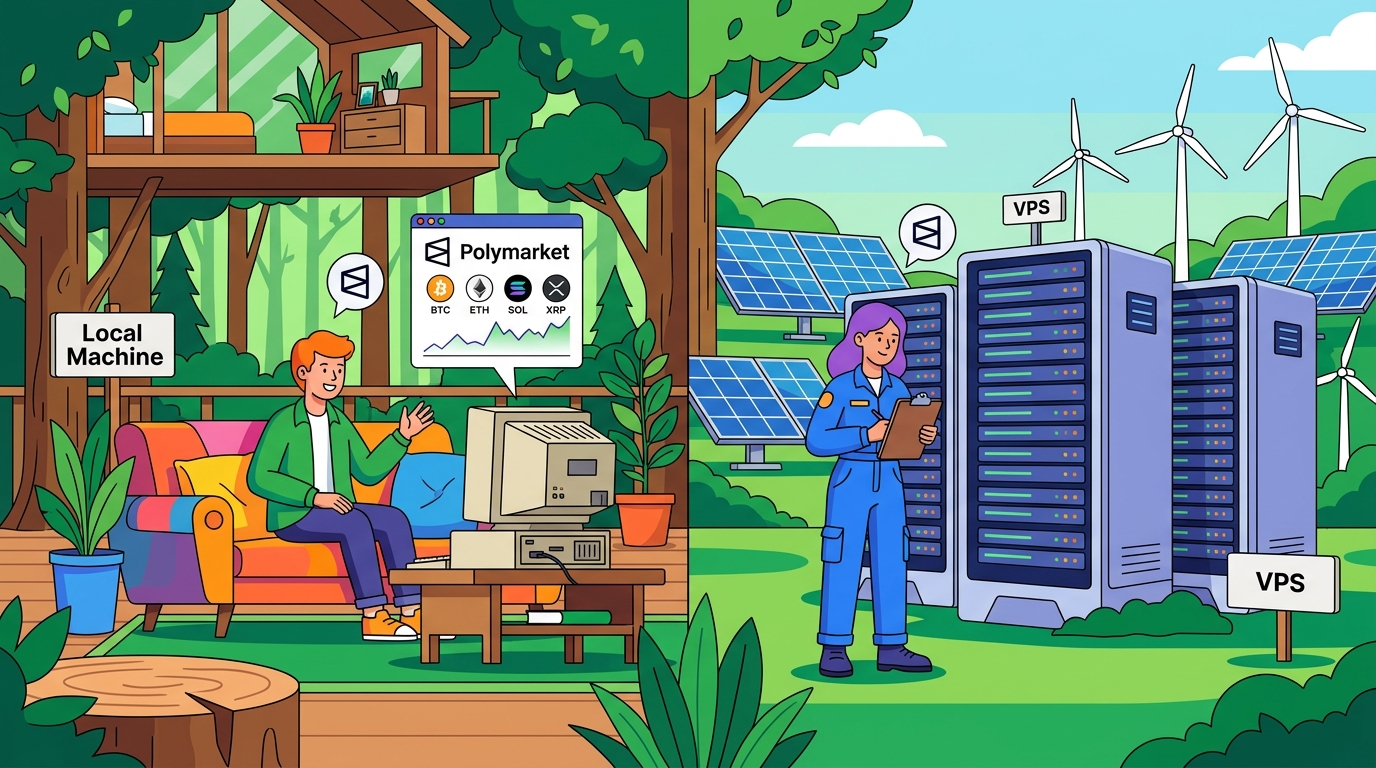 Evaluating hardware reliability against cloud scalability helps you choose the right hosting environment
The distinction between hosting environments comes down to who manages the uptime and where the Python interpreter lives. When you run the Polymtradebot script on a local machine, you are utilizing your own hardware—typically a home PC, a laptop, or a dedicated micro-computer like a Raspberry Pi. In contrast, a Virtual Private Server (VPS) is a remote, virtualized instance hosted in a professional data center, providing a persistent environment that remains online regardless of whether your home devices are powered on.
Beyond just physical location, the infrastructure security differs significantly. According to Gartner, in 2025 public cloud service workloads are estimated to suffer at least 60% fewer security incidents than those in traditional local data centers. For a bot handling Bitcoin or SOL trades, this gap in security and availability often dictates your strategy.
Defining the local environment
A local setup gives you absolute ownership of the hardware stack. You aren't paying monthly rental fees, and you have zero latency between your keyboard and the script configuration. However, you are the sole person responsible for the "three pillars" of bot stability: power, internet connectivity, and cooling. If your home Wi-Fi blips for ten seconds during a volatile 5-minute market window, your bot may miss the exit signal, turning a planned arbitrage win into a lingering loss.
The role of the Virtual Private Server
A VPS functions as a "headless" computer in the cloud. You connect via SSH, install Python, and leave the script running in a screen session or as a system service. Because these servers sit on high-speed backbone networks, they offer a static IP address and near-perfect uptime. This is mission-critical for execution-heavy strategies where being offline for even a minute results in missed opportunities.
Observation. In our practice, we see that traders running 15-minute trend-following strategies often start on a local machine to save costs, but those focusing on 5-minute arbitrage almost always migrate to a VPS within the first week to eliminate home-network latency.
The choice is rarely about which is "better" in a vacuum, but rather which matches your specific trading frequency:
| Feature | Local Machine | VPS (Cloud) |
|---|---|---|
| Upfront Cost | $0 (if using existing PC) | Monthly subscription |
| Power Reliability | Subject to local outages | Data center redundancy |
| IP Address | Usually dynamic (changes) | Static (consistent) |
| Maintenance | You handle hardware/OS updates | Provider handles hardware |
Criteria for comparing hosting environments
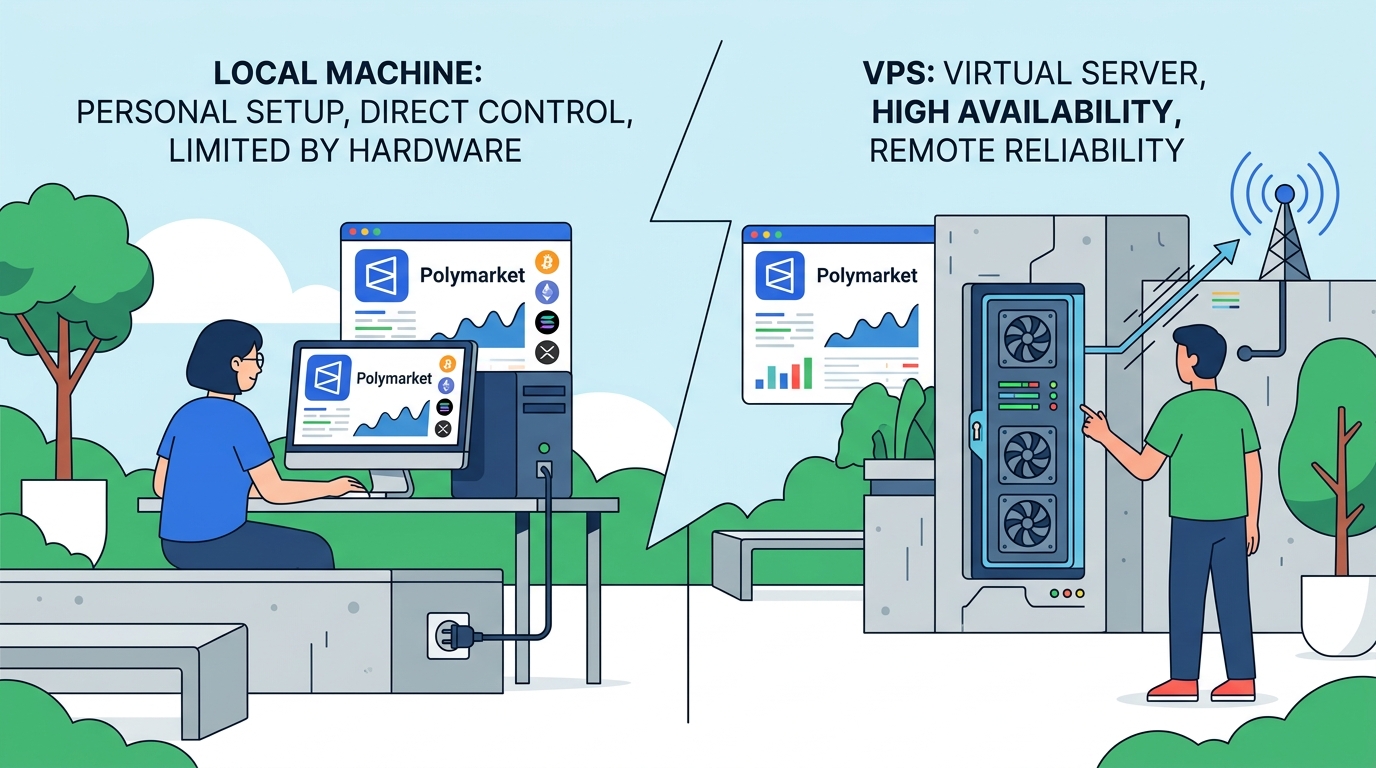 Evaluating key performance factors helps you decide between a local machine vs vps for your bot
Selecting where to run your bot requires balancing technical overhead against the specific demands of Polymarket’s order books. While a local setup costs nothing upfront, a reliable entry-level VPS in 2025 typically ranges between 5 and 7 USD for 1 vCPU according to Servers Expert. This small monthly fee often pays for itself by eliminating the "hidden" costs of home hosting, such as electricity and the risk of missed trades during a local ISP outage.
Uptime and execution speed
Polymarket’s 5-minute markets for Bitcoin and ETH move fast. If your internet drops for sixty seconds or your laptop goes into sleep mode, the bot misses the entry signal or, worse, fails to exit a losing position. A VPS provides 99.9% uptime and sits in a data center with high-bandwidth backbone connections. This reduces the time between a signal triggering in your Python script and the order hitting the exchange. In 5-minute intervals, a 500ms delay caused by a congested home Wi-Fi network can be the difference between capturing an arbitrage gap and getting filled at a worse price.
Security and key management
Hosting locally means your private keys and API secrets live on a machine you likely use for browsing, email, and downloads. This creates a larger attack surface for malware. A VPS allows for an isolated environment where only the Polymtradebot dependencies are installed. However, physical security is the flip side: a local machine is under your roof, while a VPS provider technically has access to the underlying hardware. We recommend using environment variables or encrypted secret managers regardless of the environment to keep your credentials out of plain-text scripts.
Maintenance and total cost
Running a bot 24/7 on a personal computer increases hardware wear and adds to your monthly power bill. There is also the "human tax" of maintenance. On a local machine, you must manually manage OS updates that might force a reboot mid-trade. On a VPS, you can set up a clean Linux environment (like Ubuntu 22.04 LTS) specifically for Python.
What we noticed. When running 15-minute trend strategies, a brief local disconnection is annoying but rarely fatal; however, for 5-minute arbitrage, we found that even a minor background Windows Update on a local machine can spike CPU usage enough to lag the bot's execution loop.
Resource isolation
If you host locally, your bot competes for RAM and CPU cycles with your browser tabs and other apps. If your system hangs while you're watching a video, the bot hangs too. A VPS ensures that the 1GB or 2GB of RAM you pay for is dedicated entirely to your Python environment, providing a stable baseline for risk management calculations and signal processing.
Hosting on a local machine: pros and cons
 A home computer offers total control but requires constant power and internet stability
Running Polymtradebot on your own hardware eliminates recurring monthly overhead and keeps your sensitive API keys within your physical reach. It is the most direct way to interact with the script, as you own the entire stack from the silicon to the Python environment. However, this control introduces structural vulnerabilities that can be fatal for high-frequency trading in Polymarket’s 5-minute markets.
The benefits of local control
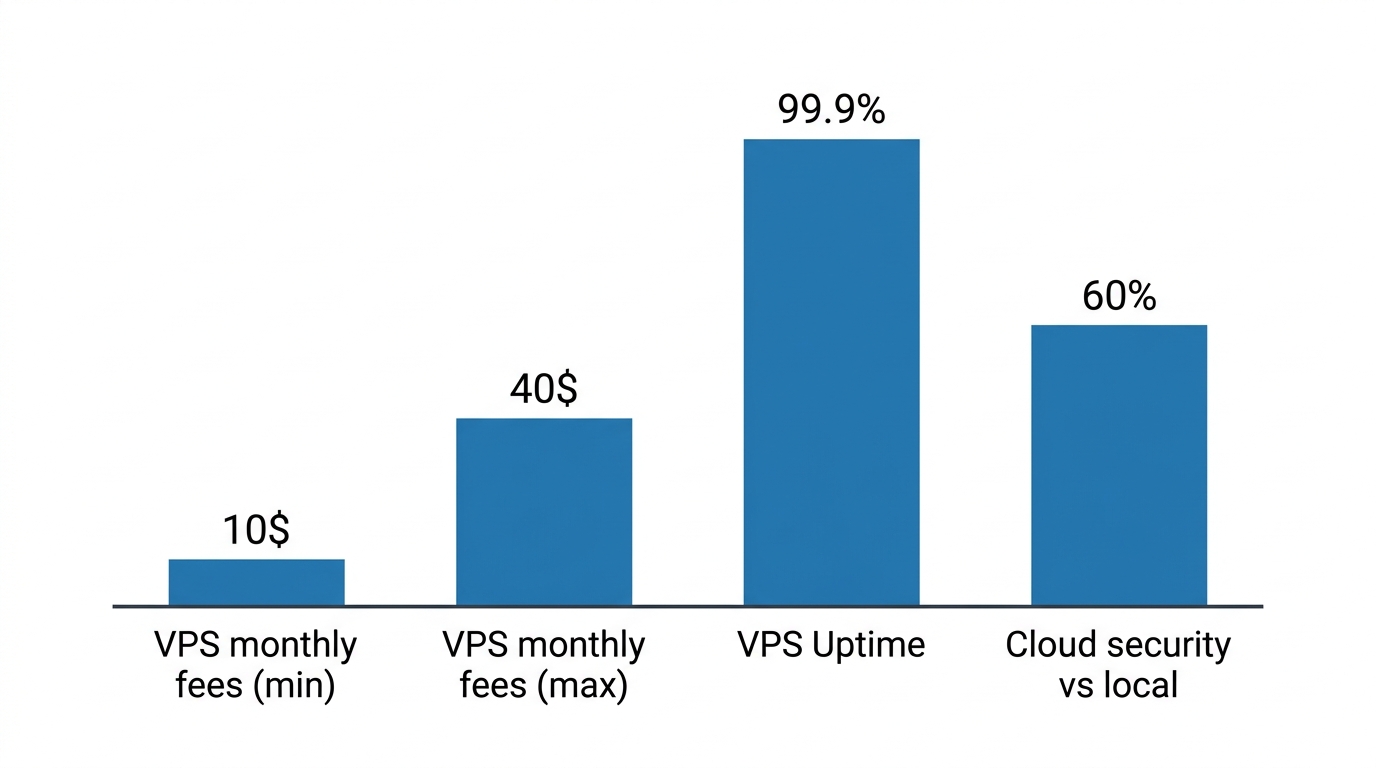
The primary advantage is cost. By using a machine you already own, such as a desktop PC or a dedicated Raspberry Pi, you bypass the $10–$40 monthly fees typical of a reliable VPS provider. You are not renting a slice of a server; you are utilizing existing resources.
Data sovereignty is the second pillar. When you host locally, your private keys for your Polygon wallet never leave your premises. You don't have to trust a third-party provider's internal security protocols or worry about "noisy neighbors" on a shared server affecting your script's performance.
Stability risks and the "Downtime Tax"
The trade-off for zero subscription fees is the burden of maintaining 100% uptime. Most home setups are not designed for mission-critical execution. A single ISP hiccup or a Windows "forced update" at 3:00 AM can disconnect your bot, causing it to miss a crucial exit signal in a 15-minute trend.
Physical failures are equally disruptive. Without an Uninterruptible Power Supply (UPS), a momentary power flicker resets your hardware, killing your active Python processes. While Polymtradebot includes risk management features to handle restarts, the gap between a crash and a manual reboot can result in unmanaged exposure in volatile markets.
Security and the Gartner benchmark
While physical control feels safer, local environments often lack the hardened security of professional data centers. Gartner estimated that by 2025, public cloud service workloads would suffer at least 60% fewer security incidents than those in traditional local data centers. Home networks are frequently vulnerable to lateral movement from other compromised devices, such as IoT gadgets or personal laptops, which can expose your trading environment to malware.
Observation. In our testing, we found that local machines frequently struggle with "micro-stutters" caused by background OS telemetry or anti-virus scans, which can add 500ms to 1s of internal latency during order execution.
Comparison: Local Machine vs. VPS
| Criterion | Local Machine | VPS (Cloud) |
|---|---|---|
| Hardware Cost | $0 (if already owned) | $10 - $80 / month |
| Uptime | Dependent on home power/ISP | 99.9% guaranteed |
| Latency | High (varies by home ISP) | Low (data center backbone) |
| Setup Complexity | Low (plug and play) | Moderate (SSH/Linux CLI) |
Hosting on a VPS: pros and cons
A Virtual Private Server (VPS) acts as a high-availability bridge between your Polymtradebot script and the Polymarket order book. While a local machine relies on your home’s electrical grid and consumer-grade ISP, a VPS places your Python environment inside a data center with redundant power feeds and enterprise-grade networking. For a bot executing 5-minute "Up or Down" strategies, this shift from "best-effort" home internet to a guaranteed 99.9% uptime SLA is often the difference between a profitable arbitrage and a missed exit.
The advantages of data center infrastructure
The primary benefit of a VPS is reliability that your home hardware cannot replicate. Data centers are built to withstand power surges and cooling failures, ensuring your bot stays online through the night.
- Enterprise-grade uptime and DDoS protection. Most VPS providers include basic DDoS mitigation at the network level. This prevents your bot from being knocked offline by external traffic spikes that would otherwise crash a home router.
- Remote monitoring via SSH. You can use Secure Shell (SSH) to log into your server from a smartphone or laptop while traveling. This allows you to check logs, adjust risk parameters, or restart the Polymtradebot script without needing physical access to a desk.
- Static IP addresses. Unlike home connections that often rotate IPs, a VPS provides a consistent identity. This simplifies API whitelisting and reduces the chance of being flagged for suspicious login activity by exchange providers.
Costs and virtualization trade-offs
The tradeoff for this reliability is a recurring monthly bill and shared hardware resources. Unlike your PC, where you own 100% of the CPU cycles, a VPS is a "slice" of a larger machine.
- Monthly recurring costs. You are renting infrastructure. While the price is predictable, it is a permanent line item in your trading overhead that must be cleared by your bot’s performance.
- Virtualization overhead. If a provider oversubscribes their physical hardware—cramming too many users onto one CPU—you may experience "noisy neighbor" syndrome. This can cause micro-stutters in execution speed, though it is rarely an issue with reputable tier-1 providers.
Market shifts and pricing
The barrier to entry for professional hosting has dropped significantly. According to data from Servers Expert in 2025, the average monthly cost for a reliable entry-level VPS typically ranges between 5 and 7 USD for 1 vCPU. This small investment buys you into a massive global infrastructure trend.
Enterprises are increasingly moving away from self-managed hardware; Mordor Intelligence reported in 2026 that managed services captured 67.85% of the virtual private server market share as companies outsourced monitoring and compliance to specialists. By using a VPS, you are adopting the same institutional standard for your Polymarket trades.
What we noticed. When running the Polymtradebot on a local machine, we found that even a brief 30-second Wi-Fi "hiccup" during a high-volatility 5-minute market could lead to a failed order execution, leaving a position unhedged and exposed.
Author recommendation
If you are strictly in the "paper trading" phase or just testing the Python environment, stick to your local machine. However, the moment you commit live capital to 5-minute or 15-minute markets, move to a VPS. You do not want to lose a trade because your laptop decided to install a Windows update or your router rebooted at 3:00 AM. For a few dollars a month, you eliminate the hardware as a point of failure, allowing you to focus entirely on your arbitrage strategies and risk management.
Local machine vs VPS: breakdown by execution speed
Execution speed in Polymarket trading isn't about how fast your CPU can calculate a RSI value; it is about how quickly your Python script can talk to the exchange. When you run a bot on a local machine, your data travels through standard residential ISP routing, which is optimized for streaming and browsing, not low-latency API calls. A VPS sits directly on a data center backbone, cutting out the "middlemen" of the public internet.
Network path and API latency
Your home internet connection likely has a ping to Polymarket’s endpoints ranging from 30ms to 100ms, depending on your distance from their servers. While this seems fast, residential lines are prone to "jitter"—sudden spikes in latency caused by other devices on your network or ISP congestion. In a 5-minute market, where price discovery happens in seconds, a 200ms spike can result in your order hitting the book after the spread has already collapsed.
A VPS provides a stable, low-latency environment. Because these servers are located in major financial and tech hubs, they often maintain sub-10ms pings to major cloud providers. For the Polymtradebot script, this means your limit orders are placed and canceled with surgical precision, ensuring you aren't left holding a position in a 5-minute Bitcoin "Up" market while the price has already moved against you.
Hardware performance for Python scripts
While a high-end gaming PC has more raw power than a $5 VPS, it is a noisier environment for execution. Windows background updates, antivirus scans, and browser tabs compete for CPU cycles and memory. This "background noise" can cause micro-stutters in Python script execution.
Observation. In our practice, we’ve seen local machines miss execution windows not because of the internet, but because an OS update triggered a 100% disk usage spike at the exact moment the bot needed to parse a WebSocket message.
A VPS offers a clean, isolated environment. You aren't just paying for the hardware; you are paying for the "quiet" that allows the Python interpreter to prioritize your trading logic. For arbitrage strategies between different crypto markets (BTC, ETH, SOL), this consistency is mandatory. If you are trying to capture a price discrepancy between two pools, the milliseconds you save on a data center connection often pay for the monthly VPS subscription in a single successful trade.
Latency comparison at a glance
| Metric | Local Machine (Residential) | VPS (Data Center) | Impact on Bot |
|---|---|---|---|
| Average Ping | 30ms – 120ms | 2ms – 15ms | Faster order placement |
| Jitter/Spikes | Frequent (ISP dependent) | Negligible | Reliable 5-min execution |
| Uptime | 95% (Power/ISP risks) | 99.9% – 99.99% | No missed signals |
| Environment | Shared with daily tasks | Dedicated to Python | Prevents script lag |
When to pick a local machine vs when to pick a VPS
The decision to host locally or on a cloud server depends on your current phase of operations: are you hardening your logic or executing live capital? If you are still in the development cycle, your local machine is the superior choice. You can iterate on the Polymtradebot Python script, adjust your arbitrage parameters, and run extensive simulations in paper trading mode without incurring a monthly subscription. This zero-cost environment allows you to break things and restart without worrying about remote connection logs or data center billing.
The case for local testing
Use your home setup or a dedicated Raspberry Pi when you need physical access to the hardware and absolute control over the data.
- Rapid Iteration. Modify the script and restart the bot instantly.
- Simulation. Run the Polymtradebot paper trading mode to see how your strategy handles 5-minute market volatility before committing real funds.
- Zero Overhead. No monthly fees or API keys managed through a third-party dashboard.
Why serious trading requires a VPS
Once you move from simulation to live execution in Polymarket’s 15-minute or 5-minute "Up or Down" markets, the local machine becomes a liability. A single Windows update or a brief ISP hiccup can "hang" a trade, leaving your position exposed during a sharp price shift. A VPS provides a persistent environment where the bot stays online 24/7, regardless of whether your laptop is closed or your home internet drops.
What we noticed. In our testing, trades executed from a residential connection often see 150ms+ higher latency compared to a data center backbone. In high-frequency arbitrage, that delay is the difference between capturing a price discrepancy and getting "front-run" by other bots.
For high-frequency strategies, a VPS is mandatory. You need the low-latency backbone of a data center to ensure the bot reacts to price changes faster than the competition. If you have unstable internet, avoiding local hosting is a matter of risk management; the potential loss from a missed exit trade far outweighs a $5 or $7 monthly VPS fee.
Quick selection guide
| Use Case | Recommended Hosting | Why? |
|---|---|---|
| Script Development | Local Machine | Free, fast debugging, and easy file access. |
| Paper Trading | Local Machine | No financial risk; perfect for strategy stress-tests. |
| 5-Minute Markets | VPS | Requires 99.9% uptime and sub-100ms API response. |
| Arbitrage | VPS | Competitive edge through data center network speeds. |
| 15-Minute Trends | VPS | Ensures the bot doesn't go offline while you are away. |
Choosing your environment
Your choice between a local machine and a VPS hinges on how much you value uptime versus physical control. If you are testing new arbitrage strategies or running simulations in paper trading mode, your home desktop provides a zero-cost environment with a familiar interface. You can watch the Python script execute in real-time and adjust risk management parameters without worrying about remote connection latency.
For live execution in Polymarket’s 5-minute and 15-minute markets, the reliability of a VPS becomes a necessity rather than a luxury. A dedicated server eliminates the risk of a Windows update or a home Wi-Fi hiccup causing a missed entry or an unmanaged exit. Moving your bot to a data center near the Polygon RPC nodes ensures your trades hit the order book while your local setup is powered down.
Compare the hosting specs to your trading volume and select the plan that matches your technical comfort level. Check the Polymtradebot pricing to see which package fits your current strategy.
FAQ
Can I run the Polymtradebot on a Raspberry Pi at home?
Yes, you can run the Python script on a Raspberry Pi 4 or 5 provided it has a stable internet connection. While the Pi handles the computational load of 5-minute market analysis easily, home power outages remain a significant risk. We recommend using a Pi primarily for paper trading or low-stakes testing before moving to a professional host.
Does a VPS improve the execution speed of 5-minute Polymarket trades?
A VPS improves execution speed by reducing network latency between your bot and the Polygon blockchain nodes. While the script's internal logic remains the same, placing the bot in a data center ensures your transactions reach the network in milliseconds. This prevents "slippage" where the market price moves before your trade is confirmed by the sequencer.
Is it safe to store my Polygon private keys on a cheap VPS provider?
Storing private keys on any third-party server requires caution and proper encryption. Avoid "bottom-tier" providers with poor reputations, and always use environment variables or encrypted configuration files rather than hardcoding keys into the script. For maximum security, use a dedicated VPS instance where you are the sole user with root access.
How much RAM does a Python trading bot actually need on a VPS?
A standard Polymtradebot instance typically requires 1GB to 2GB of RAM to run smoothly alongside the OS. Python is efficient, but memory usage can spike if you are logging heavy historical data for arbitrage analysis. A basic VPS plan with 2GB of RAM is usually the "sweet spot" for performance without overpaying for unused resources.
Can I switch from a local machine to a VPS without restarting my paper trading session?
You cannot migrate a live session's internal memory state, but you can sync your trade logs and balance to maintain continuity. Simply copy your configuration files and the latest local database to the VPS and restart the script. The bot will pick up from the current market state and continue its simulation using your existing history.
Sources
- Mordor Intelligence (2026) — Managed services captured 67.85% of the virtual private server market share in 2025 as enterprises outsourced server monitoring and compliance.
- Gartner (2025) — Public cloud service workloads are estimated to suffer at least 60% fewer security incidents than those in traditional local data centers.
- Servers Expert (2025) — The average monthly cost for a reliable entry-level VPS in 2025 typically ranges between 5 and 7 USD for 1 vCPU.